
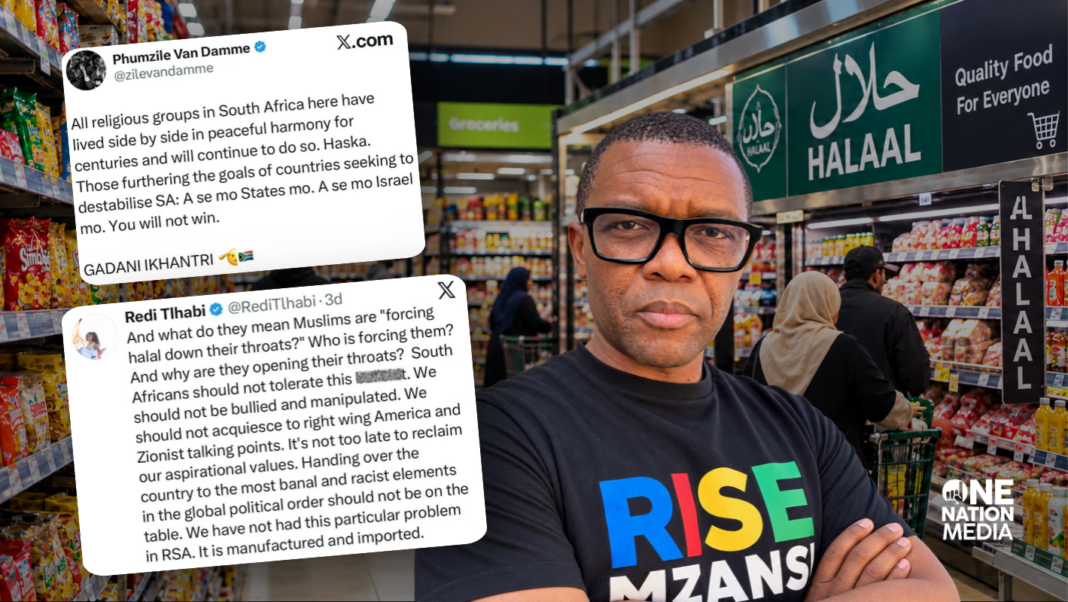

Should South Africa’s Muslim minority have to change its religious practices to accommodate the Christian majority? Or does freedom of religion mean equal respect for all, regardless of numbers?
That question has sparked heated debate online following a viral video by social media personality Sokhana Saliwa, who questioned halaal food certification and whether South Africa should accommodate Muslim religious practices at all.
However, RISE Mzansi leader Songezo Zibi says the controversy is not simply about food — it reflects the growing influence of Christian nationalism.
“We don’t have that history”
Speaking to One Nation Media, Zibi said the rhetoric being used against Muslims increasingly resembles that of the Christian nationalist movement in the United States.
“They’re saying South Africa is a Christian country. We don’t have a history of that at all in South Africa,” Zibi said.
Christian nationalism is the belief that national identity should be tied to Christianity, giving Christian values primacy over other faiths. In the US, it has become closely associated with white Christian nationalism. Zibi warns that some voices in South Africa are attempting to establish a local version.
“The whole thing is based on a massive lie and a distortion of history to create a new reality where people can victimize people who are either black or brown or who are not Christian,” he said.
Does being a minority mean fewer rights?
At the heart of Saliwa’s video is a question: Why should a Christian-majority country accommodate Muslim dietary requirements?
For Muslims, halaal is not merely a preference but a religious obligation. Halaal certification allows them to identify food prepared in accordance with Islamic requirements.
It does not restrict anyone else. Major brands such as Tiger Brands and Bokomo have carried halaal certification for years, with the same bread and cereal products purchased and consumed by Christian, Muslim and non-religious households alike.
Crucially, businesses are generally not required to obtain halaal certification. It is a voluntary commercial decision that allows them to serve a wider customer base, including nearly one million Muslim South Africans.
Zibi questioned why the availability of halaal food should be perceived as a threat when it does not prevent anyone else from purchasing or consuming those products.
An attack, not a debate
For Zibi, the controversy goes far beyond an online dispute over food.
“This is not a debate. This is an attack. It’s organized,” he said.
He argues that certain online influencers are borrowing talking points from white supremacist and Christian nationalist movements in Europe and North America, which portray Muslims, immigrants and religious minorities as threats to national identity.
He also pointed to South Africa’s history, highlighting the roles Muslim and Jewish South Africans played in the struggle against apartheid.
Religious minorities are not outsiders seeking special treatment. They have long been part of South African society and its history.
The controversy ultimately raises a fundamental question: Should the religious beliefs of a majority determine how minorities are permitted to practise their faith, or should religious freedom apply equally to everyone?
A further question arises: While South Africa’s Constitution provides grounds to defend Muslim religious practices in this instance, does it offer a reliable guarantee of the freedom to practise Islam?
The same constitutional framework that recognises religious freedom also permits limitations on that freedom. The state and its courts ultimately determine which restrictions are legally acceptable, even where Muslims regard the practices concerned as religious obligations.
Constitutional safeguards provide avenues to challenge restrictions, but religious practice remains subject to the state’s interpretation of the law and its priorities.
In November 2023, India’s Uttar Pradesh government banned the production, storage, distribution and sale of halaal-certified food products, with an exemption for exports. India’s democratic framework did not prevent the authorities from imposing restrictions on religious certification.
European restrictions on kosher and halaal slaughter without stunning illustrate similar concerns.
In December 2020, the Court of Justice of the European Union ruled that member states could require reversible stunning during religious slaughter to promote animal welfare. Animal welfare thus provided a legal justification for restricting certain forms of religious practice despite guarantees of religious freedom.
Minorities within a secular democracy
Commenting on the controversy, Moulana Uwais Dockrat, director of The Guardian Dawa Project, argued:
“This controversy exposes one of the fundamental problems with democracy, a problem its enthusiastic defenders conveniently overlook.
“Democracy places enormous political power in the hands of numerical majorities, leaving minorities constantly struggling to preserve their identities, beliefs and practices against the preferences of the majority. Today the controversy concerns halaal food. Tomorrow it could concern Islamic education, Muslim dress, the adhān or any other aspect of religious life that the majority decides it does not wish to accommodate,” Dockrat said.
“This is the ugly reality behind the romanticised language of democracy. We are repeatedly told that democracy represents freedom, equality and the will of the people. But whose will? Whose freedom? What happens when the majority wishes to impose its preferences upon everyone else?
“Are minorities expected to surrender their convictions simply because they cannot win a popularity contest? The tyranny of the majority does not become justice merely because it is exercised through democratic processes. A million votes cannot transform oppression into justice, nor can numerical superiority establish moral truth.
“In fact, the very necessity of constitutional protections against majoritarian excesses demonstrates the inherent danger of unrestricted majority rule,” he said.
Dockrat added that constitutional protections ultimately depend on institutions being willing to uphold them.
“Muslims must recognise that their religious obligations are not negotiable concessions granted by the majority, nor should their ability to practise Islam depend upon demographic calculations.”
He concluded by questioning the moral authority often attributed to democratic systems.
“This controversy should force us to question the almost sacred status democracy has acquired in contemporary political discourse. The fundamental question is simple: since when did having more people on your side make you morally right?” he said.


