
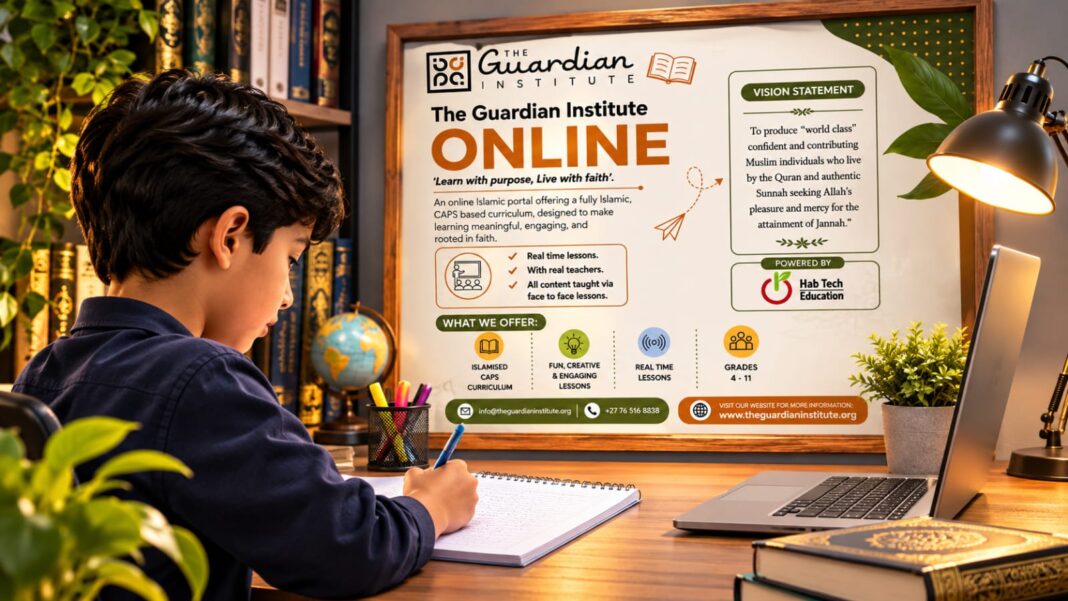

For a growing number of South African Muslim parents, the traditional classroom is no longer simply a place of learning, but a source of concern over bullying, safety and the erosion of religious values. As the 2027 academic year approaches, some families are turning to online homeschooling in search of an education that does more than deliver good marks — one that protects their children’s dignity, nurtures their imaan and allows them to practise Islam without compromise.
For many Muslim families, it’s not just about marks. It’s about safety, salaah, the right to wear hijaab and raising children without having to apologise for who they are.
These are some of the hurdles traditional schooling presents. But homeschooling and online education are becoming alternatives for families who want more say in how — and where — their children learn.
For some parents, the decision is driven by concerns about bullying, school violence, substance use and children’s safety. Others are looking for more individual attention, flexibility and greater control over their children’s education.
For Muslim families, there is another layer: faith.
Safety, bullying and big classes
Waseelah Ranjumia, an operations manager at the Global Muslim Treasury, told One Nation Media (ONM) that the reasons are both practical and deeply personal.
“Many parents are worried about safety, bullying and big classes where their child doesn’t get enough attention,” she said.
“Others want more flexibility, or simply want more say in their child’s values. For Muslim families, faith is a big reason,” Ranjumia added.
Saaima Moola, a director at Habtech Education SA, identified safety, flexibility and quality of education as three of the main reasons parents are considering alternative schooling.
“Families want safer learning environments, opportunities for children to learn at their own pace and more individual attention,” she said.
Sumaya Khan, a parent interviewed by ONM, said recommendations from other parents influenced her decision to take on homeschooling.
“I’ve heard of homeschooling & had second thoughts, but after seeing a few kids that I know personally manage it so well, I took it on.
“Both my kids have actually exceeded my expectations of online schooling. Their results have made me so proud and increased my trust in online schooling.”
Nadia Tariq, another parent, told ONM that bullying by teachers and students towards her children influenced her decision.
“We decided to remove our kids from the homeschool center and just continue with Habtec online at home mainly because my youngest was being bullied by a teacher and my eldest was being bullied by peers. The whole year, we addressed this issue, and my youngest started showing alarming signs of anxiety.”
In Islam, the protection of a child — their body, their mind, their imaan — is an amanah, a trust. For parents like Nadia, leaving was not about running away from school. It was about protecting that trust.
Where salaah and modesty are part of the day, not an exception
The directors of the Institute for Alternate Development (IAD) told ONM that parents also want their children to learn in environments that accommodate their Islamic identity.
“Parents want their children to learn in a setting that protects their Islamic identity, where salaah, modesty and good character are part of the day and not something to fit around it,” the directors said.
They added: “Families are also looking to combine academic education with madrasah learning, while considering practical concerns such as safety, school fees and flexibility for children doing hifz or an Alim course.”
For Muslim families, the appeal can therefore extend beyond the classroom. The Guardian Institute, for example, offers a Shariah-based online schooling programme that allows learners to follow the CAPS curriculum while supporting their Islamic identity.
“At The Guardian Institute, families can choose what suits their budget: books only, registration with their own tutor or madrasah, or TGI Online classes for Grades 4 to 11,” Ranjumia said.
It is the idea of tarbiyah — not just education, but upbringing — that draws many parents. In a mainstream school, Islam is often something a child has to squeeze in between break time, sport and homework. At home, it can be the centre.
What learners themselves say
The difference is also felt by learners themselves.
Aleena Tariq, a learner currently being homeschooled, told ONM that comfort and flexibility had been among the biggest advantages.
“I love learning from home. I feel more comfortable and less like I don’t fit in. Everyone is so sweet and kind, and my teachers are doing a great job at teaching me.”
Another learner, Luqman Griffin, said online homeschooling had given him more confidence to participate.
“The best part of doing online homeschooling is having more opportunities to be myself and more open to answering because I’m not judged or told I’m wrong about it,” he said.
Rayhaan Macsteel said she enjoys working at her own pace and has more freedom to study.
“My experience has been good at home because I can work at my own place and I have more freedom and also I can study in a comfortable environment and I have more time for learning and I do get a lot of perks because I’m doing online schooling.”
“In normal school, I was shy to ask questions. Now in online class, I feel more comfortable to ask,” Amina said, adding that she enjoyed learning in a quiet environment and at her own pace.
But can everyone afford it?
However, affordability remains a concern, particularly for lower-income households.
The IAD directors said online schooling can cost less than private Islamic schools because families do not have to pay for buildings, transport or uniforms.
“At IAD, fees for 2027 start from R1,590 a month, and we offer a lower-cost self-driven option where learners work from recorded lessons,” they said.
Moola said families now have different options, ranging from full live classes to self-paced programmes aligned with the Curriculum and Assessment Policy Statement (CAPS). However, access to devices and data remains a challenge for lower-income households. Some schools offer payment plans to make education more affordable.
Ranjumia similarly acknowledged that online schooling is not always accessible to everyone.
“Online school can cost less than private school, but families also need a device, data and someone at home. That’s hard for many low-income households,” she said.
The parents interviewed by ONM also described the financial adjustment as a sacrifice.
“Data, a device, and school fees add up. And balancing work, home, and school is not easy. Some days are hard,” they said.
The challenges: motivation, friends and load-shedding
Despite the advantages, alternative schooling comes with challenges, particularly around social interaction and maintaining motivation.
Ranjumia said: “Children could miss out on experiences such as school outings and spending time with classmates.”
The IAD directors also acknowledged that self-discipline at home, load-shedding and unstable internet connections can interrupt learning.
Moola said: “Schools address these challenges through structured timetables, teacher check-ins, group projects and extracurricular activities. Recorded lessons and offline work also allow learners to catch up when connectivity becomes a problem.”
Rayhaan pointed out that it is not always easy to stay focused and connect with teachers.
“I would say sometimes it’s hard to always be motivated because there are many distractions in a home and it’s hard to communicate with teachers if you don’t understand something because they don’t have time to only teach you and I don’t get to socialise with learners as I would in a normal school.”
Griffin added that staying motivated could also be difficult.
“I struggle with being motivated because I don’t have as many friends as I used to in normal school,” he said.
Do parents have to become teachers?
Another concern for parents is whether they must take responsibility for teaching their children themselves.
Ranjumia said: “Parents do not necessarily have to become teachers, as tutors and online classes can provide additional support.”
The IAD directors explained that their teachers handle lessons, assessments and progress reports, while parents ensure learners follow a routine and attend classes. Moola similarly emphasised that parents do not need an educational background. Teachers take responsibility for teaching and marking, while parents receive timetables, progress updates and access to support when needed.
Quality and academic progress are also important considerations for parents concerned about examination readiness.
Moola said schools use CAPS-aligned curricula, regular assessments and progress reports to monitor learners’ development. Qualified teachers provide feedback, while revision sessions, past examination papers and mock examinations help prepare learners for assessments.
The parents interviewed by ONM said the transition had resulted in significant academic improvement for their children.
More than a classroom
While traditional schooling remains the choice for most South African families, the experiences of parents and learners choosing non-traditional education show that education should offer more than the classroom.
Safety. Individual attention. Academic development. And for some families, the freedom to nurture their children’s religious values.
In the Qur’an, parents are reminded that children are a trust. For a growing number of South African Muslim parents, homeschooling is not a rejection of school — it is an attempt to honour that trust more fully: a place where a child can learn maths and make salaah on time, where modesty is normal, where asking a question is not embarrassing, and where deen is not something to fit around the day, but something the day is built around.


