
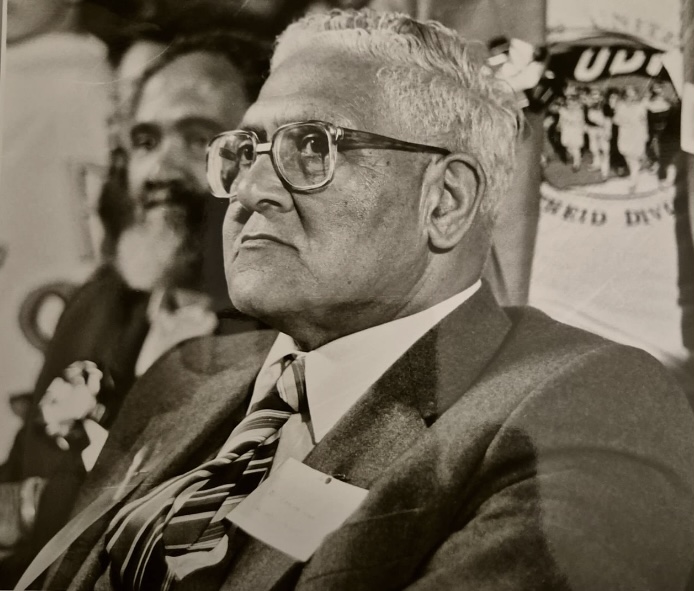

During the height of apartheid, for many white sport officials, players and fans Hassan Howa was the reason South Africa was blocked from playing international sport. But for me, he was much more that, writes Dougie Oakes who shared personal experiences of a softer side of the hard-line administrator
When I described the biography I wrote about Hassan Howa as a ‘labour of Love’, I knew from the start that this was more than a throwaway line. It was part of a story packed with valuable lessons, for me and, hopefully, for others who read the book.
For some white South Africans, Hassan Howa was a person they loved to hate. He was the face of opposition. He was the man who would not bend, who would not compromise and who would not accept the apartheid government’s insistence that sport should be played according to the colour of a person’s skin.
This made him a problem.
And yet, there was another Howa.
He was also the man who ensured that a young cricketer had the right trousers to play the game at representative level. I know this because I was that cricketer.
I was 15 when my cricket kit was wonderfully basic – a white sweater, shorts, socks and sandshoes. Even my parents could manage that. But then, when Mr Howa decided I should play for the Wynberg Under-21 board side, he created a problem.
Under-21 cricket required long trousers, a cricket shirt, proper boots and a jersey, which I could not afford. He looked at me and said, ‘Don’t worry. Only the trousers are important.’
That, in a nutshell, was Howa.
While some white officials and spectators saw him as the great scourge of apartheid sport, I saw him as a man walking around the different fields at William Herbert on a Saturday morning, quietly asking better-off cricketers if they might lend their long trousers to a fellow player they probably didn’t even know.
I did not understand the significance of it at the time. But I do now.
Perhaps that is why I’m so pleased that the pic of Howa on the cover of my biography, Hassan Howa: No Normal Sport, is one of him smiling. He smiled a lot, unlike the image of the man supporters of apartheid liked to portray.
His sisters and his wife, Sybil, remembered a man who enjoyed life and took particular delight in sharing it with those around him.
Once a month, they went to Rondebosch Town Hall. Being Howa, he soon got to know the musicians and sometimes became the master of ceremonies.
This is the man we sometimes lose when we talk about him because the public man was so formidable. Yet, the private man was warm, funny and deeply involved in the lives of the people around him, from helping an opera singer, Leona Gordon, raise cash to follow her dream of singing in England, to helping wherever he could.
And that warmth stretched far.
Ganie Allie, a family member, discovered this warmth in the worst possible circumstances. In August 1976, during the countrywide rebellion, Allie and his brother Abduraghmaan were standing behind the gate of their home in Tiervlei when police opened fire on them.
Abduraghmaan died.
The police then arrested Ganie and accused him of incitement and public violence, despite his having just returned from teaching at Alexander Sinton High School. The charges were eventually thrown out.
But the damage was done.
Fifty years later, Allie still struggled to speak about the killing without tears. Through it all, stood Howa.
‘He was a pillar of support to our family,’ said Allie.
He helped raise money for a lawyer. He stood with the family when they challenged another apartheid indignity, an attempt to classify members of the family as Indian rather than ‘Malay’, a decision that could have forced them out of Ravensmead, where they lived and ran their business.
Perhaps this is the lesson in writing of a life rather than simply recording a career. People are rarely only what history remembers them for.
Howa fought apartheid, certainly. But he also played the piano. And loved musicals. And danced. And smiled – a lot.
And, now and then, he made sure a 15-year-old boy had a pair of long trousers so he could walk onto a cricket field and believe he belonged there.