
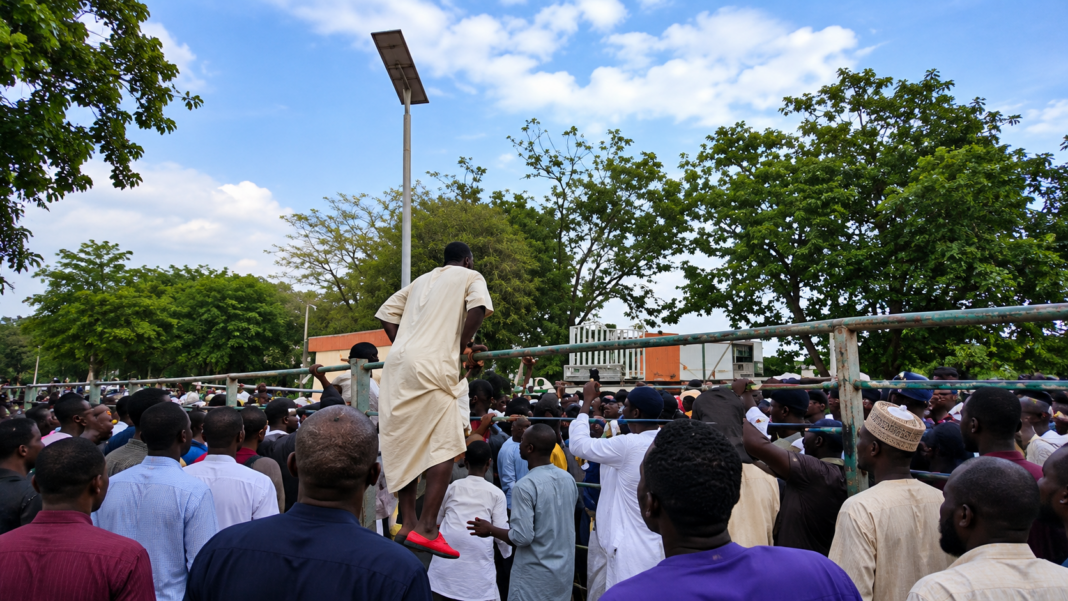

For a generation that did everything right — degree, hustle, prayer — and still cannot afford to live, a shout outside a mosque in Abuja was about more than one president.
For many young Nigerians, the struggle to make ends meet has become a daily reality. A university degree does not guarantee a job, a regular salary is often insufficient to cover basic needs, and starting a small business can mean battling rising costs and unreliable electricity.
Against this backdrop, the public booing of President Bola Ahmed Tinubu in Abuja has brought renewed attention to the frustrations building across the country.
What happened in Abuja?
The incident occurred on 13 November, when Tinubu visited the Shehu Shagari Central Mosque in Abuja for Friday prayers. As his convoy departed, some people reportedly shouted “Ba ma so” and “Ba ma yi” — Hausa expressions meaning “We do not want you”. Videos of the confrontation circulated widely on social media, attracting reactions from Nigerians at home and abroad.
However, the circumstances surrounding the incident were more complicated than a straightforward political protest.
Some worshippers reportedly became angry because security restrictions prevented them from entering the mosque after the president arrived, while others complained that they could not leave until his convoy departed. The confrontation therefore reflected both immediate frustration with security arrangements and broader dissatisfaction with the administration.
The Abuja episode comes amid demonstrations and public complaints in cities including Lagos and other parts of the country over economic hardship, unemployment and insecurity. Although these expressions of anger do not represent every Nigerian’s position, they reveal growing impatience among citizens struggling to cope with everyday pressures.
The burden of economic hardship
For ordinary households, the rising cost of living remains one of the most painful consequences of Nigeria’s economic difficulties.
Since Tinubu removed the petrol subsidy in May 2023 and introduced foreign-exchange reforms, transport fares, food prices and other household expenses have placed enormous pressure on families. The government has defended the measures as necessary to address longstanding economic weaknesses, improve public finances and attract investment.
While the reforms have contributed to improvements in some economic indicators, many Nigerians are still waiting to feel the benefits in their pockets.
Young people are particularly exposed. Graduates spend months or years searching for employment, while those fortunate enough to find work often struggle with salaries that cannot comfortably cover rent, transport and food. For aspiring entrepreneurs, expensive electricity, limited access to affordable credit and unpredictable business costs make survival difficult.
Afrobarometer’s 2025 report on Nigerians aged 18 to 35 found that 23 per cent were unemployed and looking for work. Sixty per cent had considered emigrating, while the high cost of living and unemployment emerged as major concerns.
These figures tell a story beyond statistics: a generation increasingly uncertain about its ability to build a stable future in its own country.
In Islamic terms, this is not just an economic problem. It is a question of rizq — provision — and dignity. When a young man cannot provide for his family, or a young woman with a degree cannot find work to support her parents, the frustration is not abstract. It is personal. It is spiritual.
Insecurity and fading opportunities
Economic hardship is not the only concern. Insecurity has also disrupted the lives of young Nigerians, particularly in communities affected by banditry, kidnapping, insurgency and communal violence.
In parts of the North-West and North-East, attacks have forced families from their homes, disrupted farming and trading activities, and interrupted children’s education. For young people, the consequences extend beyond immediate danger. They include lost educational opportunities, unemployment and the fear of an uncertain future.
The World Bank has repeatedly identified insecurity, weak job creation and limited opportunities for businesses as significant obstacles to Nigeria’s development.
For some young Nigerians, migration has consequently become an attractive alternative. Afrobarometer’s finding that 60 per cent had considered leaving the country reflects the depth of concern about employment prospects, economic conditions and personal opportunities.
They call it japa — to run, to escape. But for many, it is not excitement about leaving. It is grief about feeling forced to leave.
Beyond the booing
Tinubu’s administration can point to economic reforms, increased government revenues and improving growth as evidence that difficult decisions are beginning to produce results. Supporters argue that reversing longstanding economic weaknesses requires patience.
But for young Nigerians struggling to afford food, secure employment or establish businesses, long-term economic projections offer little immediate comfort.
The booing in Abuja should not automatically be interpreted as a nationwide rejection of the president. Nor should the grievances of young people be reduced to partisan politics. Their concerns cut across political, religious and regional boundaries.
A Muslim youth locked outside a mosque because of a presidential visit, a Christian graduate in Lagos sending out 200 CVs with no reply, a trader in Kano watching transport costs eat into his profit — they may vote differently, pray differently and speak different languages. But they are asking the same question: When will it get better for us?
As Nigeria approaches the 2027 general election, the administration faces an important challenge: translating economic recovery into improvements that ordinary citizens can actually experience.
For a generation asking difficult questions about its future, the demands are straightforward: decent jobs, affordable living, quality education, reliable electricity and safer communities.
Ultimately, young Nigerians want more than promises of a better tomorrow. They want to see a future they can begin building today.


