
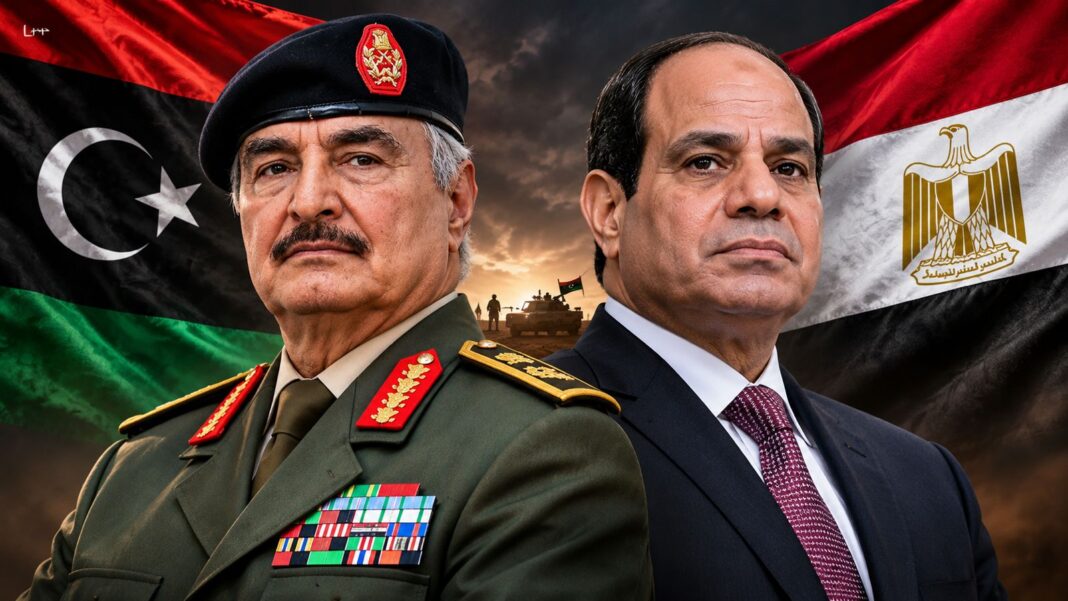

Closer ties between Benghazi, Ankara and Abu Dhabi, combined with security disagreements over Sudan and competing energy interests in the Mediterranean, appear to be undermining the historic partnership between Cairo and Khalifa Haftar. By expanding its diplomatic engagement with Tripoli, Egypt is now seeking to safeguard its interests without relying exclusively on its former ally in eastern Libya.
Reports of the withdrawal of Egyptian military advisers attached to Khalifa Haftar’s forces in eastern Libya come amid a broader reshaping of regional power dynamics. Although the reported withdrawal has not been officially confirmed, recent diplomatic and military developments point to an evolving relationship between Cairo and the Haftar camp. Long regarded as one of the field marshal’s key political and security backers, Egypt now appears to be facing a growing diversification of its historic ally’s external partnerships, particularly with Turkey and the United Arab Emirates (UAE).
At the heart of these tensions is the 2019 maritime agreement signed between Ankara and the Tripoli-based Libyan government. On 20 October 2026, the eastern Libyan parliament approved the memorandum, bringing to an end years of opposition to the deal. The decision marks a turning point in relations between Benghazi and Ankara, which were once on opposing sides of the conflict during Haftar’s 2019–2020 offensive to capture Tripoli. It is also a source of concern for Cairo, which believes the agreement’s provisions undermine its maritime and energy interests in the eastern Mediterranean.
For Egypt, the stakes go beyond the mere delimitation of maritime zones. A rapprochement between Turkey and Libya could strengthen Ankara’s economic, diplomatic and military presence in an area Cairo considers strategically important to its national security. It also comes at a time when Egypt maintains energy partnerships with Greece and Cyprus, two countries that likewise oppose the memorandum.
Reda Shaaban, a Libya specialist, argues that Cairo opposes any initiative by eastern Libya that could alter regional balances without prior consultation with neighbouring countries. According to him, the implications of the maritime agreement extend beyond economic considerations. They also involve military cooperation, the training of local forces and an expanded Turkish security presence in Libya. Over time, this development could affect Egypt’s strategic depth.
Beyond the Mediterranean, disagreements between Cairo and the Haftar camp also extend to the war in Sudan. Egypt supports the Sudanese Armed Forces (SAF), led by General Abdel Fattah al-Burhan, while reports cited by several sources point to ongoing UAE efforts to facilitate the movement of fighters, weapons and military equipment from Libyan territory into Sudan in support of factions linked to the Rapid Support Forces (RSF).
For Cairo, whose southern border is directly exposed to the consequences of the Sudanese conflict, instability in Sudan risks fuelling population displacement, cross-border trafficking and security threats across vast desert areas. This divergence therefore represents another factor that could undermine trust between the two partners.
The growing influence of Saddam Haftar, the field marshal’s son and currently second-in-command of the eastern military leadership, adds another dimension to this evolving situation. His diplomatic trips and contacts with Ankara and Doha illustrate the Haftar camp’s determination to diversify its foreign relations. For this emerging generation of leaders, cooperation with former adversaries could provide a means of strengthening political legitimacy while reducing dependence on a single partner.
However, this strategy carries risks for Cairo, which has long regarded Haftar’s forces as an essential component of securing its western border. Benghazi’s diversification of external partnerships could weaken Egypt’s ability to influence the military and political decisions of its neighbour.
The United Arab Emirates, for its part, has significant economic and financial leverage in eastern Libya. Its relationship with the Haftar family could enable Abu Dhabi to expand its influence over Saddam Haftar, particularly in reconstruction, infrastructure and security cooperation. Nevertheless, differences between Abu Dhabi and Cairo over Sudan further complicate the prospect of a lasting alignment of their interests.
It is against this backdrop that the reopening of Egypt’s historic embassy in Tripoli on 7 November 2026, after twelve years of closure, should be understood. Beyond its symbolic significance, Cairo is seeking to send a strong message to the Haftar camp while directly defending its maritime interests in its dealings with the government of Abdelhamid Dbeibah, particularly in relation to Turkey.
For Badr Hassan al-Shafei, a professor of African Studies and Conflict Resolution at Cairo University, Egypt has realised that relying exclusively on the Haftar camp no longer necessarily serves its strategic interests. According to him, this diplomatic opening towards Tripoli is intended to establish a balance between Libya’s competing factions while also sending a message to Haftar that his decisions should be more closely coordinated with Cairo.
The 13 November meeting between Saddam Haftar and Hassan Rashad, head of Egypt’s General Intelligence Service, also illustrates the determination to maintain a security channel with the eastern Libyan command. According to reports, the meeting alone does not provide sufficient grounds to conclude that it was a summons intended to bring Haftar into line or a negotiation aimed at resolving existing disagreements. It nevertheless demonstrates that contacts between the two sides are continuing despite tensions.
In light of these developments, the prospect of a lasting restructuring of the Egyptian-Libyan partnership appears more plausible than that of an immediate break. Cairo is seeking to protect its border security, energy interests and regional influence while broadening its engagement beyond Benghazi. However, its geographical and security dependence on eastern Libya makes a complete break with Haftar difficult.
The key question, therefore, is not simply whether Egypt is turning away from its former ally, but how it intends to retain its influence in a Libya where alliances are becoming increasingly flexible and where the interests of its partners no longer necessarily coincide with its own.


