
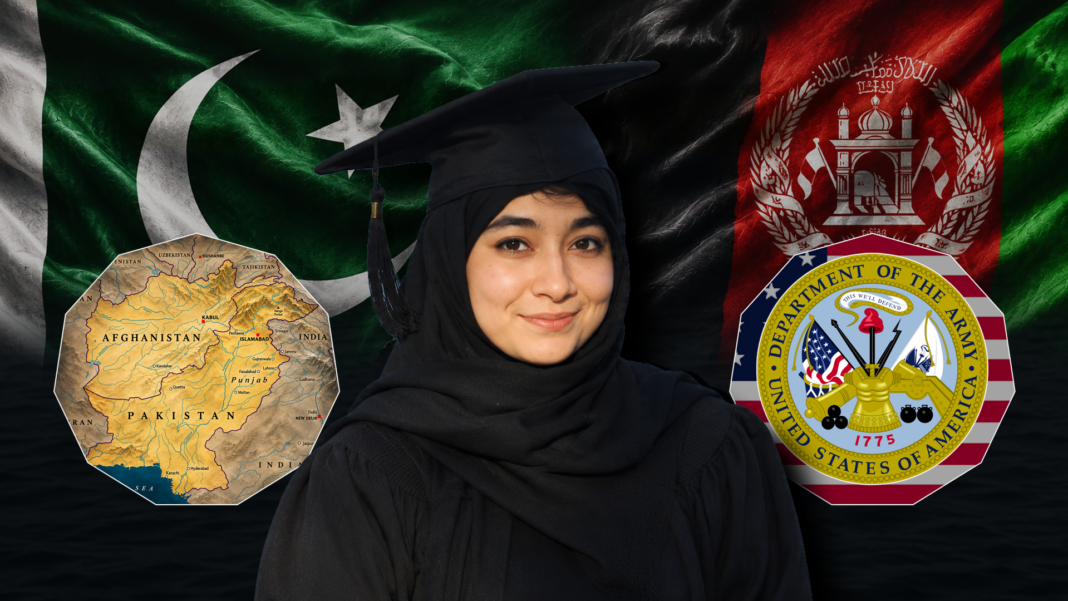

In the early autumn of 1990, an exceptionally bright, softly spoken 18-year-old girl from Karachi, Pakistan, arrived in the United States on a student visa. She carried with her the immense expectations of a highly educated, middle-class family and an intellect that would soon flourish at some of America’s most elite academic institutions. Her name was Dr. Aafia Siddiqui.
To those who shared university lecture halls and mosque basements with her throughout the 1990s, she was an inspiring example of a modern, deeply devout Muslim woman: an MIT graduate, a Brandeis PhD, a passionate advocate for early childhood education and a tireless charity worker. Yet, to international intelligence agencies operating in the aftermath of September 11, this same woman was viewed through an entirely different lens. She became the subject of allegations that she was a valuable asset to al-Qaeda, eventually dubbed the “Lady al-Qaeda” by sections of the sensationalist Islamophobic media.
To truly understand the geopolitical firestorm surrounding her name today, one must first look beyond the prison uniform at FMC Carswell and examine the life of Dr Aafia Siddiqui before her fateful disappearance in 2003.
The scholar of the elite
Aafia Siddiqui’s American journey began at the Houston, Texas, home of her brother, an architect, before she transferred to the prestigious Massachusetts Institute of Technology (MIT).
At MIT, Siddiqui did not merely blend into the background. She excelled, earning her undergraduate degree in biology in 1995. Her academic promise was such that she received the competitive Carroll L. Wilson Award to support a research proposal examining Islamisation policies in Pakistan and their impact on women.
Her academic trajectory only accelerated from there. She moved to Brandeis University, where she immersed herself in the cutting-edge field of cognitive neuroscience. In 2001, she successfully defended her doctoral dissertation, which examined how humans learn through imitation — a complex study of cognitive development.
According to investigative reports, including a profile published by The Guardian, her academic peers remembered her as a fiercely focused, highly capable student who balanced rigorous laboratory work with the demands of an expanding family, having married anaesthesiologist Dr Amjad Khan in 1995 and given birth to her first two children during her gruelling studies.
The pillar of the community
Alongside her demanding laboratory work, Siddiqui established herself as a prominent figure in local Muslim community life in New England. She became an active member of the Muslim Students Association (MSA) during her university years.
Her activism was defined by an energetic commitment to da’wah (Islamic outreach) and humanitarian relief. During the Bosnian war of the mid-1990s, when systematic violence against Bosniak Muslims dominated international headlines, Siddiqui organised donation drives, clothing collections and slideshow presentations to raise awareness and funds for refugees.
She was also deeply invested in practical educational reform. She regularly proposed ideas for early childhood educational software and actively distributed copies of the Quran to local libraries, prisons and community centres.
To the families she interacted with, she was a gentle, maternal figure dedicated to uplifting her community through faith and formal education.
This visible, public life is documented by her family and advocacy networks, including the Aafia Foundation’s official website, which emphasises her formative years as a period defined by humanitarianism and academic excellence.
The shift into the counter-terrorism crosshairs
The trajectory of Siddiqui’s life altered irreversibly on September 11, 2001.
In the seismic shift that followed the attacks, the very traits that had made her an outstanding community figure — her international ties, fierce religious devotion, leadership roles in Islamic student groups and advanced scientific knowledge — came under scrutiny as global security agencies intensified their investigations.
The scrutiny intensified significantly following the March 2003 arrest of Khalid Sheikh Mohammed, identified by US authorities as the mastermind of the September 11 attacks.
During interrogations associated with the CIA’s secret detention programme, al-Qaeda operatives reportedly named Siddiqui as a high-level courier and financial facilitator who had been tasked with using her American connections and scientific background to assist the network.
These allegations remain contested, particularly given serious concerns about the coercive interrogation methods and torture employed by the CIA, FBI and US military police during the War on Terror.
The vanishing point
By early 2003, Siddiqui had returned to Pakistan with her three young children, amid growing concerns about FBI scrutiny in the US.
In March 2003, the FBI reportedly sought information about her whereabouts for questioning, a development subsequently highlighted in human rights reporting, including material from Amnesty International.
Around this period, according to her family’s account, Aafia Siddiqui packed her bags, placed her three young children in a taxi in Karachi and headed towards the airport for a short domestic trip to Islamabad.
She vanished without a trace. For five agonising years, her name existed largely as a ghost in the annals of global intelligence.
To US authorities, she was a suspected terror operative whose whereabouts remained unknown. To her family and human rights advocates, she was the victim of an enforced disappearance, allegedly abducted by Pakistani intelligence and secretly transferred into brutal US military custody at Bagram Air Base in Afghanistan.
American authorities have denied holding Siddiqui during those missing years, and the allegations surrounding her disappearance and alleged detention have never been conclusively established.
The brilliant neuroscientist who had once walked the pristine corridors of MIT had been swallowed by the global War on Terror.
When she finally re-emerged in 2008 in the dirt-strewn streets of Ghazni, Afghanistan, the woman who had once been celebrated as a gifted academic and community activist appeared radically changed — at the centre of a deeply controversial case that would soon culminate in a high-profile American criminal trial.


