
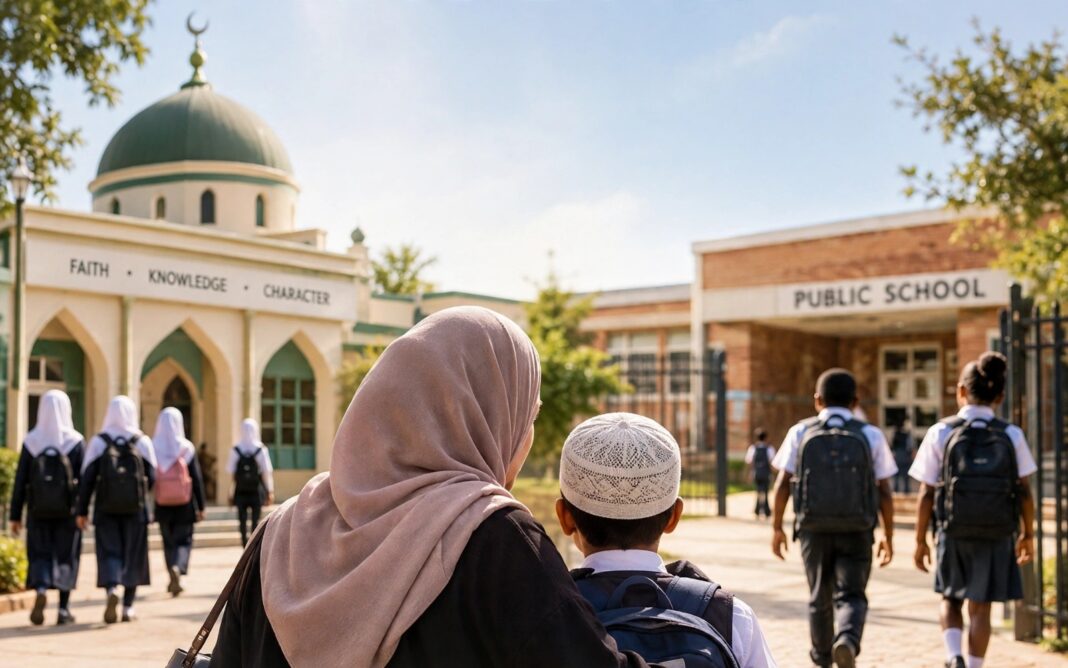

Should Islamic education be a privilege of the wealthy? As rising school fees place faith-based education beyond the reach of many working-class Muslim families in South Africa, Shonie Lesago examines whether financial barriers are threatening parents’ efforts to preserve their children’s Islamic identity.
“One of the main reasons parents choose Muslim schools is the desire to raise children in an environment that reinforces Islamic principles,” Aaliyah Bham of The Guardian Institute told One Nation Media (ONM).
For many families, that environment extends beyond the classroom, making Islamic practices an integral part of everyday school life rather than an exception.
“Islamic schools make it easier for learners to observe daily prayers. We have a mosque facility at our school. We also encourage following the other pillars of Islam such as fasting during Ramadan, wearing religious clothing such as the hijab, and celebrating the Eid festivals. This allows children to practise their religion without feeling that their beliefs are unusual,” said Shamsaad Mia, Head of Department for Further Education and Training at Nizamiye School Mayfair.
For Bham, however, the purpose of Islamic education goes beyond religious rituals.
“Islamic education extends beyond teaching learners to perform Salaah or recite the Quran. It also involves developing their character, strengthening their Islamic identity and encouraging them to consider their faith when making decisions.”
She added: “The reminders of what pleases Allah and what displeases Him can help shape children’s understanding of right and wrong, although parents cannot completely shield them from wider societal influences.”
For Muslim parents, the decision is therefore as much about upbringing, morality and identity as it is about academic achievement.
Concerns about the social environment in mainstream schools also influence their choices.
“Some parents worry about bullying, discrimination, inappropriate language, substance abuse. They may choose an Islamic school because they believe it will provide a more supportive environment,” Mia explained.
The cost of Islamic education
However, providing children with an Islamic learning environment often comes at a considerable financial cost.
Both educators acknowledge that independent Muslim schools are generally more expensive than public schools because they offer the national curriculum alongside Islamic instruction.
While some working-class families can afford the fees, for others they represent a substantial financial burden.
South Africa’s education system comprises public and independent schools. Public schools operate within a state funding framework, with no-fee schools providing access to education for families unable to afford school fees.
Independent Muslim schools, meanwhile, must comply with registration and educational regulations while largely relying on their own funding. Government subsidies are available only to qualifying institutions.
For many Muslim households already struggling with the rising cost of living, the financial demands of private Islamic education can be prohibitive.
“Some parents genuinely want an Islamic environment for their children but cannot manage the financial commitment,” Bham said.
“It is saddening that the opportunity to provide one’s child with an Islamic education has, in many cases, become a luxury that not every family can afford.”
At Nizamiye School Mayfair, Mia said scholarships are offered to working-class families to help ease the financial burden.
Bham, however, believes a more sustainable, community-wide approach is needed.
She advocates greater financial support through community donations, bursaries and long-term funding initiatives that would allow Islamic schools to maintain educational standards without excluding lower-income families.
Such responsibility, she argues, should be shared by the wider Muslim community rather than falling solely on individual parents.
Beyond academic distinctions
While Islamic identity and religious development remain central considerations, academic performance continues to play an important role in parents’ decisions.
Bham said many Muslim schools achieve commendable academic results, demonstrating that Islamic and mainstream education can complement one another.
However, she cautioned against defining educational success purely through examination results and distinctions.
“Our responsibility extends beyond producing learners who achieve distinctions,” she said.
According to Bham, parents should evaluate schools not only on academic performance but also on their ability to nurture discipline, responsibility, respect and good character.
Facilities, resources and safety standards can vary considerably between schools, regardless of whether they are public or independent institutions.
For Muslim families, the challenge is finding an environment that develops academically capable students while instilling the Islamic principles that shape their conduct beyond the classroom.
Making Islam the foundation, not an add-on
Another important consideration is how Islamic schools integrate religious teachings with South Africa’s Curriculum and Assessment Policy Statement (CAPS).
Bham warned that treating Islamic Studies as a subject entirely separate from mainstream academic learning risks creating an artificial divide between religious knowledge and other disciplines.
“Islamic Studies is often taught separately from mainstream academic subjects, potentially leaving learners with the impression that religion and other areas of knowledge operate independently,” she explained.
At The Guardian Institute, educators have adopted an Islamised curriculum designed to incorporate Islamic perspectives into the teaching of nationally prescribed academic subjects.
Mathematics, for example, can encourage students to appreciate order and precision in Allah’s creation.
Science can inspire reflection on the signs of Allah, while Economic and Management Sciences can introduce Islamic principles such as honesty, fairness, ethical trade and the prohibition of riba (interest).
The objective is to ensure that students understand their education through an Islamic worldview rather than treating their faith as something separate from everyday knowledge.
“Our objective is for learners to understand that Islam is not separate from their education. Rather, Islam provides the foundation through which they understand knowledge, responsibility and their purpose in life,” Bham said.
“Religious and academic education should reinforce one another.”
Growing demand, unequal access
Bham believes awareness of the importance of Islamic education is growing among Muslim parents, particularly as families become increasingly concerned about the social, cultural and ideological influences their children encounter at school and online.
For many, Islamic schools represent an opportunity to preserve religious identity while equipping the next generation with the academic knowledge and practical skills needed to navigate the modern world.
Yet growing demand does not necessarily translate into greater accessibility.
With independent Islamic schools facing operational costs and working-class households struggling financially, the gap between parental aspirations and affordability remains a significant challenge.
The issue raises broader questions about the Muslim community’s collective responsibility to make Islamic education accessible beyond affluent households.
Community-funded bursaries, sustainable financial models and stronger institutional support could help bridge that divide, ensuring that academic excellence and Islamic development are not privileges determined by household income.
Ultimately, the challenge facing South Africa’s Muslim community is not simply how to establish and maintain successful Islamic schools, but how to ensure that children from all socioeconomic backgrounds can benefit from them.
For parents seeking to raise the next generation with a strong Islamic identity, access to faith-based education should not become a luxury determined by their ability to pay.


