
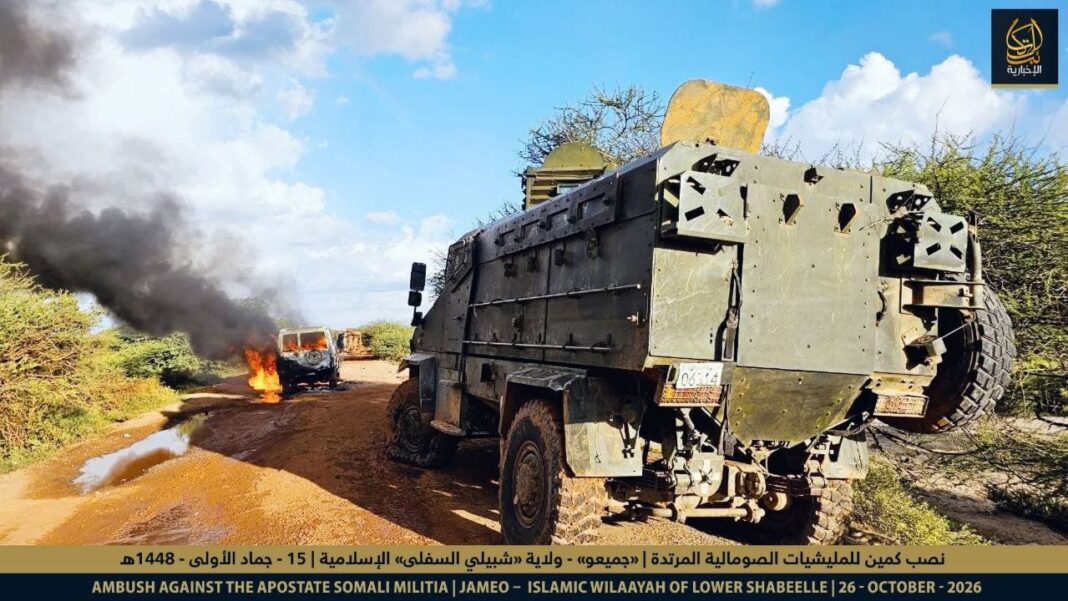

SOMALIA — A major Somali military offensive in the Lower Shabelle region reportedly ended in heavy losses after Al-Shabaab ambushed a large contingent of foreign-trained regime soldiers, claiming to have killed more than 413 troops during an initial battle and a subsequent 48-hour pursuit.
According to statements released by Al-Shabaab’s military command, the confrontation began on Monday afternoon, 26 October 2026, when approximately 2,000 Somali government soldiers advanced towards areas under the group’s control in Lower Shabelle.
The force consisted primarily of Somali special forces trained by Turkey and the United States, alongside other government units. These foreign-trained formations are regarded as among the best trained and equipped of the regimes security forces, having benefited from extensive foreign military assistance.
The troops were travelling in a convoy of more than 110 military vehicles, including armoured vehicles, armed pickup trucks, transport trucks and armoured personnel carriers.
Despite the convoy’s substantial military strength and reported Turkish air support, Al-Shabaab fighters launched an ambush near Jameeco, on the outskirts of Leego, close to the Baledogle airbase in southern Somalia.
The regime offensive was reportedly accompanied by Turkish F-16 fighter jets and unmanned aerial vehicles, which attempted to provide air support to the advancing forces during the engagement.
Heavy fighting continued for more than three hours, with Al-Shabaab initially claiming to have killed 321 government soldiers, wounded an even greater number and taken numerous others prisoner.
The group also reported capturing most of the convoy’s military vehicles, including Turkish-supplied armoured vehicles, armed pickup trucks and transport trucks carrying substantial quantities of supplies. Large quantities of weapons, ammunition and other military equipment were reportedly seized, while numerous vehicles were destroyed.
According to Al-Shabaab, surviving regime fighters subsequently abandoned the battlefield and retreated into the wooded terrain between Leego and Baledogle, where they were pursued by the group’s fighters.
The pursuit reportedly continued for 48 hours, after which Al-Shabaab’s military command announced the conclusion of its operation and revised the death toll to more than 413 government soldiers, with additional troops wounded, captured or dispersed.
Al-Shabaab’s wider campaign is aimed at overthrowing the regime and re-establishing Islamic rule across the country. The group controls significant areas, where it administers territory according to Islamic law (Shariah). Al-Shabaab operates an extensive parallel administrative structure, effectively functioning as a shadow government through its own judicial, taxation, security and governance systems.
Against this backdrop, the reported confrontation in Lower Shabelle illustrates the difficulties facing the Somali regime in its efforts to expand territorial control and dislodge Al-Shabaab from its established strongholds.
The outcome also raises serious questions about the effectiveness of the regime’s military strategy and its heavy reliance on foreign training, equipment and operational assistance.Despite these advantages, regime forces reportedly failed to advance into Al-Shabaab-controlled territory and instead suffered substantial casualties, lost military equipment and were forced into retreat.
The battle also demonstrates Al-Shabaab’s continuing military strength and its ability to defend territories under its control against large-scale offensives. The group’s capacity to confront a heavily equipped military formation, sustain an engagement lasting several hours and subsequently pursue retreating troops points to considerable organisational and operational capabilities. It also suggests that Al-Shabaab remains firmly entrenched in parts of Lower Shabelle, where the government continues to struggle to establish lasting territorial control.
The reported seizure of Turkish-supplied armoured vehicles, weapons, ammunition and other military supplies would further compound the regimes setbacks, potentially strengthening the very force its military operations were intended to weaken.