

MYTH ONE: “It is merely a political system”
As South Africa approaches the municipal elections of 4 November, the conversation is predictably full of personalities, promises and political arithmetic. Yet a far more important question rarely receives serious attention: what sort of system are we being asked to understand and operate within? Before discussing the people who occupy its offices, we ought to examine the worldview that gives those offices their authority. That worldview is often called secularism. It is frequently presented as a political arrangement with no philosophy attached. That is the first myth, writes Moulana Uwais Dockrat.
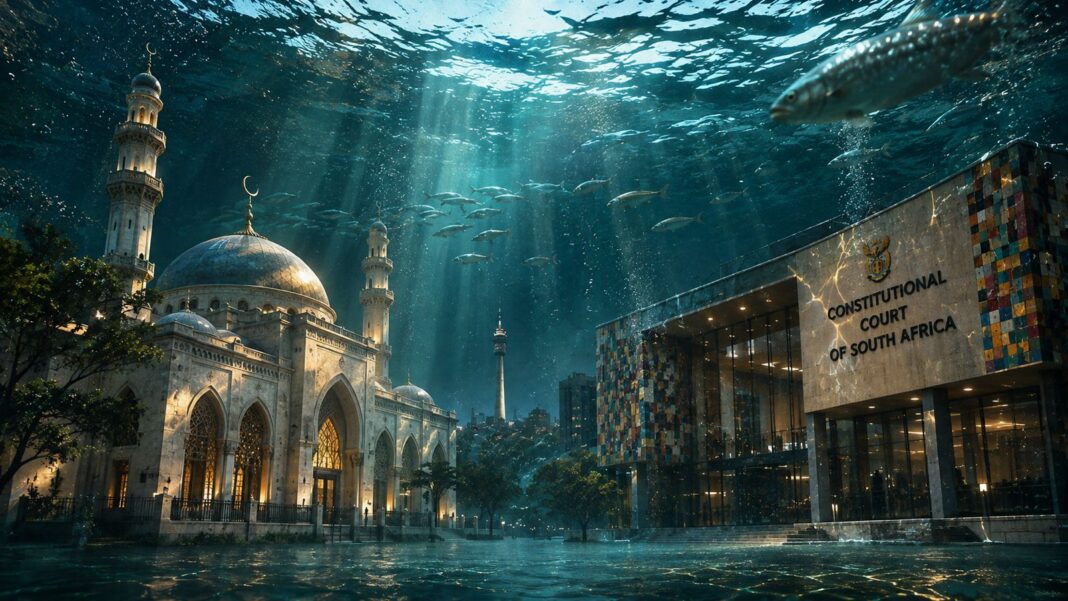
Imagine two fish swimming in a river. One asks the other how the water is today. The second looks puzzled: “What water?” The joke works because the thing surrounding us is often the thing we notice least. Secular assumptions have become so familiar that many people no longer recognise them as assumptions. They are simply labelled normal, modern, objective or sensible. A religious conviction, meanwhile, is expected to introduce itself, declare its interests and request permission to speak.
The first difficulty begins with the modern category of “religion”. We are accustomed to treating it as one compartment alongside politics, economics, law, education and culture. Religion, in this picture, is about personal belief, rituals and community identity. But Islam is not merely a collection of rituals awaiting a quiet corner of public life. Islam is dīn: a comprehensive claim about the Creator, the human being, knowledge, morality, authority and the purpose of existence. When public life is divided into religious and non-religious compartments, somebody has already decided that certain matters lie beyond the jurisdiction of revelation.
Every civilisation operates through a worldview. It answers questions of ontology: what is ultimately real? Epistemology: what counts as knowledge? Anthropology: what is a human being? Ethics: who determines right and wrong? Teleology: what are we here for? And politics: who has the authority to command? Islam answers these questions through revelation, sound reason and the recognition that human beings are servants of Allah. Secular political thought, in its different forms, ordinarily locates final public authority in human institutions and the constitutional order. That is not an absence of a worldview. It is a different allocation of authority.
None of this means that every secular person is an atheist, or that every secular arrangement denies religion a public presence. Secular traditions differ considerably. Some allow space for religious institutions, permit religious expression in public and reject the strict exclusion of faith. South Africa itself does not follow the most rigid model of subjugation. But a system can outwardly accommodate religion while still reserving the ultimate right to determine its legal boundaries. Hospitality is not the same as surrendering the title deed.
Consider how the argument is usually framed. Islamic principles on family, finance or public morality are described as “bringing religion into politics”. Yet the contrary position is treated as though it were philosophy-free. Human autonomy, popular sovereignty and constitutional supremacy become the default setting; revelation must justify its appearance. A set of philosophical commitments has been smuggled into the room wearing a badge marked “neutrality”. Rather convenient, is it not?
The central issue is therefore not whether Muslims can live, work or cooperate within existing institutions. Of course, we must navigate the realities around us. The issue is whether we understand the distinction between using a system and accepting its assumptions as our own. A Muslim may engage with the state without accepting that the state is the final moral authority. Practical engagement need not become intellectual surrender.
Before the election noise grows any louder, we need the courage to ask the question that comes before all the others: are we judging secularism by Islam, or quietly judging Islam by secularism? Until we recognise the water, we cannot seriously discuss the river.


