

MYTH TWO: “Secularism is the only path to world peace”
We are once again offered a familiar sermon from the pulpit of modern politics: religion causes war; secularism produces peace. Apparently, humanity spent centuries killing in God’s name until the secular state arrived to rescue us. But as Moulana Uwais Dockrat argues, the conclusion precedes the evidence. Question secularism, we are told, and you are questioning peace itself. What a campaign.
Let us stop repeating this fairy tale. Wars with religious dimensions were real. In one widely cited index of 1,763 recorded wars, only about 120 appear under “religious wars”; that index is not a definitive accounting of causes, but the caricature of religion as the principal engine of war is plainly unsustainable. Even the Thirty Years’ War, regularly advertised as the definitive “religious war”, involved dynastic rivalry, territory and political power. The neat story of a murderous religious past followed by a peaceful secular present is not serious history. It is a selective reading designed to make one system look innocent.
Consider the bloodshed of modernity. The First World War cost roughly twenty million lives. The Second killed tens of millions more, with estimates commonly reaching sixty to eighty million. Imperial ambition, nationalism, racial ideology, rival states and industrialised warfare drove these catastrophes. The modern age perfected mass conscription, aerial bombardment, concentration camps and atomic warfare. The devastation dwarfed that of many earlier conflicts routinely invoked to condemn religion. Yet somehow we are asked to believe that modern political arrangements have proved themselves the unique guardians of peace.
This is not the claim that every modern war was caused by secularism. It is the much simpler, devastating objection to its sales pitch: the historical record provides no justification for treating secularism as the necessary condition for peace. If violence committed in religion’s name discredits religion, why does violence committed by modern states never discredit the ideology that places the state above religion? Why does one category answer collectively for its worst offenders while the other receives endless excuses?
Listen to the vocabulary. When a non-state organisation attacks civilians, the language is immediate: terror, barbarism, extremism. When a powerful state bombs a city, destroys infrastructure or devastates families, we are invited to discuss “security”, “stability”, “strategic interests” and “collateral damage”. A uniform, a flag and an official press briefing cannot transform a victim into a footnote. The double standard is not accidental: the powerful frequently get to name both the violence and its perpetrators.
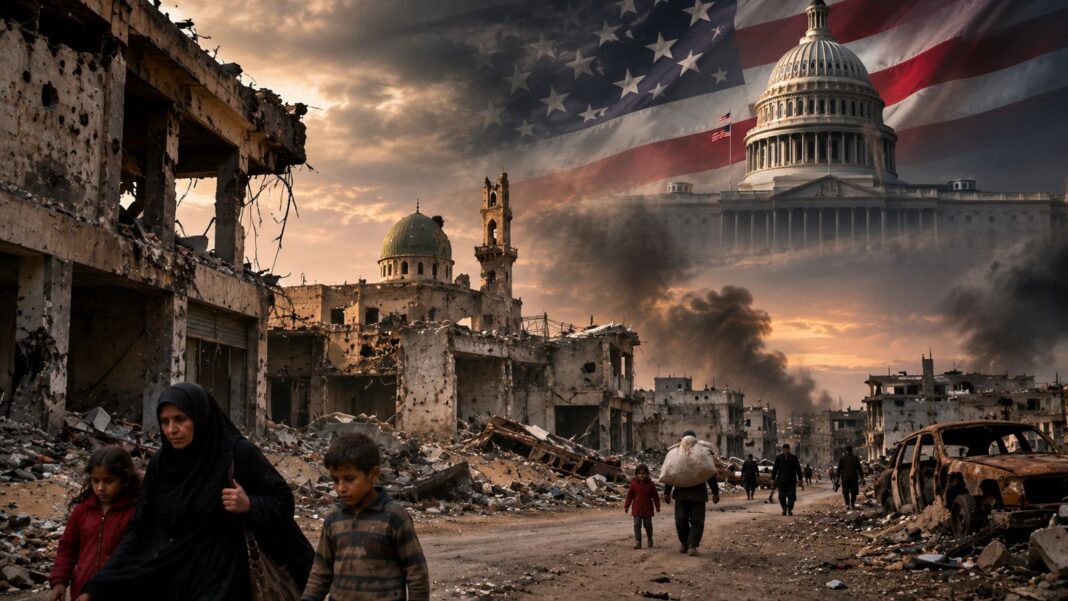
America illustrates the problem. The United States is routinely celebrated as a heroic defender of freedom and the secular international order. Yet Brown University’s Costs of War project estimates that at least 4.5 to 4.7 million people died directly and indirectly in post-9/11 war zones involving US military interventions and counterterror operations. Those deaths cannot all be assigned to one government; the wars involved many actors. But what an indictment of the claim that secular power, wrapped in the language of liberation, brings peace. Who is called the terrorist? Who receives the medals, the documentaries and the title of hero? On whose authority?
Here is the deeper deception. Secularism presents the state as the neutral referee required to restrain dangerous religions. Having established that pretext, the state claims final authority to determine where religion may operate and what it may demand. That is not simply separation. It is the subjugation of religion under a supposedly superior public authority. Peace becomes the slogan used to justify the hierarchy. The state is not merely keeping the peace; it is deciding who may define it.
Our task is not to swallow inherited categories, sanitised histories or official labels. We must scrutinise the actions of states as rigorously as those of movements, judge harm by a consistent moral standard, and refuse the idea that Islam must be domesticated for society to be safe. Secularism has not earned the exemption it claims. Wake up: before asking what this system promises, ask whose violence it excuses and whose faith it subordinates.


