
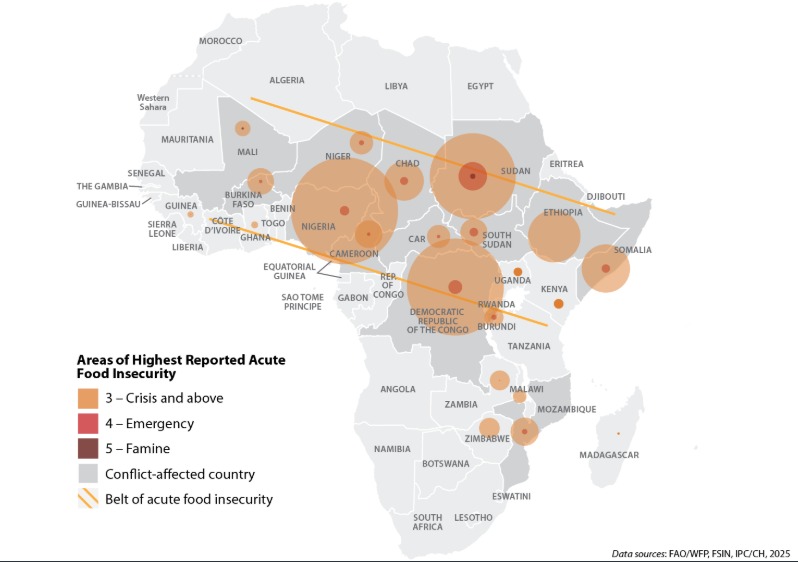

Wars, poverty and a lack of government investment are leaving millions of people across Africa struggling to access enough food, with children, women and the elderly among those most vulnerable to malnutrition.
Zaeem Kara, Marketing Coordinator at Ashraful Aid South Africa, told One Nation Media (ONM) that the United Nations report on food security highlights a growing hunger crisis across the continent.
“According to the 2026 United Nations food security report, 309 million Africans experienced hunger in 2025, while 66.6% could not afford a healthy diet. Poverty, conflict, displacement and climate shocks continue to place vulnerable households at risk of malnutrition,” Kara said.
The Alliance for a Green Revolution in Africa (AGRA), in the 74th edition of its report published in October 2026, warned that food insecurity across East, Southern and West Africa is expected to remain severe through 2027.
In East Africa, food insecurity will be driven by rainfall deficits, crop losses, conflict, displacement, high staple food prices, declining household food stocks and constrained humanitarian assistance.
In Southern Africa, declining household food stocks, weakening purchasing power, high food and transport costs, and increasingly adverse El Niño-related rainfall conditions are expected to worsen food insecurity.
In West Africa, food insecurity is expected to worsen due to insecurity, displacement, poor or disrupted harvests, rainfall deficits, declining household food stocks, weakened livelihoods and high food prices, which are increasing dependence on markets.
Humanitarian aid across the continent
Several humanitarian organisations are working beyond national borders to address hunger and food insecurity in different parts of Africa.
Ashraful Aid has responded to the growing need by distributing food hampers and providing meals to vulnerable communities across the continent.
“In our response in 2025–2026 to food security, we were able to distribute 40,000 food hampers across Africa and distribute 600,000 meals across Africa,” Kara said.
“Our food security work includes household food parcels, cooked meals, community feeding and emergency relief. We also support conflict-affected communities in Sudan through food assistance and work with regional teams and local partners to reach vulnerable households.”
Karrim Abed, Head of Intergovernmental Relations at the Al-Imdaad Foundation, told ONM that the organisation has also observed an increase in malnutrition among children.
“We are finding that there is an increase in malnutrition among children, and in terms of less food for the nutrition of children, this is something that the Al-Imdaad Foundation has noticed as it initiated the Phila Mtwana initiative, which helps malnourished children who do not have sustainable livelihoods from their parents,” he said.
Shaffie Dickson Laja, Projects Manager at Ashraful Aid Malawi, told ONM that the organisation has an ongoing initiative to feed patients and distribute food hampers across the country.
“One of our ongoing initiatives is a weekly feeding programme conducted every Wednesday at the National Cancer Centre in Lilongwe, where we provide meals to more than 250 patients receiving care at the facility. In addition, we distribute food hampers to vulnerable individuals and households in different communities across the country,” Laja said.
Who is most affected by malnutrition?
Laja said the organisation’s humanitarian initiatives are intended to serve different vulnerable groups rather than focusing on one particular category of people.
“Our beneficiaries include women, children, elderly people, persons with disabilities, refugees, unemployed individuals and families experiencing hardship. We also support other vulnerable groups, including those in orphanages and communities affected by disasters and food shortages,” he said.
According to the Al-Imdaad Foundation, senior citizens, infants, women and children are among those most affected by food insecurity, particularly in communities affected by conflict and economic hardship.
“The senior citizens, the infants, women and children, all these people become the victims of this situation. These people don’t have food, do not have anything to sustain themselves because of the conflict situation and economic issues.
“Innocent children have different issues in terms of starvation, no access to food, no access to proper medical care, et cetera,” Abed said.
Unity in serving affected communities
Kara said addressing malnutrition requires more than immediate food assistance, with sustainable interventions and cooperation between stakeholders also essential.
“At Ashraful Aid, we believe that addressing malnutrition requires more than providing a meal today. It requires consistent food assistance, sustainable livelihoods and strong partnerships. By working with local communities, donors and volunteers, we strive to reach those most in need while maintaining responsible operations that allow us to continue serving communities in the years ahead.”
Kara added that local partnerships play an important role in ensuring humanitarian assistance reaches those who need it most.
“Local collaboration between regional teams, community partners and volunteers helps coordinate distributions, extend reach and use resources responsibly.”
Laja said the growing demand for humanitarian assistance highlights the need for stronger partnerships and sustainable interventions.
“This growing need highlights the importance of strengthening humanitarian partnerships, mobilising additional resources and supporting sustainable interventions that help communities become more food-secure,” he said.
He added that the organisation’s assistance is not limited by the religious or social backgrounds of those receiving support.
“At the same time, our humanitarian approach is inclusive. We assist vulnerable people regardless of their religious affiliation, colour, background or social status. Our primary consideration is the level of need and the opportunity to alleviate suffering and restore human dignity,” Laja said.
Abed also emphasised the importance of cooperation between governments, non-governmental organisations and the private sector in addressing humanitarian challenges.
“Partnership has to be three-way; it has to be the government, it has to be the NGO sector, and the business sector. I call it the samosa partnership. It’s a three-way, it’s a samosa partnership. And inside the samosa must be the community being served and assisted,” he said.
Initiatives supporting local communities
Abed explained that the Al-Imdaad Foundation runs an initiative called One Home, One Garden, which helps families in communities where it operates become more self-sufficient and less dependent on government or external assistance.
“The One Home, One Garden impacts on the mother and the families to get together at a 30-square-metre garden and to start doing your own sustainable livelihood,” Abed said.
Kara explained that Ashraful Aid also has long-term livelihood and resilience initiatives, including a 2026 pilot programme in Malawi aimed at improving household incomes and reducing dependence on emergency relief.
Challenges facing humanitarian organisations
Despite their efforts, humanitarian organisations continue to face challenges in meeting the growing demand for food assistance.
Laja said limited resources remain one of the biggest obstacles to expanding programmes and reaching more vulnerable households.
“Our main challenge is the limited availability of resources to meet the growing demand for food assistance.
“Although we remain committed to supporting vulnerable communities, the needs on the ground often exceed the resources available to us. This means that we cannot always reach everyone who requires assistance or provide support at the scale we would wish to achieve,” he said.
“The rising cost of essential food commodities and the need to sustain regular feeding activities also place pressure on humanitarian programmes.
“We therefore continue to rely on the generosity of donors, well-wishers and strategic partners to sustain our initiatives and extend assistance to more people in need,” Laja added.
Abed said that although humanitarian organisations continue to receive support from communities, additional funding remains necessary.
“So funding is never enough; there is no shortage, but there is always a need for more to do more. Our communities that can afford funding are very helpful, ready to assist with any of the different types of interventions that we need, which we are seeing as the Al-Imdaad Foundation,” he said.
Kara also highlighted the importance of maintaining diverse sources of financial support to ensure the continuity of humanitarian programmes.
“There is diversified support seen through public donations, recurring contributions and corporate partnerships that help sustain programmes throughout the year.”
As hunger continues to affect millions across the continent, humanitarian organisations warn that immediate food assistance is only part of the solution. Without adequate investment, stronger partnerships and long-term interventions, vulnerable communities will continue to face uncertainty over where their next meal will come from.


