

By Zingisa Mkhuma
By the time DA leader Helen Zille handed over a transformer to residents of Meadowlands Zone 9 in Soweto, many households were celebrating and singing the praises of the party. And who could blame them? After years of power outages, load reduction, collapsing infrastructure and government failures, a functioning transformer felt like a miracle for residents who had gone for months without electricity.
However, those dancing in the streets today could, in years to come, discover that the real gift was never the transformer itself. The real gift was an introduction to a different model of governance, one in which every service has a cost, every account must be paid, and sentiment carries less weight than financial sustainability.
To the uninitiated, Gogo Zille’s recent antics in Gauteng paint a picture of a leader deeply invested in the struggles of ordinary people. One day she is blissfully paddling through water-filled potholes in Ekurhuleni. On another, she is swimming in clean water gushing from a burst pipe in the northern suburbs of Johannesburg.
She visits neglected sports fields in Eldorado Park and Orange Farm. She takes a spin in a Gusheshe (BMW) as a sign that she embraces township culture with gusto. Then she arrives in Soweto bearing a transformer to much ululation and jubilation.
For communities battered by years of poor service delivery under ANC-led municipalities – water cuts, potholes, electricity disruptions, crumbling hospitals, rising crime, illegal immigration and the general inefficiencies that have become synonymous with government dysfunction – such gestures can seem noble and benevolent.
While it is easy to point a finger squarely at the ANC, which governed the country for three decades and carries responsibility for much of the decay that we experience today, nobody is denying that the ANC has made serious mistakes by tolerating incompetence, failing to act decisively against corruption and allowing infrastructure in many places to collapse.
Gauteng, and Johannesburg in particular, should be in far better condition than they are today. Residents are up in arms over this situation, and many have vowed to punish the ANC at the 4 November polls.
However, for all its many faults, the ANC at least embraced the principle that the government should cushion the poor against the harsh realities of poverty. The concepts of indigent support, free basic services and debt relief programmes emerged from a belief that millions of South Africans simply do not have the means to survive without some form of state assistance.
For years, many township residents benefited from policies that provided free basic water, electricity and rates rebates. Even struggling middle-class homeowners who fell on hard times because of retrenchments, inflation and economic decline have often been able to apply for assistance.
Yes, the questions still are: Was the system perfect? Not at all. Was it abused? Certainly.
But it recognised a fundamental reality about South Africa: millions of people are unemployed, millions more are underemployed, and many households survive from one month to the next with no sound financial buffer whatsoever other than meagre social grants.
On the other hand, the white-led DA approaches this question differently. The party that prides itself on sound governance, revenue collection and strict financial discipline has never shown any compassion or generosity towards the poor of Khayelitsha, Philippi and the Cape Flats, where it too has been in power for more than three decades.
Its supporters often point to municipalities under DA control, like Midvaal in Gauteng, as evidence that accountability and efficiency can coexist. But efficiency without compassion can become cruelty for those previously disadvantaged and battered by the apartheid system.
Residents cheering for a donated transformer today should ask themselves a simple question: what happens tomorrow? What happens when the cameras are gone and the television crews have packed up? What happens when municipal officials arrive demanding payment? What happens when households that cannot afford electricity are told there are no exceptions, no debt write-offs and no free services available?
The DA has consistently opposed debt relief measures championed by the ANC-led City of Johannesburg. The party has criticised debt cancellation initiatives that have provided struggling households with an opportunity to get back on their feet. It argues, with some justification, that municipalities cannot survive if residents do not pay for services.
The people of Meadowlands should understand that the transformer is not merely a gift. It is a symbol of the DA’s vision of government. A government that fixes infrastructure, certainly. A government that insists on payment irrespective of one’s situation in life. A government that prioritises efficiency and compliance, without necessarily sharing the ANC’s commitment to extensive social support.
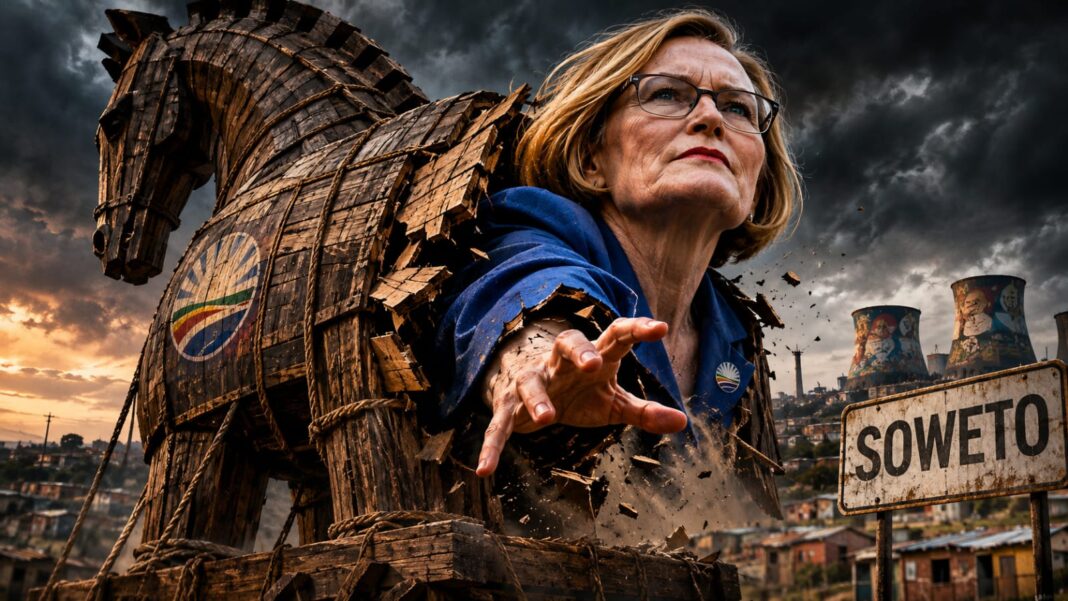
Some voters may welcome that trade-off, while others, like me, who have never had to live without electricity for months, may regard this transformer as a Trojan horse.
Like the famous gift of Greek mythology, it arrives wrapped in goodwill. It solves an immediate problem and creates gratitude. But hidden inside is a racist political philosophy that many beneficiaries may not fully appreciate.
The tragedy is that many residents may only realise the difference when the bill arrives. And unlike a transformer, that reality cannot be switched off.
Zingisa Mkhuma is former Editor of Pretoria News and Sunday Independent.


