
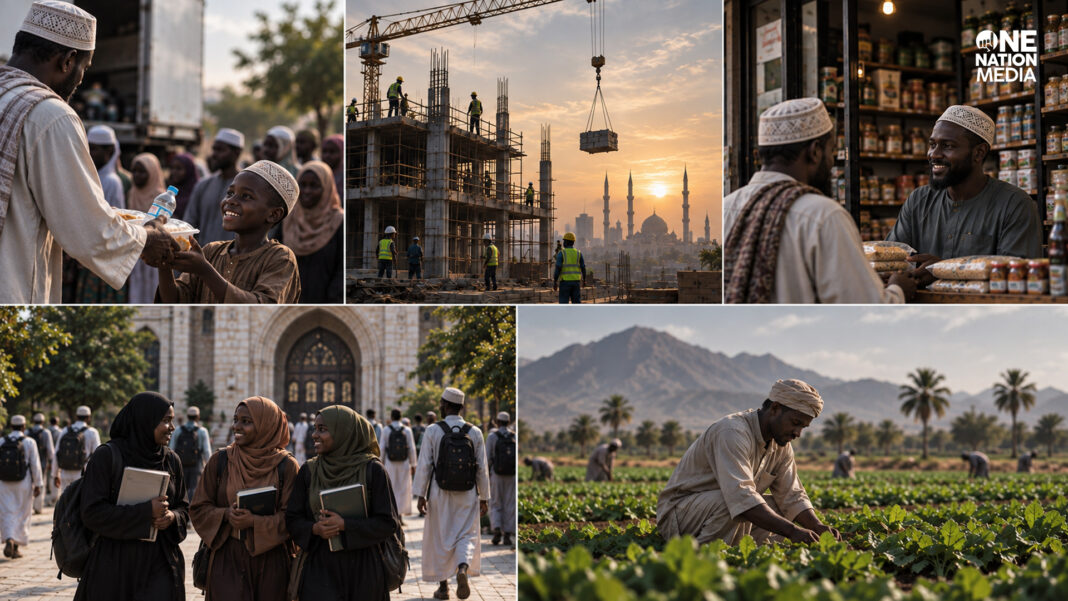

Teslim Adeyemo argues that Muslim charities must move beyond relief and help build the capital, institutions and enterprises needed for long-term self-sufficiency.
Ask most Muslims what their community’s charities do, and the list arrives quickly: feed the hungry, sponsor orphans, dig wells and send relief when floods, wars or displacement devastate another Muslim population.
All of that is true, and none of it is insignificant.
On 6 June 2026, Burkina Faso closed the first tranche of its inaugural diaspora bond, the Emprunt Patriote. The government had sought FCFA 125 billion from citizens and the diaspora and received FCFA 151.5 billion within a month — despite the country still fighting an active insurgency.
What the familiar story of Muslim charity leaves out is that decades of relief work have yet to produce a comparable transnational Muslim financial mechanism capable of mobilising development capital from the Ummah itself at such scale.
The maqasid demand more than survival
Muslim humanitarian organisations have helped preserve the Ummah’s daruriyat — the necessities without which life and society begin to collapse — and that work has saved countless lives.
But the maqasid al-Shariah do not end with survival.
Classical Islamic thought also recognises hajiyat, needs that remove hardship, and tahsiniyat, the refinements and conditions associated with dignity, excellence and human flourishing.
Flourishing cannot simply be delivered as emergency aid. It must be built and actively sustained.
A sector that funds programmes but rarely capitalises entrepreneurs risks keeping communities alive without giving them the means to become economically and institutionally self-sustaining.
The sector remains concentrated at the necessities tier
Imam al-Ghazali’s classical framework distinguishes between three broad levels of human interests: daruriyat, the necessities without which life and social order are gravely impaired; hajiyat, needs that alleviate hardship; and tahsiniyat, those things that contribute towards refinement, dignity and excellence.
Much of the modern Muslim humanitarian sector understandably concentrates on the first tier.
Major organisations such as Islamic Relief, Muslim Aid and their counterparts across Africa and Asia have developed extensive institutional capacity around emergency response, food security, water and sanitation, healthcare and orphan sponsorship.
Each of these is a legitimate and necessary intervention consistent with protecting the objectives of the Sharia.
But humanitarian architecture is principally designed to alleviate suffering. It is not, by itself, an economic development model capable of producing communities that eventually no longer require recurring intervention.
Civilisations are not built by governments or charities alone
Civilisations are not built solely by governments, nor by charities that increasingly find themselves compensating for failing or absent state institutions.
They are also built by entrepreneurs.
These include profit entrepreneurs who create enterprises, norm entrepreneurs who reshape what societies value and knowledge entrepreneurs who establish institutions capable of educating future generations.
A profit entrepreneur developing halal supply chains, a norm entrepreneur transforming Muslim attitudes towards work and dignity, or a knowledge entrepreneur founding a university department all require something fundamentally different from emergency relief: patient capital.
They need financial support measured in years, not grant cycles measured in months.
The proper role of government, when functioning effectively, is to create the environment within which such people can build — not to replace them.
Yet across parts of the Muslim world, NGOs increasingly perform quasi-state functions: administering welfare, operating clinics and distributing food, while entrepreneurs capable of creating self-sustaining economic and intellectual capacity remain comparatively undercapitalised.
Burkina Faso and Indonesia have shown what is possible
Burkina Faso’s bond is worth examining because of what it demonstrates.
A state facing fiscal pressure and active conflict mobilised domestic and diaspora savings through a formal investment instrument, offering returns of 6.75% and 6.85% over five and seven years respectively, with the capital intended for projects including an agro-industrial zone, energy infrastructure and roads.
It did so without waiting for another international pledging conference.
Indonesia has demonstrated another model through waqf.
Since 2020, its national waqf authorities have channelled cash waqf into government sukuk through the Cash Waqf Linked Sukuk programme, using the proceeds and returns to support social projects including healthcare, education and relief.
The principle has therefore already been demonstrated: Muslim capital can be pooled through formal financial instruments and directed towards long-term public benefit.
What remains largely absent is a comparable cross-border mechanism capable of capitalising Muslim entrepreneurs and productive enterprises across multiple countries at meaningful scale.
Relief in Sudan, Gaza and the Sahel cannot wait
Sudan, Gaza and the Sahel are experiencing acute humanitarian crises, and no serious proposal should ask relief organisations to divert money away from people whose survival depends on assistance today.
That is not a minor concession.
Protecting daruriyat is not optional, and any Ummah-wide financial mechanism must continue funding emergency relief for as long as such needs exist.
But keeping people alive and building the institutions on which they can eventually stand are two different tasks.
The Muslim sector has developed considerable expertise in the first. It now needs far greater ambition in the second.
There is no inherent contradiction between the two. An organisation could operate a life-saving humanitarian programme while also helping capitalise a waqf-backed enterprise fund, development vehicle or other patient-capital mechanism.
The point is not to replace charity.
It is to build beyond it.
The Ummah has been asked to give — but rarely to invest
Burkina Faso did not wait for an aid pledging conference or a UN resolution before attempting to finance its agro-industrial development.
It asked its own people for capital through a defined instrument, offering agreed returns over an agreed period.
Its people responded.
That distinction matters.
Muslims around the world are repeatedly asked to donate: during Ramadan, after earthquakes, during wars, when famine strikes and when another refugee crisis emerges.
They respond with extraordinary generosity.
But the OIC, major waqf institutions, Islamic financial bodies and transnational Muslim organisations have rarely posed a different question at comparable scale:
What if the Ummah were asked not merely to donate, but to invest?
What if Muslims were offered credible, transparent and professionally managed vehicles through which their capital could finance enterprises, infrastructure, education and productive assets across Muslim communities — with measurable outcomes and, where appropriate, measurable returns over five, seven or 10 years?
The Ummah has repeatedly demonstrated that it can mobilise enormous resources in moments of catastrophe.
The challenge now is to develop institutions capable of mobilising those same resources for construction rather than only reconstruction, for enterprise rather than only emergency relief, and for long-term capacity rather than permanent dependency.
Until that question is asked seriously and at scale, the Ummah will continue proving that it can survive.
It will not yet have proved that it can build.
Teslim Adeyemo is a development strategist and the founder of UmmahBuilders, a platform equipping Muslim community leaders with practical frameworks for institutional development and local governance. A former Director of Digital Media at the Dawah Institute, he holds a Master’s in International Affairs and Diplomacy with a specialisation in International Development. His work sits at the intersection of Islamic ethics, media strategy, and community development across Africa and the diaspora. He writes and consults on building Muslim institutions that translate faith into civilisational action. You can follow Teslime on LinkedIn and his Substack.


