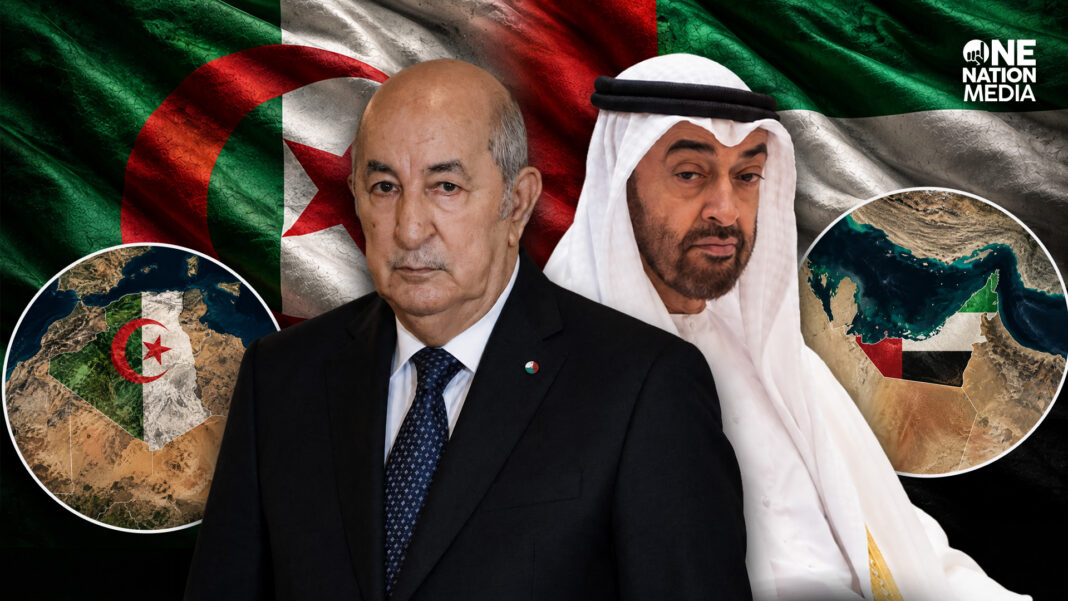

Algeria has announced it is cutting diplomatic relations with the United Arab Emirates, accusing Abu Dhabi of carrying out a series of “provocative or hostile” actions despite repeated warnings from Algiers.
Algeria’s Foreign Ministry said on Thursday that the UAE’s actions had reached a point where they could no longer be considered acceptable, adding that the government had “exhausted all means of preserving bilateral relations”.
The Emirati ambassador was summoned to the ministry, formally informed of the decision and given 48 hours to comply.
Algeria later announced that it would close its airspace to UAE-registered civilian and military aircraft from Friday.
According to Ennahar TV, citing Algeria’s Defence Ministry, commercial UAE flights operating to and from Algiers will be exempt from the restriction until the end of 2026, when the current aviation agreement expires.
The UAE said it hoped Algeria’s decision would be temporary.
In a statement, the UAE Foreign Ministry said Abu Dhabi continued to value its relationship with the Algerian people and highlighted ties between the two populations, including the Algerian community living in the Emirates.
Anwar Gargash, diplomatic adviser to UAE President Mohammed bin Zayed Al Nahyan, also wrote on X that diplomatic relations should be based on “rationality, communication and clarity of interests” rather than “riddles and signals that require decoding”.
Gargash did not directly mention Algeria.
Years of growing tensions
Relations between Algeria and the UAE have deteriorated steadily in recent years as the two governments have found themselves on opposing sides of several major regional disputes.
One of the clearest dividing lines is Israel.
Algeria remains firmly opposed to normalisation with Israel, while the UAE established diplomatic relations with Israel under the US-brokered Abraham Accords in 2020.
Morocco, Algeria’s main regional rival, also normalised relations with Israel the same year, deepening Algiers’ concerns over the emerging regional alignment between Rabat, Abu Dhabi and Tel Aviv.
Western Sahara has become another major source of tension.
The UAE supports Morocco’s claim of sovereignty over the disputed territory and has opened a consulate there, while Algeria backs the Polisario Front and its demand for an independent Western Sahara.
Competition and political tensions have also increasingly extended into the Sahel.
The UAE has expanded its political, economic and security relationships with several African governments, including states in the Sahel, while Algeria has traditionally regarded the region as part of its strategic sphere of influence.
Algiers’ relations with some of its southern neighbours have also become more complicated following successive military coups and major political shifts across Mali, Niger and other parts of the region.
Algerian President Abdelmadjid Tebboune has repeatedly issued unusually strong criticism of the UAE without always naming it directly.
He has previously described the country as a “micro-state” or “statelet” seeking to destabilise governments across the region.
“Wherever they set foot, blood flows,” Tebboune said during a televised interview in July, accusing the UAE of having a “very negative impact”.
“We want them to stay away, so that blood does not flow in our country,” he added.
Tebboune said at the time that Algeria could have broken diplomatic relations much earlier, but had avoided doing so because it did not want to deepen divisions within the Arab world.
Thursday’s announcement marks the culmination of years of worsening relations between Algiers and Abu Dhabi and represents one of Algeria’s sharpest diplomatic confrontations with another Arab government in recent years.