
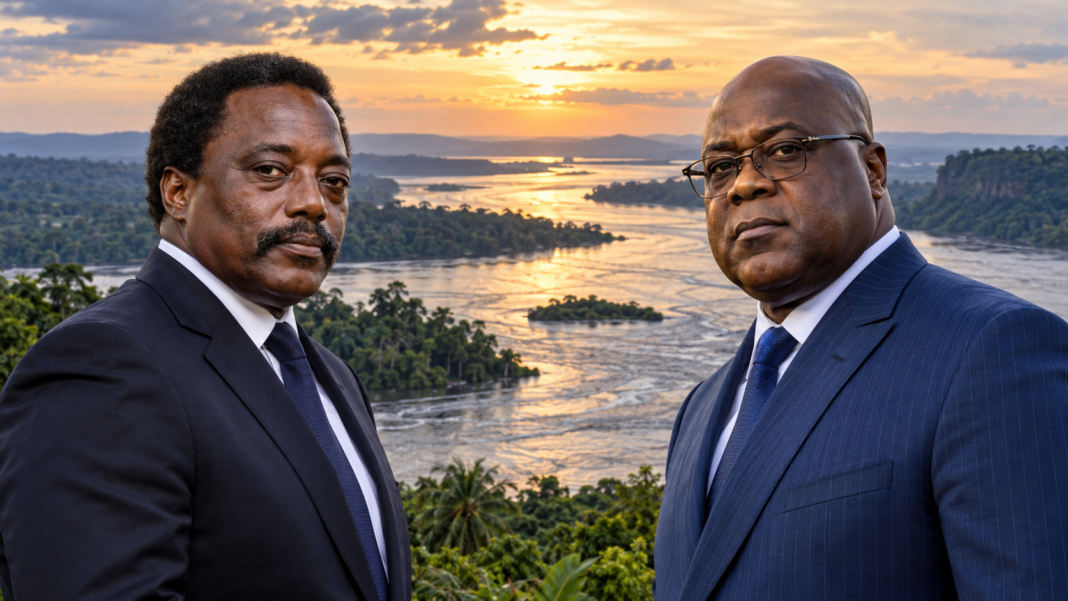

Former Democratic Republic of Congo President Joseph Kabila has gone from ruling Africa’s second-largest country to leading an armed rebellion against its government, in a dramatic political comeback rooted in three decades of regional warfare, foreign interference and the struggle for control of Congo’s vast mineral wealth.
The Democratic Republic of Congo (DRC) should be among the richest countries on earth.
The second-largest country in Africa and 11th-largest in the world, it holds vast reserves of cobalt, copper, gold, diamonds and coltan — minerals that power the world’s phones and other modern technologies.
The Congo River at Inga Falls could, if the proposed Grand Inga Dam were ever built, generate 40,000 megawatts of electricity — enough to power vast areas of Africa.
Instead, the country’s development has been blighted by brutal colonial rule — first under King Leopold II’s Congo Free State, then Belgium until independence on June 30, 1960 — followed by decades of political instability and failed leadership.
The latest dramatic development came on October 12, 2026, when Joseph Kabila, who ruled Congo from 2001 to 2019, formally emerged as a rebel leader.
From his residence in Goma, a city under M23 control since January 2025, the 55-year-old was proclaimed president of the new Front pour la refondation de la nation (FRN), or Front for the Refoundation of the Nation.
The FRN succeeds the AFC/M23 alliance. Its leadership includes familiar figures: Corneille Nangaa, the former electoral commission chief who oversaw the disputed 2018 election; Bertrand Bisimwa; Freddy Kaniki; and M23 military commander Sultani Makenga.
According to adviser Claude Ibalanky, its stated objective is to end what it describes as tyranny by any means, including armed force.
It marks a rare instance in modern Africa of a former head of state openly joining forces with a foreign-backed armed movement.
From coalition to condemnation
Kabila’s road to Goma began in Kinshasa. In 2019, he stepped down after 18 years in power and handed the presidency to Félix Tshisekedi following a disputed election.
The two initially governed through a fragile coalition, but Tshisekedi eventually dismantled the alliance and established his own parliamentary majority.
Kabila subsequently went into exile, while Kinshasa accused him of quietly supporting the resurgent rebellion in eastern Congo.
He denied the allegations until May 2025, when he reappeared in Goma via Rwanda. Several former allies subsequently joined AFC/M23 structures.
The Congolese government responded forcefully.
On September 30, 2025, a military court sentenced Kabila to death in absentia for treason, war crimes and crimes against humanity linked to the rebellion.
On April 30, 2026, the US Treasury’s Office of Foreign Assets Control (OFAC) sanctioned him for materially supporting M23 and its political wing, the AFC, through financing, encouraging defections and efforts to destabilise Kinshasa.
Kabila maintains that the allegations are politically motivated.
He has framed his political comeback around a 12-point “shock therapy” programme, first presented in May 2025 and renewed on October 9, calling for an end to authoritarian rule, the restoration of democracy, national reconciliation, economic reform and the withdrawal of foreign troops and mercenaries.
As political analyst Trésor Kibangula observed, Kabila is no longer content with maintaining links to AFC/M23 but is openly leading the political-military structure that succeeds it.
The Great Lakes conflict
Kabila’s transformation cannot be understood without examining the wider Great Lakes conflict.
The 1994 genocide in Rwanda spilled into what was then Zaire, as Hutu perpetrators of the genocide fled into eastern Congo alongside large numbers of civilian refugees.
Rwanda and Uganda intervened militarily in 1996–97, overthrowing Mobutu Sese Seko and installing Laurent-Désiré Kabila, Joseph’s father.
Rwanda subsequently fell out with Laurent Kabila and intervened again in 1998, triggering Africa’s World War — a five-year conflict involving nine countries that contributed to millions of deaths.
Although the war formally ended in 2003, violence continued in eastern Congo.
A 2009 peace agreement integrating CNDP rebels into the Congolese army eventually collapsed, giving rise to M23 in 2012 after former fighters accused Kinshasa of failing to honour the agreement.
Defeated in 2013, M23 returned in late 2021, stronger than before.
UN experts, alongside the United States and European governments, have repeatedly accused Rwanda of backing M23 and exercising command and control over its operations.
Kigali denies supporting the rebellion, citing security concerns over Hutu FDLR rebels it accuses Kinshasa of sheltering.
Kabila now leads a movement operating within a conflict shaped by four interconnected factors:
- A security vacuum: Kinshasa has never established effective control over large parts of North and South Kivu, where more than 100 armed groups operate.
- Ethnic tensions: Grievances among Congolese Tutsi communities over discrimination and citizenship have been exploited by regional actors, while Kinshasa’s reliance on Wazalendo militias, Burundian forces and alleged FDLR allies has deepened divisions.
- A mineral war economy: Control of mines in Rubaya, Walikale and elsewhere helps finance the fighting. Rwanda’s alleged role as a transit point for Congolese minerals has made the conflict increasingly self-sustaining.
- A diplomatic stalemate: The East African Community force was replaced by a Southern African Development Community mission, while Angola and Qatar pursued mediation efforts in Luanda and Doha.
Giving the rebels a prominent Congolese political figure such as Kabila could help them present themselves as a national resistance movement rather than a Rwandan proxy.
Kabila knows this political and military landscape.
His government previously negotiated with the CNDP and M23, while his longstanding networks within Congo’s security establishment remain significant.
For Rwanda, Kabila potentially offers greater Congolese political legitimacy. For Kabila, the rebellion provides a territorial foothold in Goma from which to challenge Kinshasa.
What we know and what remains uncertain
Reuters, AP and AFP reported that Kabila formally assumed leadership of the FRN in Goma on October 12, 2026, with Nangaa and Bisimwa serving as vice-presidents, Sultani Makenga as military chief and Freddy Kaniki as secretary-general.
However, several questions remain unanswered.
Is the FRN more than a political rebranding of AFC/M23? How is it financed? How will a Kivu-based coalition manage relations with other armed groups? And will Rwanda’s position change now that the rebellion has a former president at its head?
The answers could determine whether Kabila’s appointment strengthens the rebellion or creates new divisions within its leadership.
Why it matters
Congo’s tragedy has always been the gap between its extraordinary potential and political realities.
The Grand Inga Dam project — promised under Mobutu, Laurent Kabila, Joseph Kabila and Tshisekedi — remains a symbol of unrealised potential, with ageing turbines generating only a fraction of their capacity.
Meanwhile, more than 100 million Congolese continue to live in a country where vast mineral wealth coexists with widespread poverty, insecurity and limited access to electricity.
Now, a former president facing a death sentence has little to lose from continued confrontation and potentially everything to lose from a peace agreement that excludes him.
Any future negotiations in Doha or Nairobi must confront a difficult question: is Kabila a political stakeholder whose participation is necessary for peace, or a sanctioned figure threatening to prolong the conflict?
Tshisekedi accuses Kabila of treason. Kabila accuses Tshisekedi of tyranny.
Both narratives resonate within a population exhausted by war, mineral exploitation, foreign interference and leaders who promise development but fail to deliver it.
Ultimately, Congo’s political crisis reflects the collapse of boundaries between state and rebellion, national opposition and regional proxy warfare — divisions blurred by three decades of conflict across the Great Lakes region.
Kabila now embodies that contradiction: condemned in Kinshasa, commanding in Goma.
And for millions of Congolese, his transformation raises the prospect of yet another chapter in a conflict that has already devastated generations.