
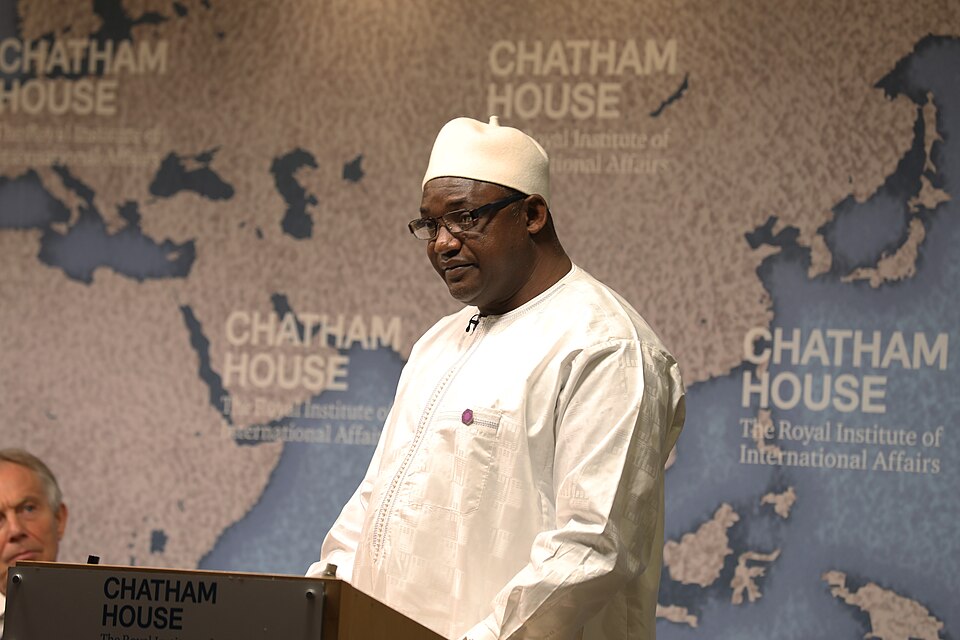

Gambian President Adama Barrow has promised to improve electricity supplies by the end of October after prolonged power cuts triggered angry protests and calls for his resignation just months before the country’s presidential election.
Demonstrations erupted across parts of the Greater Banjul Area on Monday and Tuesday as residents vented their frustration over rolling blackouts that have reportedly lasted as long as 48 hours in some areas.
Protesters burned tyres, erected road barricades and chanted “Barrow must go”, while police used tear gas to disperse crowds in several locations.
Demonstrations were reported near Barrow’s residence and the headquarters of the National Water and Electricity Company (NAWEC), as anger over the country’s worsening electricity crisis spilled onto the streets.
The unrest prompted Barrow to visit NAWEC power facilities in Brikama and Kotu on Tuesday before addressing the country later that evening.
The president acknowledged the severe impact the shortages were having on households and admitted that shortcomings in government planning, electricity generation and maintenance had contributed to the crisis.
“I know that the fans have stopped turning, children work in the dark, mothers throw away stale food, and the heat is unbearable by day and by night,” Barrow said in his national address.
He said electricity demand had reached record levels at a time when major generating units were failing and seasonal conditions were reducing the amount of hydropower available through the regional electricity network.
Barrow nevertheless acknowledged that domestic failures also had to be addressed.
“I must admit, however, the shortcomings in our planning, power generation, and maintenance systems,” he said.
Government promises additional power
Barrow announced that an additional 24-megawatt generating unit was in the final stages of installation at the Brikama Power Station and was expected to be commissioned by the end of October.
The government says the additional capacity should significantly improve electricity supply in a country with a relatively small national grid.
A contract has also been awarded for the construction of a 50-megawatt solar power plant in Soma, with the contractor preparing to begin work.
Barrow said the solar facility would help carry daytime electricity demand, allowing conventional generators to be conserved and used more effectively during the evening when household demand increases.
The president also established a Presidential Task Force on Electricity Supply, chaired by the vice president, which is expected to provide public updates every two weeks.
Barrow pledged that the overall electricity situation would improve by the end of October.
Anger over prolonged blackouts
The power shortages have become a major source of public frustration, particularly during The Gambia’s hot season.
NAWEC has previously attributed pressure on the electricity network to rising demand caused by high temperatures, technical failures and constraints affecting electricity imported through the regional power system.
The crisis has disrupted households and businesses, with residents reporting lengthy periods without electricity.
Barrow urged Gambians to remain calm and avoid violence while the government worked to stabilise the system.
“Let us not destroy in a moment of anger what we suffered so long to gain,” he said.
The protests nevertheless represent a significant political challenge for Barrow as the country approaches a presidential election scheduled for December 5.
The Independent Electoral Commission has confirmed that the vote will take place on December 5, 2026.
Barrow, who first came to power following the 2016 election that ended Yahya Jammeh’s 22-year rule, is seeking another term in office.
With the election now less than three months away, the electricity crisis risks becoming a major political issue as opposition groups and frustrated residents scrutinise the government’s record on infrastructure and basic services.
For Barrow, the immediate challenge will be whether his government can deliver the promised improvements before the end of October — and restore public confidence before Gambians head to the polls in December.