
Northern Nigeria’s education crisis will not be solved by putting a plate of food in front of a child. Hunger matters, but so do insecurity, poverty, displacement, underfunded schools and an education system that too often forces families to choose between the religious education they trust and the formal education their children need.
For millions of children, the real barrier is not simply getting into a classroom, but whether that classroom is safe, affordable, credible and capable of delivering an education worth staying for.
Nigeria has one of the world’s largest populations of out-of-school children, with the burden falling disproportionately on the north. School attendance remains particularly low in the North-East and North-West, especially among girls, but the statistics also conceal a more complex reality.
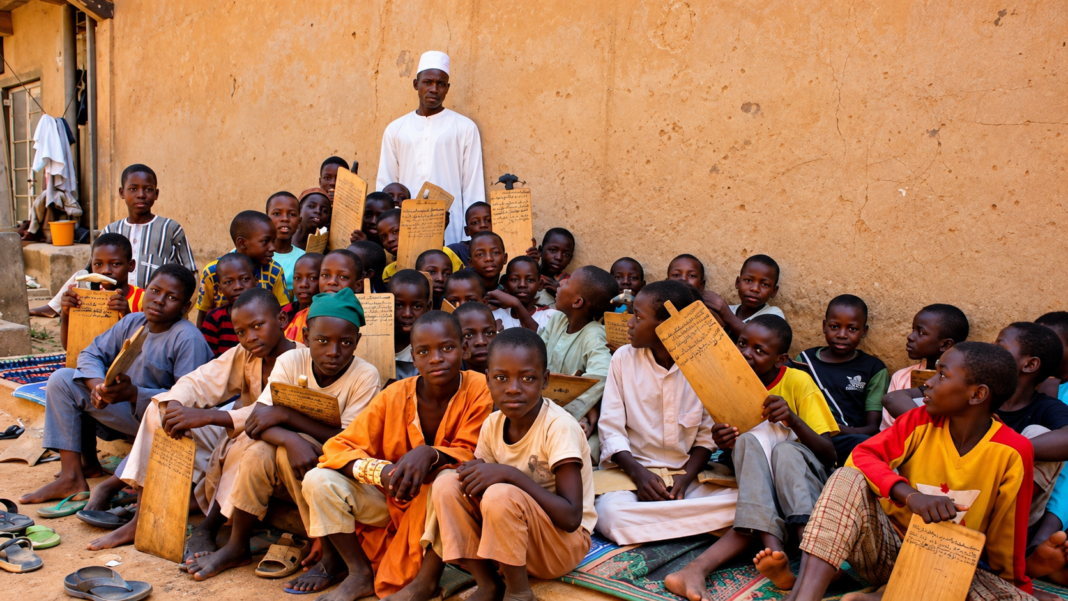
Many children officially classified as out of school are already receiving education through traditional Qur’anic schools, where they learn to recite and study the Qur’an while receiving religious and moral instruction.
The problem is not that these children are learning Islam. It is that many traditional Qur’anic schools do not provide sufficient literacy, numeracy and other subjects associated with formal schooling.
As a result, children may be receiving religious instruction while still being counted as outside the formal education system.
For northern Nigeria, therefore, the question should not be framed as a choice between Islamic and conventional education, but rather how children can retain the religious education their families value while also acquiring the literacy, numeracy, scientific and vocational skills needed to succeed in the modern world.
Bridging Islamic and conventional education
One response has been the expansion of integrated Qur’anic education.
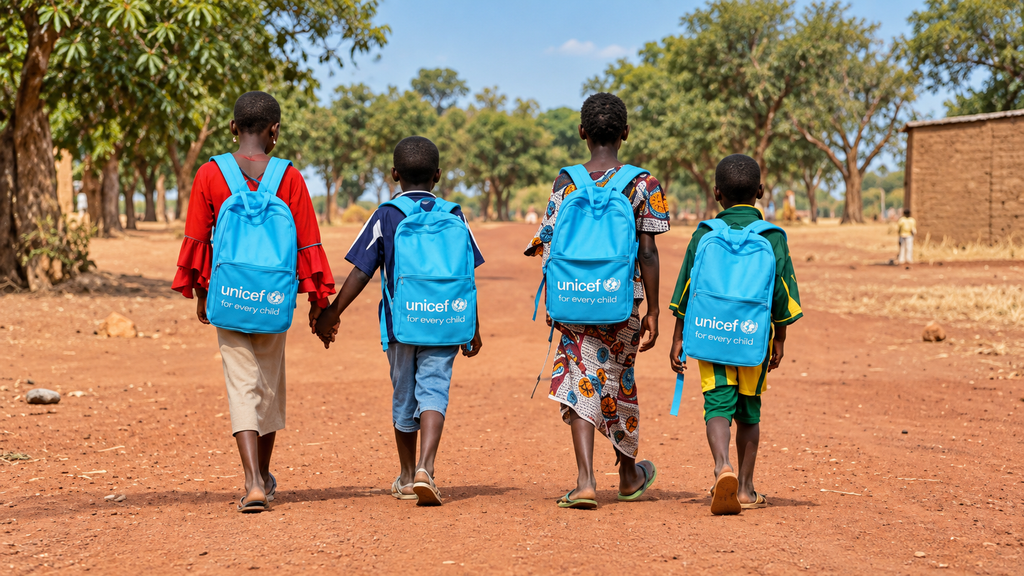
In March 2026, UNICEF reported that 100 Integrated Qur’anic Schools had been established across 10 local government areas in northern Nigeria through the EU-supported Education and Youth Empowerment Project, enrolling more than 10,000 children.
The model seeks to bridge two educational traditions rather than forcing families to choose between them. Qur’anic study remains central, while children are also introduced to subjects such as English, mathematics and other essential skills.
This approach recognises an important principle: Islamic learning and modern education are not inherently in conflict.
The Islamic intellectual tradition has historically embraced religious knowledge alongside mathematics, medicine, astronomy, language and other fields of human inquiry.
The challenge, therefore, is not to remove Islam from education, but to ensure that religious learning is complemented by the knowledge and skills children need to participate confidently in the wider world.
Poverty, however, remains one of the greatest obstacles keeping children away from school.
For families struggling to provide food, shelter and other basic necessities, sending a child to school can mean losing valuable help with farming, household responsibilities or income-generating activities.
Even where tuition is officially free, families may still face the costs of uniforms, transport, learning materials and meals.
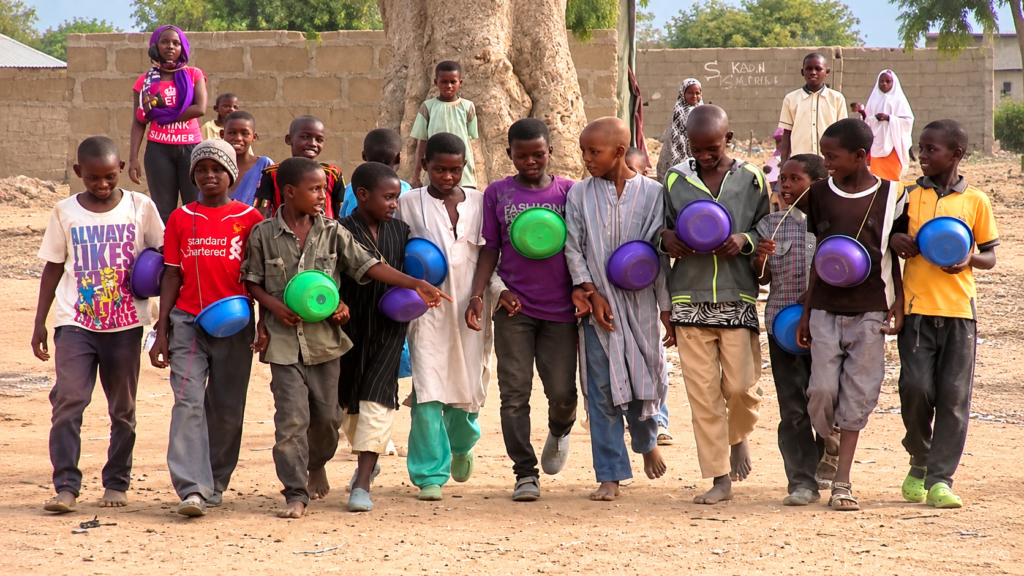
This is where Nigeria’s National Home-Grown School Feeding Programme can play an important role.
The programme is designed to provide meals to public primary school pupils while encouraging enrolment, reducing hunger and supporting local agricultural production.
For impoverished households, a guaranteed meal at school can ease some of the financial pressures associated with educating a child. For hungry pupils, regular meals can improve concentration, attendance and participation.
But a meal cannot solve an education crisis on its own.
A child may be fed at school and still sit in an overcrowded classroom without enough teachers, textbooks or basic facilities. A family may receive an incentive to enrol its children but still withdraw them if the school is unsafe, too far away or incapable of providing meaningful learning.
Poverty, insecurity and the role of Islamic charity
Islamic social and charitable traditions could form another important part of the solution.
Zakat, sadaqah and waqf have historically supported vulnerable families, students and institutions of learning across the Muslim world.
In northern Nigeria, stronger partnerships between Muslim communities, scholars, charitable organisations and educational institutions could help provide scholarships, learning materials, school infrastructure and financial support for children from the poorest households.
Such initiatives would reflect Islam’s longstanding emphasis on the pursuit of knowledge and collective responsibility towards vulnerable members of society.
But charity cannot become an excuse for state failure.
The scale of northern Nigeria’s education crisis requires sustained government investment in teachers, classrooms, learning materials, transport, social protection and functioning education systems. Security is equally fundamental.
In conflict-affected parts of the North-East, particularly Borno, Yobe and Adamawa, years of insurgency, displacement and attacks on communities have severely disrupted children’s education.
A school cannot fulfil its purpose if children cannot safely reach it or if parents fear that sending them there could place their lives at risk.
Girls face additional barriers, including poverty, insecurity, domestic responsibilities, social expectations and early marriage.
Where secondary schools are distant or considered unsafe, some families may be reluctant to allow their daughters to continue beyond primary education.
Addressing these challenges requires more than campaigns urging parents to send girls to school.
It requires safe classrooms, trusted teachers, reliable transport, community engagement and an education system that families believe respects their religious and cultural values.
Beyond school enrolment: Building an education worth staying for
There is also a crucial distinction between school attendance and actual learning.
Increasing enrolment matters, but simply placing more children inside classrooms will not resolve the crisis if they leave without being able to read, write, calculate or acquire useful skills.
Northern Nigeria therefore needs a comprehensive educational strategy that strengthens public schools, expands integrated Qur’anic education, protects girls, addresses insecurity and uses school feeding and social protection programmes to ease the burden on impoverished households.
It must also draw on Islam’s rich civilisational tradition of knowledge, charity and community responsibility without allowing those traditions to replace the state’s responsibility to provide quality education.
The real choice facing northern Nigeria is not between the Qur’an and the classroom.
It is whether an entire generation of children will be forced to choose between their religious identity and access to the knowledge, opportunities and skills needed to shape their future.
A free meal may bring a child to school, but ending northern Nigeria’s education crisis requires ensuring that when that child arrives, there is a safe, trusted and worthwhile education waiting.