
Ra’eesah Hassim asks whether Muslim institutions need to take a harder look at the source of major donations when generosity and serious allegations collide.
The State alleges he is the head of a criminal enterprise. In the community, he has also been known as a businessman, a familiar face and a generous donor to good causes.
Alleged underworld figure Nafiz Modack is currently on trial in the Western Cape High Court alongside several co-accused on charges including murder, attempted murder, corruption, gangsterism, extortion and money laundering. All have pleaded not guilty.
Prosecutors allege that Modack headed a coordinated criminal enterprise involving intimidation, surveillance and violence, while millions of rands were allegedly laundered through an Empire Investment Cars account.
Modack, who is already serving a prison sentence following another conviction, is not the first figure of his kind to cultivate a dual image. Notorious gangster brothers Rashied and Rashaad Staggie, alongside their criminal activities, were also regarded by some in Manenberg as Robin Hood figures, running food schemes, distributing bread and donating to community organisations.
The court will decide whether the allegations against Modack are proven. But for Muslim communities watching the case, it raises a question that goes beyond one trial: what happens when someone accused of serious wrongdoing is also someone who gives generously?
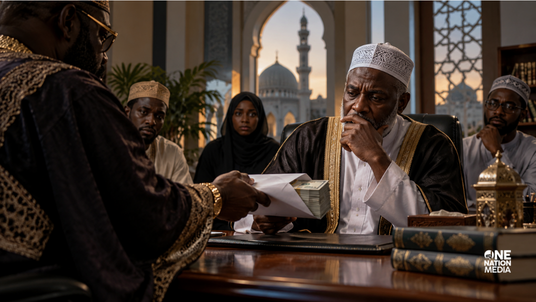
The issue is not whether Muslims commit crime. Like any community, Muslims are not immune. The more uncomfortable question is how institutions respond when the person writing the cheque for the mosque, madrasah, school or orphanage is also the subject of serious allegations.
The silence that money can buy
Generosity confers status. A large donor is honoured, thanked publicly and often given pride of place at community functions.
But that generosity can also discourage questions. When an institution depends on a donor’s support, people can become hesitant to ask where the money comes from, even when serious concerns about the source of that wealth are widely known.
It is not that every wealthy donor should be investigated. Wealth is not evidence of crime, and suspicion should not become the default response to successful people.
The problem is different: when credible concerns already exist and the response is, “It’s not our business where the money came from.”
At that point, looking away becomes a decision.
In Islam, the source matters
Islam does not separate the virtue of giving from the legality of earning.
“O believers! Do not devour one another’s wealth illegally, but rather trade by mutual consent…” (Qur’an 4:29).
How wealth is acquired matters, not only how it is spent. The Prophet Muhammad ﷺ also taught that Allah is Good and accepts only that which is good.
Islamic history offers a striking example. Before Islam, when the Quraysh, the dominant tribe in Makkah and custodians of the Kaaba, rebuilt the Sacred House, they insisted that only wealth acquired from what they regarded as pure sources should be used.
Classical accounts record that money derived from prostitution, usury or wealth wrongfully taken from others was to be excluded.
If the pre-Islamic Quraysh applied such a standard to rebuilding the Kaaba, Muslim institutions today should at least be willing to ask basic questions when confronted with large donations of doubtful origin.
Time for ‘know your donor’?
Banks are required to know their clients and scrutinise the source of significant funds. Should mosques and charities handling large sums not have their own simple ethical standard?
Not gossip. Not witch-hunts. But a clear policy for what happens when credible concerns arise.
To knowingly accept money derived from crime risks allowing sacred work to be funded by unlawful means.
The wider danger is moral rationalisation: wrongdoing begins to feel less wrong because we benefit from it. An unjust law may be challenged through legitimate means, but that is different from simply deciding that an inconvenient law does not apply to us.
That is where families, imams, teachers and Darul Ulooms matter. Guidance cannot begin only after an arrest. Communities need earlier conversations about money, power, accountability and the temptation to excuse wrongdoing when it benefits us.
This is not ultimately about Modack, or any one individual. It is about what Muslim communities value, what they tolerate and whether generosity should ever be allowed to purchase respect that has not been earned.
Before asking how much someone is willing to give, perhaps the harder question must come first: where did it come from?