
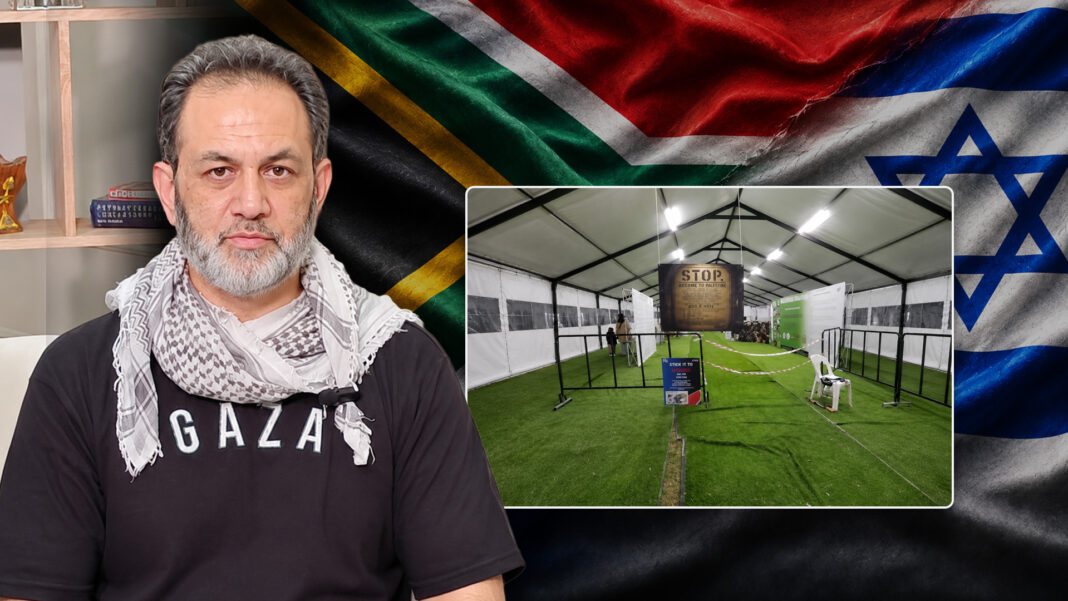

Social Intifada founder Khalid Vawda has defended Palestine awareness exhibitions at Emmarentia Primary School, rejecting accusations of political indoctrination and challenging the outrage surrounding the display of an Israeli flag.
The controversy over an Israeli flag displayed at a Johannesburg primary school has escalated into a wider dispute over Palestine solidarity, political neutrality and the role of education in raising awareness about occupation and injustice.
In an interview with One Nation Media (ONM), Khalid Vawda, founder of Social Intifada, rejected criticism from the South African Zionist Federation (SAZF), defended his organisation’s educational exhibitions and questioned the political significance of Israel’s national flag amid the devastation in Gaza.
The dispute erupted after Emmarentia Primary School apologised on 14 October for displaying the Israeli flag during a school concert. The apology prompted criticism from pro-Israel organisations, with the SAZF subsequently questioning the school’s decision to host Palestine solidarity events.
At the centre of the SAZF’s objections was Social Intifada’s Palestine Youth and Family Market, held on the school premises on 8 and 9 August. The event featured simulated Israeli checkpoints, exhibitions depicting Palestinian prisoners and displays representing Palestinians killed in Gaza.
The SAZF argued that such exhibitions were inappropriate for a primary school environment, describing them as political presentations rather than cultural activities.
Bringing Palestine home
Vawda said the exhibitions were designed to confront South Africans with the realities Palestinians experience under Israeli occupation.
“The simulated checkpoints were meant to give people, just for that day that we had the market, it was meant to give people somewhat of an inkling of what it’s like to move through the occupied West Bank.”
He explained that the displays sought to demonstrate how restrictions on movement affect Palestinian families, including their access to healthcare and ability to maintain contact with relatives.
“So the point of our Palestine Day, the family market, especially the exhibition, is to bring home Palestine to the community.”
Vawda stressed that the events were open to people of all religious backgrounds, rather than being exclusively for Muslims.
“We’ve had Muslims, we’ve had non-Muslims, we’ve had Christians, we’ve had Jews visiting, we’ve had guest speakers from the Jewish community, we’ve had schools visiting, we’ve had people of all ages, all shapes, all sizes.”
He recalled a woman becoming emotional while visiting the exhibition with her three children after viewing photographs of Gaza taken by Palestinian photographer Bilal Khaled.
For Vawda, such encounters demonstrate the importance of highlighting the human consequences of occupation beyond statistics and footage circulating on social media.
Education or indoctrination?
Rejecting the SAZF’s argument that children should be protected from political agendas, Vawda drew a distinction between indoctrination and teaching humanitarian values.
“Teaching kids about justice, teaching kids about injustice, teaching kids about standing up for the oppressed. This is not indoctrination. This is instilling values in children.”
He argued that South Africa’s own liberation history provides an important foundation for understanding the Palestinian struggle.
“So teaching people the history we’ve come from in South Africa and the history between South Africa’s struggle against apartheid and the Palestinian struggle, those are intertwined.”
Vawda highlighted the historical solidarity between Palestinian liberation movements and South African anti-apartheid organisations, contrasting those relationships with Israel’s former cooperation with the apartheid government.
He also praised Emmarentia Primary School for supporting Palestinian refugees and making its premises available for community activities.
A flag and its political meaning
The interview also addressed criticism surrounding the removal of the Israeli flag, including arguments that displaying a country’s national symbol should not automatically be interpreted as a political endorsement.
Vawda rejected the suggestion that national flags can be separated entirely from the actions of the states they represent.
“Simple question I would put back to anyone who gets offended is how would they feel if they saw the Nazi flag, Nazi Germany flag? What feelings does it evoke within them?”
Drawing a provocative historical comparison with Nazi Germany, Vawda described the Israeli flag in stark terms.
“It’s a flag of genocide. It symbolises a nation that is actively participating in a genocide.”
His remarks reflect his position on Israel’s military campaign in Gaza. Israel rejects accusations of genocide, while South Africa’s case against Israel under the Genocide Convention remains before the International Court of Justice.
Gaza’s children and the future of solidarity
Beyond the controversy surrounding the flag and exhibitions, Vawda expressed concern about the destruction of Palestinian educational infrastructure and the long-term consequences for children deprived of conventional schooling.
He praised Palestinians’ commitment to education despite displacement, military occupation and restrictions on essential resources.
“We’ve got the facilities in South Africa, and I think sometimes we may take those for granted, whereas kids in other parts of the world, Palestine, Sudan, Yemen, areas that are affected by war terribly, they do not have the same luxury that we have.”
Vawda proposed establishing direct relationships between South African and Palestinian schools through educational partnerships.
“That school becomes a twin to a school in the West Bank, or in Jerusalem, or in Gaza. And then they keep in touch with each other.”
Such partnerships, he suggested, could involve exchanging letters, poetry and educational materials, with the possibility of organising student exchanges in the future.
“And what this does is it humanises a conflict. It humanises a war. It humanises a people who have been actively dehumanised for decades now.”
For Vawda, Social Intifada’s mission extends beyond exhibitions and public demonstrations. Established to strengthen Muslim-led participation in Palestine solidarity while working alongside other communities, the organisation seeks to promote sustained awareness and meaningful connections with Palestinians.
The dispute at Emmarentia Primary School has therefore raised questions extending far beyond a single school concert: whether exposing children to the suffering of Palestinians constitutes political indoctrination, or whether education itself carries a responsibility to confront injustice.
As Palestinian children in Gaza continue to face the consequences of destroyed classrooms and disrupted education, the controversy surrounding an Israeli flag has become part of a wider debate over historical memory, solidarity and whose suffering society chooses to recognise.


