
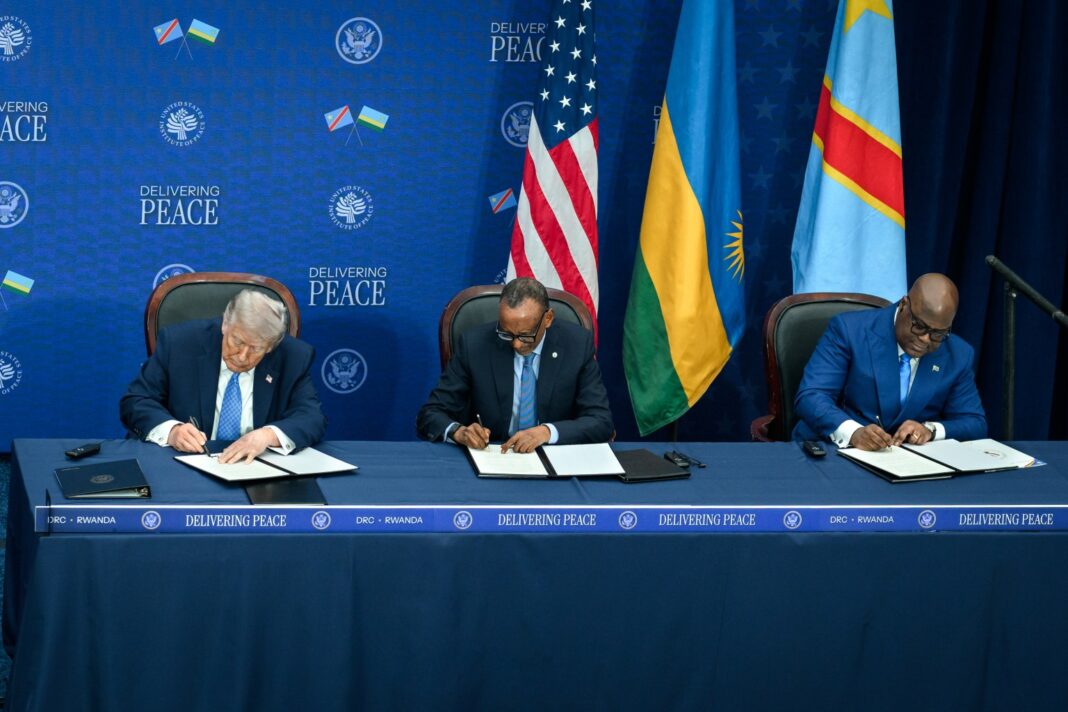

By targeting Rwanda’s Ministry of Defence and a financial institution accused of supporting M23, Washington is seeking to pressure Kigali into honouring its commitments under the peace process in the Democratic Republic of Congo (DRC). However, this strategy could either help revive negotiations or deepen tensions with Kigali, in a resource-rich region where economic interests and great-power rivalries are playing an increasingly prominent role.
On 28 October 2026, the United States took a further step in its relations with Rwanda. The US Department of the Treasury announced sanctions against Rwanda’s Ministry of Defence and Zigama Credit and Savings Society, a financial institution linked to the country’s security services. Washington accuses both entities of providing military, logistical and financial support to the March 23 Movement (M23), which is active in eastern DRC.
The US sanctions came as the European Union’s Special Representative for the Great Lakes region, Johan Borgstam, was holding talks with Ugandan President Yoweri Museveni amid growing frustration over stalled peace efforts. They also came at a time when former Congolese president Joseph Kabila’s rapprochement with M23 was adding a new political dimension to the insurgency and further complicating prospects for resolving the conflict.
According to US authorities, the Rwandan military has deployed thousands of troops alongside M23 fighters in North Kivu and South Kivu provinces, while supplying them with military equipment, including surface-to-air missiles. Zigama, meanwhile, is accused of facilitating payments for the acquisition of weapons and military equipment, as well as financial transactions benefiting the rebel movement. Washington also alleges that the institution helped facilitate the transfer of gold from territories under M23 control to Rwanda.
“Today, the United States makes good on President Trump’s promise to hold Rwanda accountable for its commitments under the Washington Accords for Peace and Prosperity,” US Treasury Secretary Scott Bessent said in a statement. “Rwanda must halt its support for M23 and withdraw its troops from eastern DRC.”
This marks a further round of sanctions imposed on Rwandan institutions and officials this year.
US geopolitical analysis and risk intelligence firm RANE Network says Washington’s tougher stance towards Kigali reflects an effort to isolate Rwanda financially and compel it to honour its commitments.
In response, Kigali has accused Washington of taking a biased approach to managing the conflict in the Great Lakes region. Rwanda alleges that the US is turning a blind eye to Kinshasa’s alleged support for the Democratic Forces for the Liberation of Rwanda (FDLR), while focusing its sanctions primarily on Rwandan institutions. According to Rwandan authorities, this approach undermines Washington’s credibility as an “honest broker”.
Historically regarded as a key strategic partner in US security policy in Africa, Paul Kagame’s Rwanda now appears to be facing a degree of diplomatic marginalisation. This shift could prompt Rwandan diplomats to seek alternative allies and adopt more confrontational anti-Western rhetoric, as illustrated by Rwanda’s high-profile participation in the Russia-Africa Summit.
Minerals: The other dimension of Washington’s strategy
The stakes go beyond security concerns alone. Rich in gold, coltan and cobalt, eastern DRC is of considerable economic and strategic importance. By targeting Zigama, which is accused of facilitating financial networks linked to M23 and the transfer of minerals from areas under its control, Washington is also seeking to cut off the revenue streams generated by these activities.
This move comes amid growing competition over critical minerals, as the United States seeks to diversify its supply chains and strengthen its presence in a sector where China already has a significant foothold in the Congolese mining industry. It is increasingly difficult to overlook the close connection between peace, trade transparency and access to strategic resources in Washington’s approach to the Great Lakes region.
Pressure that could backfire on Washington
The key question is whether this diplomatic offensive will help revive the peace process. In theory, sanctions could encourage Kigali to reconsider its position by raising the costs associated with its alleged support for M23. They could also serve as a warning to the economic and financial networks involved in trading minerals sourced from conflict-affected areas.
However, their effectiveness will depend on whether they can bring about verifiable changes on the ground. Pressure perceived as being directed exclusively at Rwanda risks reinforcing Kigali’s sense that it is being unfairly targeted, while reducing its willingness to cooperate with US-led mediation. Several experts, including former US diplomat Tibor Nagy, have argued that “sanctioning only one side will not help” resolve the standoff between Rwanda and the DRC.
Rather than compelling Kigali to back down, unilateral pressure could encourage the Rwandan government to dig in further behind its security rationale, which it portrays as an existential concern in the face of the FDLR threat.
Another risk concerns Kinshasa. Observers of the Great Lakes region also fear that the measures could send an unbalanced signal to the Congolese capital. If it feels emboldened by US diplomatic backing, Félix Tshisekedi’s government may become less inclined to meet its reciprocal commitments, particularly regarding the neutralisation of the FDLR and border security. Without verifiable commitments from both sides, however, the implementation of the Washington Accords risks remaining deadlocked.
Ultimately, the question is not simply whether Washington can force Kigali to change course, but whether it can turn diplomatic pressure into genuine momentum for peace. A stabilisation of eastern DRC that serves the economic interests of major powers without guaranteeing the security of local populations would remain an incomplete peace.


