
Nigeria’s leading Islamic body has called for stronger protection of Muslim rights, greater unity among scholars and a comprehensive overhaul of the country’s security system, while rejecting claims that Christians are facing genocide in Nigeria.
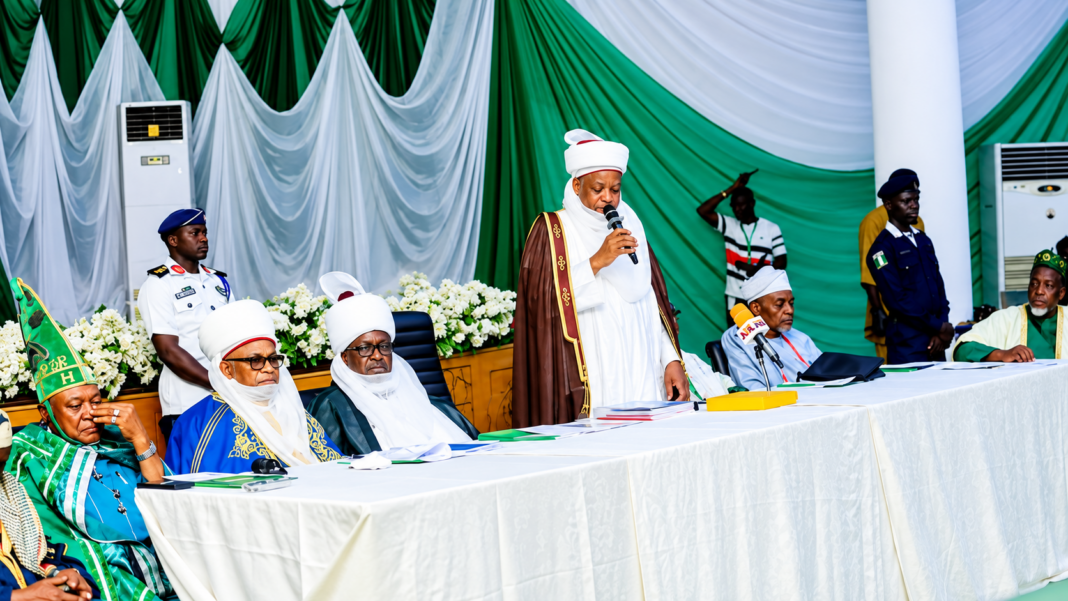
The Nigerian Supreme Council for Islamic Affairs (NSCIA) outlined its position in a communiqué issued after its General Assembly at the Abuja National Mosque on 1 October 2026. The gathering, presided over by the Sultan of Sokoto, Alhaji Muhammad Sa’ad Abubakar, brought together senior scholars, traditional rulers, Chief Imams and representatives of Muslim organisations from across the country.
On religious freedom, the Council reaffirmed a central Islamic principle: there is no compulsion in religion. It stressed that Muslims must not force others to accept Islam and warned against manipulating the faith to justify hatred, violence or attacks against people of other beliefs.
The NSCIA also called on Muslim clerics and scholars to end public attacks against one another, urging that differences be resolved through recognised internal mechanisms. Greater unity among scholars, it said, was essential to strengthening the Muslim community and enabling it to contribute more effectively to Nigeria’s development.
Rejects genocide claim, demands security reform
The Council’s intervention comes amid an intense national and international debate over insecurity, religious identity and allegations of persecution in Nigeria.
The NSCIA rejected claims that Christians, or any other religious community, are facing genocide in the country, arguing that insecurity affects Nigerians across religious lines and should not be reduced to an exclusively religious conflict.
Instead, the Council called for an urgent and comprehensive overhaul of Nigeria’s security architecture. It backed the principle of decentralised policing, but said any reform must guarantee professionalism, accountability, constitutional safeguards, adequate funding, respect for fundamental rights and effective coordination between federal and state security structures.
The Council also warned against treating Muslims as outsiders in parts of the country where Muslim communities have existed for generations. It specifically condemned attempts to deny the history and presence of Muslims in Igboland, warning that such narratives could deepen discrimination, exclusion and hostility.
Hijab rights in focus
A significant part of the communiqué focused on the rights of Muslim women and students, particularly their right to wear the hijab.
The NSCIA called on government agencies and institutions to respect the right of Muslim female students, National Youth Service Corps members, security personnel and women in the workplace to wear the hijab, describing the practice as a fundamental religious right.
It criticised the handling of hijab-related disputes involving the University of Ibadan, Obafemi Awolowo University and the University of Lagos, accusing authorities at their international schools of resisting court decisions that upheld the right of Muslim students to wear the hijab. The Council urged the institutions to comply fully with the law.
It also called for the implementation of a Supreme Court judgment concerning a mosque project at Rivers State University, where Muslim students had previously faced opposition from university authorities.
Civic responsibility
Beyond defending religious rights, the NSCIA urged Muslims to strengthen their contribution to Nigeria through education, economic participation and civic engagement.
The Council encouraged Muslims to obtain their National Identification Numbers and Permanent Voter Cards and to participate fully in elections and other democratic processes.
It also called for greater investment in an education model that combines Islamic knowledge with science, technology, engineering, arts and mathematics, while urging parents, scholars and community leaders to provide stronger moral guidance to younger generations.
The broader message was clear: the defence of Muslim rights must go hand in hand with responsibility to the wider society. By insisting on religious freedom, peaceful coexistence, civic participation and institutional reform, the NSCIA sought to present Islam not as a source of division, but as a framework for principled citizenship, social stability and national development.