
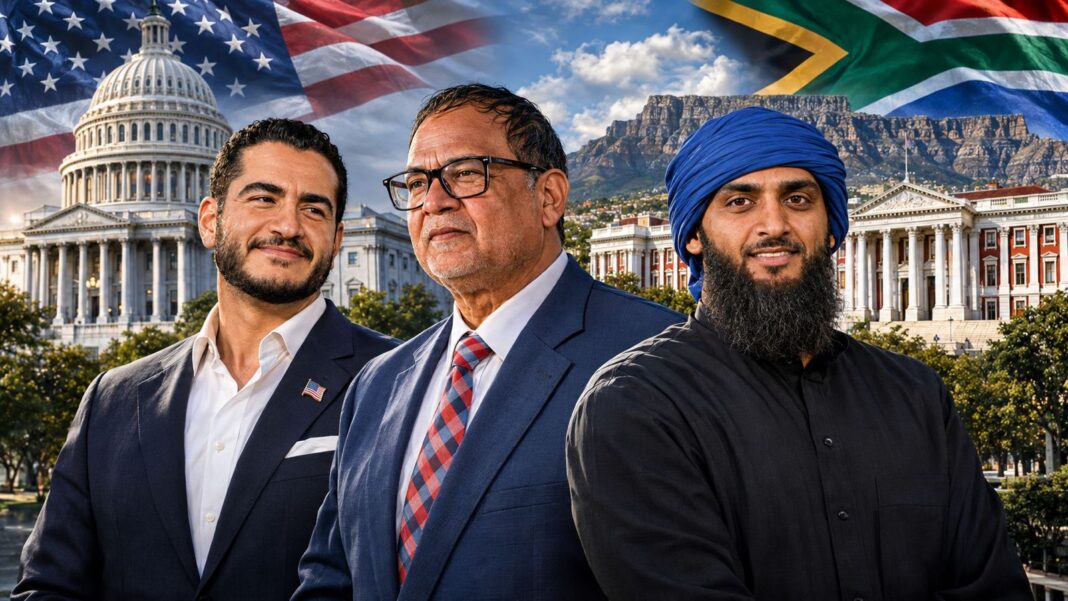

The election of Muslim politicians to positions of power in Western democracies is often celebrated as a victory for Muslim representation. But does having Muslims in government necessarily mean that Islamic principles are being advanced, or are Muslim identities simply being accommodated within a secular-liberal political order? Moulana Uwais Dockrat examines the difference between symbolic representation and genuine ideological influence.
The recent American elections have been celebrated as another milestone for Muslim political representation. Muslim candidates have secured seats in Congress, including the first Muslim elected to the United States Senate. Last year, New York elected its first Muslim mayor. Similar developments have taken place elsewhere, including Britain, where Muslims have increasingly entered Parliament.
For many Muslims, these developments represent progress. After years of discrimination, suspicion and political marginalisation, seeing Muslims occupy positions of influence can understandably generate pride and optimism.
But before the celebrations become too enthusiastic, we need to ask a deeper question.
Who exactly do these individuals represent? Are they bringing Islamic principles to positions of power, or are they bringing Islam into the service of an existing political worldview?
These are two very different things.
Symbolic representation versus substantive representation
As one reputable Muslim scholar has pointed out, there is an important distinction between symbolic representation and substantive representation. A person may share our name, appearance, culture and religious identity without necessarily representing our moral principles or worldview.
Merely gaining access to those in power does not mean possessing meaningful influence over their decisions.
This reminds us of the famous words of Malcolm X, al-Hajj Malik El-Shabazz, in his 1964 speech, The Ballot or the Bullet:
“Sitting at the table doesn’t make you a diner, unless you eat some of what’s on that plate.”
Although spoken in a different historical context, his warning about the difference between inclusion and meaningful participation remains relevant.
We might be invited into government offices, photographed beside presidents and given seats at prestigious political gatherings. But what has actually changed? Who determines the agenda? And whose principles are ultimately being advanced?
We finally have a seat at the table. Wonderful. But who wrote the menu? Who decided what could be served? And are we merely there to make the table look diverse?
This is precisely the danger of token representation. Symbolic victories can become substitutes for meaningful change. The satisfaction of seeing familiar faces in positions of influence can distract us from examining what is actually being represented. This raises a historical parallel.
In 1835, British colonial administrator Thomas Babington Macaulay openly described the type of Indian elite British education was intended to produce:
“Indian in blood and colour, but English in taste, in opinions, in morals, and in intellect.”
The objective was not to transform Indians physically. It was to cultivate people who retained their indigenous identity while adopting the worldview of their colonial rulers.
The colonisers did not need Indians to become British in appearance. They wanted them to become British in their thinking.
The lesson extends beyond colonial India.
Muslim identity within a secular liberal political order
Modern secular-liberal political systems do not necessarily require everyone to abandon their religious or cultural identities. They can accommodate Muslim names, Islamic clothing, religious ceremonies and cultural celebrations while retaining secular liberalism as the governing political and moral framework.
Indeed, diversity can become a celebrated feature of the system.
You may retain your skin colour, language, cultural traditions and even your religious identity. But the deeper question is whether your understanding of morality, law, human nature, freedom and political authority must ultimately conform to secular-liberal assumptions.
The system may have little difficulty accommodating your Muslim identity, provided your worldview does not fundamentally challenge its own.
And this is where the real question of representation begins.
A Muslim politician may sincerely identify as Muslim while advancing an understanding of individual freedom, morality, law and political authority rooted primarily in secular liberalism.
We see this concern arise in South Africa and abroad: Muslim politicians publicly endorsing LGBTQ+ causes and moral positions that conflict with Islamic teachings, some promoting practices Islam regards as haram and others attending religious festivals involving acts of shirk.
These actions are often justified in the language of tolerance, inclusivity and national unity. But since when did respecting others require us to endorse their religious beliefs or moral frameworks?
There is a fundamental difference between peaceful coexistence and ideological conformity. If a politician’s Islamic identity is celebrated while Islamic principles are repeatedly compromised, we must ask: what exactly is being represented?
Such a politician may represent Muslims demographically without representing Islam ideologically.
Of course, Muslim political representatives may secure certain practical benefits for their communities. These should be acknowledged, but they do not settle the deeper question of what worldview is being advanced and at what ideological price.
We must distinguish between having Muslims represented within a political system and having Islamic principles represented in the political order.
The two are not necessarily the same.
When representation comes at an ideological cost
Political participation involves choices, compromises and competing interests. But the success of an individual Muslim politician should not automatically be confused with the advancement of Islamic values themselves.
The deeper danger is that Muslim identity becomes a form of political decoration while the underlying worldview remains entirely unchanged.
Islam becomes an identity to be accommodated rather than a comprehensive din whose teachings may challenge the assumptions of those in authority.
And eventually, we may find ourselves celebrating the presence of Muslims in institutions without asking what those institutions are actually promoting.
This is why Muslim representation requires greater scrutiny, not less. We should examine the principles being defended, the assumptions being accepted and the political framework within which these representatives operate.
What are we gaining, what are we surrendering and at what price?
The objective cannot simply be to prove that Muslims, too, can succeed within a secular-liberal political order. That establishes very little about the position of Islam itself.
Our criteria for success must remain independent of the applause, recognition and approval offered by those whose worldview we may fundamentally dispute.
Because having Muslims in power is not necessarily the same as giving power to Islamic principles.
And perhaps the greatest irony would be celebrating how thoroughly we have entered the system, only to discover that the system has entered us.


