
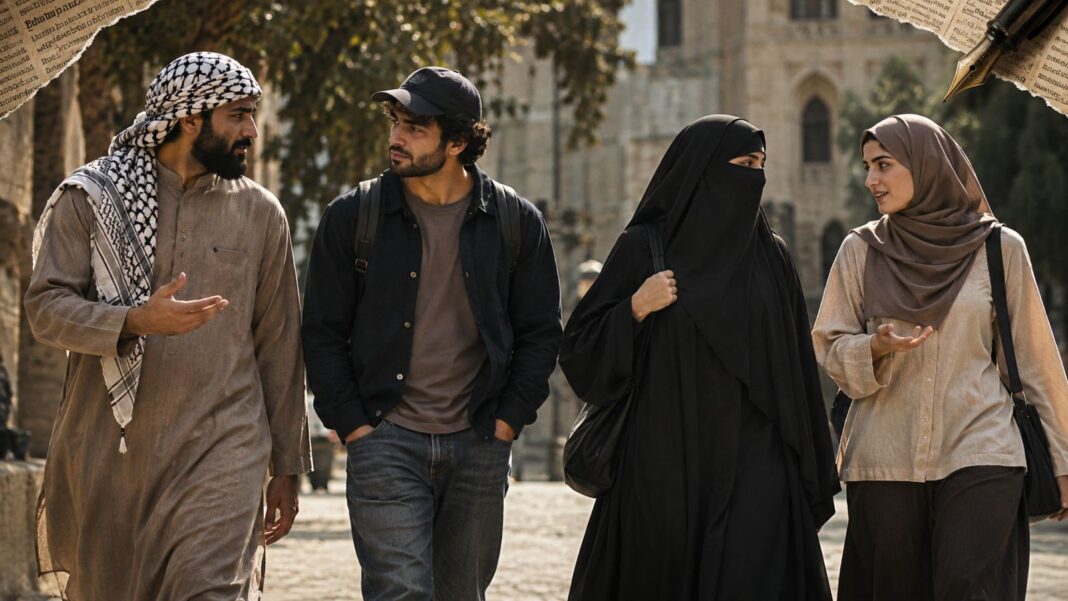

An online debate over the kurta, qamis and Islamic dress has brought an increasingly familiar tension within South African Muslim communities into focus, raising broader questions about Prophetic tradition, cultural identity and the tendency to judge religiosity by outward appearance: where does following the Sunnah end and cultural preference begin, and can the clothes a Muslim wears become a measure of their piety?
At the centre of the discussion are the kurta, qamis and topi, garments widely associated with Muslim men, particularly within South Africa’s Indian Muslim community. While some argue that these garments reflect the dress of Rasulullah ﷺ and should be encouraged as an expression of love for his Sunnah, others caution against presenting a particular style of clothing as though it were a universal Islamic uniform.
The original commentary, published under the heading Who Made the Kurta the Uniform of Islam?, challenged what its author described as a tendency within certain Muslim circles to regard men wearing trousers and shirts as somehow less religious than those dressed in traditional garments. The argument was not against wearing a kurta or topi but against attributing a degree of religious superiority to those who do. It maintained that Islam’s requirements concerning dress centre on modesty and covering the awrah, rather than prescribing one ethnic or cultural style for all Muslim men.
The commentary also questioned the consequences of allowing Indian cultural expressions to become synonymous with Islamic identity, particularly in a diverse South African Muslim society where Muslims of different ethnicities and backgrounds share religious spaces.
Recognising the virtue of Prophetic dress
However, the argument prompted a counter-perspective from Moulana Shakeeb of Perth, who cautioned against reducing the Prophetic manner of dress to an ordinary cultural preference. He pointed to the extensive narrations documenting the clothing of Rasulullah ﷺ, particularly those recorded in Imam al-Tirmidhi’s Shama’il Muhammadiyyah. Among these is the narration of Umm Salamah (RA), which identifies the qamis as the garment most beloved to the Prophet ﷺ.
He also highlighted the distinction between declaring a particular garment compulsory and recognising the virtue of adopting the clothing practices of Rasulullah ﷺ. From a Hanafi perspective, he further noted that certain aspects of dress carry specific considerations in salaah. Deliberately rolling up one’s sleeves during prayer, for instance, is regarded as makruh (disliked), while some scholars also consider short-sleeved clothing contrary to the proper etiquette of salaah.
His broader argument was that Muslims should not dismiss the Prophetic manner of dress simply because the garments were also part of the culture in which Rasulullah ﷺ lived.
He also introduced a historical dimension, arguing that British colonial influence in the Indian subcontinent contributed to the erosion of the dignity associated with traditional Muslim clothing. European dress was increasingly associated with refinement and social advancement, while traditional attire was made to appear backward or inferior. For him, wearing traditional Muslim clothing is therefore also an expression of pride in a religious heritage that should not be viewed as inferior to Western styles of dress.
Where culture and the Sunnah intersect
The debate subsequently drew a rebuttal from Shabir Moosa of Perth, who argued that the Sunnah cannot be separated from the cultural context in which it was practised simply because certain garments originated in Arab society. Referring to narrations concerning the wearing of white clothing and the instruction to distinguish oneself from non-Muslims, he argued that Prophetic guidance extended beyond the basic requirements of covering the awrah.
He cited narrations in which the qamis is identified as a garment frequently worn by Rasulullah ﷺ, maintaining that its significance within the Sunnah should not be dismissed as merely cultural. His central argument was that the Sunnah can be expressed through the cultural practices of a particular society while simultaneously transforming and regulating those practices through Prophetic guidance. In other words, the fact that a garment originated within a particular culture does not automatically strip it of its religious significance.
However, the original commentator clarified that his objection was not to Muslims adopting the clothing of Rasulullah ﷺ, nor to the religious significance attached to doing so. Rather, he was challenging what he described as an attitude within certain Hanafi Indian Muslim circles in South Africa, where traditional Indian Muslim dress can become an informal standard against which the religiosity of other Muslims is measured.
He warned that such attitudes risk creating divisions in an already diverse Muslim community, particularly in a country where questions of ethnic identity, migration and belonging have at times strained relations between different Muslim communities. The distinction, he maintained, is between encouraging Muslims to follow the Sunnah and creating the impression that those who dress differently are somehow lesser Muslims.
Can clothing be a measure of taqwa?
Seeking further clarity on the relationship between outward appearance and religious devotion, One Nation Media (ONM) asked Islamic theologian Mufti Yusuf Moosagie whether the way a person dresses determines their level of piety. His response drew a distinction between recognising the virtue of a particular choice of clothing and making assumptions about the spiritual standing of the person wearing it.
“Only Almighty Allah knows a person’s true level of taqwā,” he said.
He explained that clothing can serve as an outward expression of modesty and love for the Sunnah, and that Muslims can acknowledge the virtue of such a choice without passing judgement on an individual’s heart. Citing Surah al-Najm (53:32), Mufti Moosagie referred to the Qur’anic reminder: “He knows best who has taqwā.”
On the question of salaah, he encouraged Muslims to make a particular effort to adopt Sunnah dress and present themselves before Allah Ta’ala with dignity. Referring to Surah al-A’raf (7:31), he quoted the instruction: “Take your adornment at every place of prayer.” He added that people naturally give thought to their appearance when attending an occasion they consider important.
His comments reinforce the importance of recognising the value of Sunnah dress without assuming that outward appearance provides a complete picture of someone’s relationship with Allah.
The discussion nevertheless raises further questions about the practical application of Hanafi fiqh, particularly the distinctions between what is compulsory, recommended and disliked in the clothing worn during salaah. These rulings should not be conflated, as the virtue of adopting a particular garment is a separate question from the validity of one’s prayer.
Preserving the Sunnah without dividing the Ummah
Ultimately, there is a distinction between loving the clothing of Rasulullah ﷺ, encouraging others to follow his example and using a particular style of dress to assess another Muslim’s faith. Muslims should be able to take pride in the Sunnah, preserve their cultural heritage and encourage modesty without turning differences in clothing into divisions within the Ummah.
A kurta may reflect a person’s love for the Sunnah, but the garment alone cannot reveal what is in their heart. Taqwa is not something that can be conclusively measured by looking at someone’s wardrobe. That knowledge belongs to Allah (SWT).