
Opening the doors of its new centre in Bo-Kaap, the Islamic Propagation Centre International (IPCI) is seeking to continue the legacy of a renowned Islamic scholar while creating a welcoming environment for the community and tourists.
The IPCI was co-founded in 1957 by the late Sheikh Ahmed Deedat to present Islam in its pristine and original form to people of all faiths. The aims of the Islamic organisation are to empower communities through moral values, build bridges across faiths for greater understanding and present Islam comprehensively to people of all backgrounds.
Headquartered in Durban, the organisation has officially opened a centre in Cape Town’s Dorp Street, capitalising on the city’s popularity as a tourist destination. The centre is near the historic Auwal Masjid, South Africa’s oldest mosque, established in 1794.
Why Cape Town, why Bo-Kaap?
Head of Comparative Religion at the IPCI, Moulana Ismail Moosa, said that for many years, the IPCI had sought to establish a base of operations in the Western Cape and explained why Cape Town was specifically chosen.
He said: “One of the major driving factors behind this was that a lot of the da’wah that Sheikh Deedat used to do was directed at tourists. Those tourists would come to the oldest masjid in South Africa and one of the most significant masjids in the Southern Hemisphere.
“Many tourists would visit Durban CBD in the 80s and 90s when it was very different from what it is now. Over time, the state of the CBD has degenerated and Cape Town has become the hub of tourism,” he said.
“In order to replicate or continue the concept behind what Sheikh Deedat did, the IPCI decided to create a hub in the Western Cape.”
Moosa went on to explain that the project had continued for decades, with an initially rented site being closed down, followed by the rental of other premises, before a property was finally purchased at 56 Dorp Street — the same road as the Auwal Masjid.
According to Moosa, the Auwal Masjid continues to attract tourists every day, with tens, if not hundreds, passing by daily to see the first masjid established in South Africa. The property purchased by the IPCI is about 100 metres from the masjid, and the idea behind establishing a presence there is to serve several purposes.
A base for da’wah, a hub for tourists
Moulana Moosa said: “First, it is to speak to those tourists that visit the masjid. Second, to serve as a base of operations for da’wah and street da’wah activities, engaging church leaders, da’wah at universities, so literature and expertise can be sought from here.
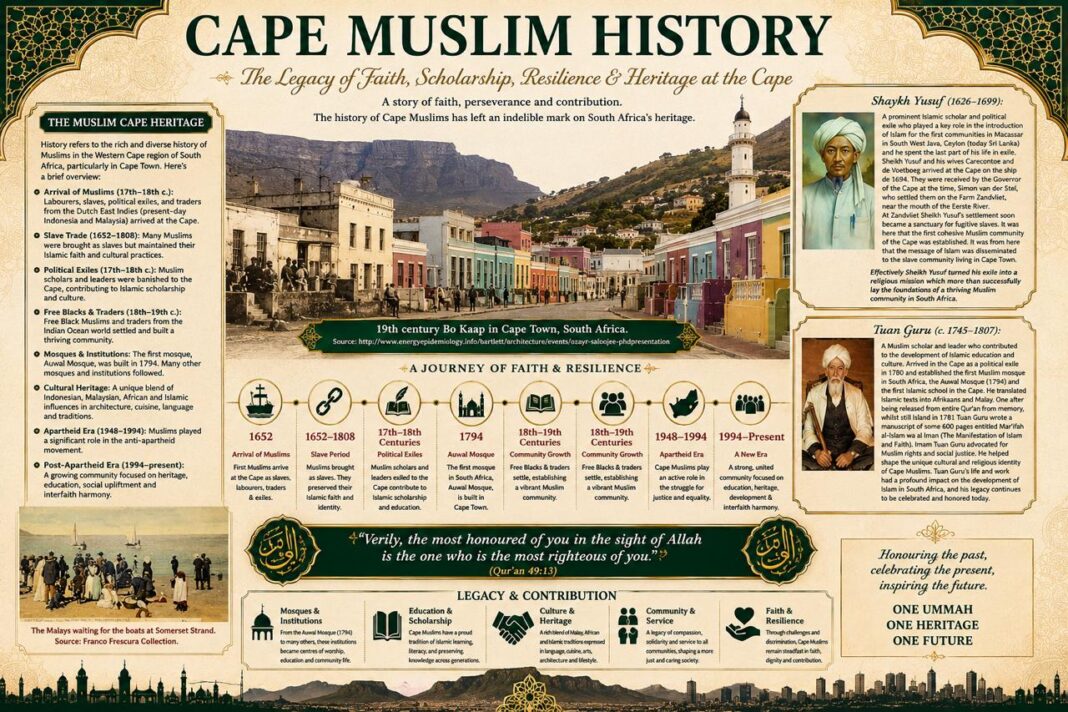
“Alhamdulillah, over the years this has manifested. The office in Dorp Street is now an exhibition centre in the sense that we have murals on the walls detailing the history of Muslims in Bo-Kaap, we have a wall about the history of Islam, also a da’wah wall, and these beautiful murals span the entire office and they form an exhibit that one can go through.
“What is so intriguing about this is that the Auwal Mosque, unfortunately because of various myriad factors, is generally closed except for salaah times, and many tourists are not able to see the masjid. But in the IPCI hub there is an Auwal Masjid wall that replicates what one would see in the Auwal Masjid — like the Qur’an that was handwritten by Sheikh Tuan Guru, as well as the small block of the initial bricks that were laid back then, and a nice picture of the inside of the masjid.
“This can all be seen in a life-sized mural on the wall at our office. With all of this, it automatically becomes a tourist hub,” he added.
Literature, guides and street da’wah
The centre also has a full-time da’i who conducts guided tours of the exhibitions and undertakes da’wah work.
Moulana Moosa said: “Then Alhamdulillah, we also managed to hire a da’i, who has been there for the last few months, someone who loves da’wah, who is there and loves to guide the tourists throughout the exhibition and to give them da’wah.”
“We have been getting dozens and dozens of tourists every month taking literature from us. The IPCI is stocked up with literature in different languages and we have Qur’ans in various languages such as German, Spanish, Russian, etc.,” he said.
“A team is currently running a da’wah street operation once a week with a few brothers of Cape Town. They are doing da’wah with church leaders and programmes at various universities, all of this basically taking place under the auspices of the IPCI office, which is serving as a base for all these things,” he explained.
Funded by the community, for the community
According to Moosa, the purchase of the property in Dorp Street was made possible after the IPCI sold a property that it had been renting out to generate income for a few years. The IPCI management saw the need for a base in Cape Town, which would operate on donations from the community. Any funds donated to the centre will go towards da’wah, literature and the upkeep of the centre.
Various Islamic leaders attended the official opening event, held on Friday. Moulana Moosa said: “We wanted to include the community in whatever we do because it is a hub for the community, so we invited key role players such as President of UUCSA Moulana Abdul Khaliq Ally and the President of the MJC Sheikh Riad Fataar and many others who have been involved in da’wah over the years.
“We thought the best way to get the community involved was to invite the key role players, for them to come and take it back to their organisations where they would inform their communities, insha’Allah,” he concluded.
From Durban to Dorp Street, from Sheikh Deedat’s legacy to a new generation of da’is — the IPCI’s new home in Bo-Kaap is not just an office. It is meant to be a place where a tourist can walk in curious and walk out with understanding.