
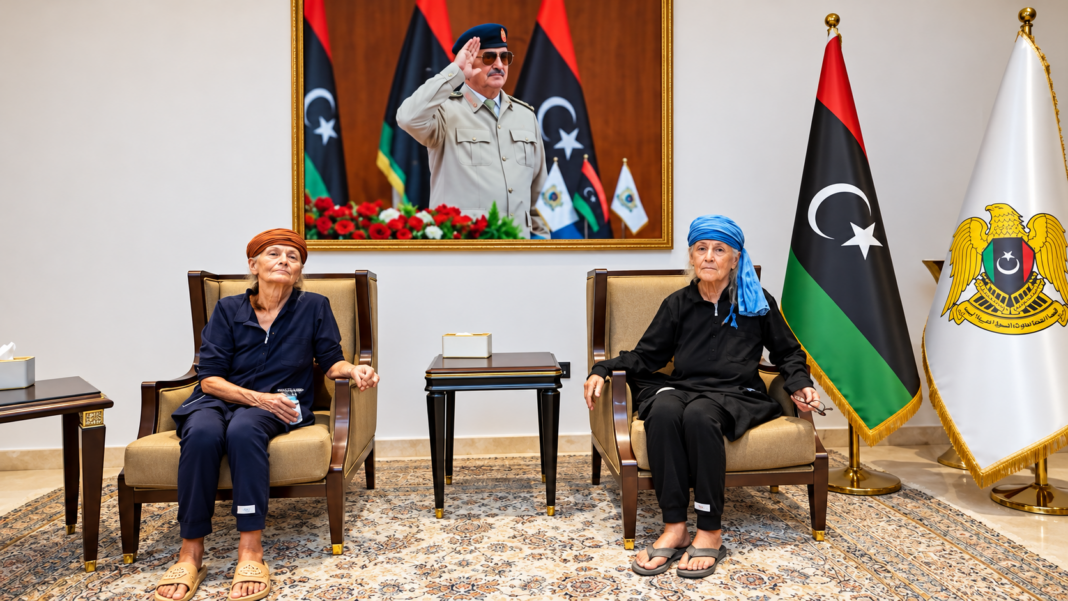

The release of two European women held hostage in the Sahel has raised questions over alleged multimillion-euro ransom payments, the United Arab Emirates’ possible involvement and the growing regional influence of Libya’s powerful Haftar family.
The release of Swiss national Claudia Abbt and Austrian national Eva Gretzmacher after prolonged captivity has offered a rare glimpse into the secretive world of hostage negotiations in the Sahel — and the regional power struggles surrounding them.
Abducted separately in Agadez, Niger, in 2025, the two women were believed to have been held by Islamic State’s Sahel affiliate (IS-Sahel), which operates across the tri-border region between Mali, Niger and Burkina Faso.

On 21 October 2026, they were freed and transferred to Benghazi in eastern Libya before returning to their respective countries the following day.
Their release followed extensive diplomatic efforts, with eastern Libyan military commander Khalifa Haftar and his son Saddam reportedly playing significant roles in securing their freedom.
According to sources familiar with the negotiations, the breakthrough was not the result of a single agreement, but months of stalled talks, competing demands and high-stakes mediation.
A deal that nearly fell apart
The Haftar camp reportedly attempted to secure the women’s release in September, but negotiations collapsed over disagreements concerning the terms of their freedom.
According to sources familiar with the discussions, the captors had initially agreed to release Gretzmacher while keeping Abbt in captivity.
The Haftar camp reportedly rejected the proposal as efforts continued to secure the release of both women.
Swiss authorities had established a task force involving police and intelligence personnel to support negotiations, while diplomatic efforts continued through regional and international channels.
The episode highlights how armed groups can use hostages as bargaining chips, with the outcome of negotiations depending not only on the captors’ demands but also on the influence and connections of those mediating.
The breakthrough reportedly came following renewed mediation involving Saddam Haftar, the field marshal’s son and an increasingly influential figure within eastern Libya’s security establishment.
The women were transferred from Niger to Libya before arriving in Benghazi, where they received medical attention and assistance from representatives of their respective governments.
The precise terms of their release, including any financial arrangements or guarantees, have not been publicly disclosed.
The mediator in the middle
A key figure in the negotiations was reportedly Malian intermediary Chérif Ould Taher, an influential figure with longstanding connections to trans-Saharan networks, armed groups and alleged drug-trafficking operations.
According to French newspaper Le Monde, Ould Taher has previously facilitated hostage negotiations involving armed groups operating in the Sahel.
His reported involvement highlights the reliance on informal networks that operate across national borders, connecting armed groups, smugglers, political figures and regional security establishments.
Such networks can provide access to captors beyond the reach of conventional diplomatic channels, but their involvement also raises questions about accountability, transparency and the concessions required to secure hostage releases.
The ransom question
The most sensitive aspect of the negotiations concerns allegations of substantial ransom payments.
According to Le Monde, sources familiar with the discussions claimed that the captors received multimillion-dollar payments allegedly financed by the United Arab Emirates (UAE), a longstanding ally and financial backer of the Haftar camp.
One source alleged that approximately $10 million was paid for each hostage, although neither the amounts nor the alleged UAE involvement has been independently verified or officially confirmed.
If substantiated, the payments would carry serious implications.
While they may have helped secure the women’s freedom, they would also raise concerns about the indirect financing of IS-Sahel, which has been responsible for deadly attacks and widespread insecurity across the region.
Ransom payments can provide armed groups with significant financial resources to sustain their operations while creating further


