

By Abdulrahman Abdulghany
Founder, Islam & Comparative Religion Academy (ICRA)
There are journeys that take you across geographical boundaries, and there are journeys that introduce you to histories, communities and opportunities whose significance extends far beyond the borders of the places you visit.
My recent visit to the beautiful island nation of Mauritius was certainly one of the latter.
As part of our wider Dawah engagement across Africa and beyond, our visit was an opportunity to connect with the Muslim community, engage with its leadership, appreciate its rich Islamic heritage and explore avenues for meaningful collaboration in strengthening Dawah on the island and throughout the wider Indian Ocean region.
Mauritius, an island nation in the Indian Ocean, covers approximately 2,040 square kilometres and has a population of about 1.24 million. It is a remarkable multicultural society, with Hindu, Christian and Muslim communities forming the principal religious groups.
Muslims constitute approximately 17–18% of the population and have a longstanding presence in the country’s social, commercial and religious life.
Yet perhaps one of the most fascinating aspects of Mauritius is that its connection with the Muslim world may be considerably older than many people imagine.
An island with an Arabic connection
Long before European colonial powers established their presence on the island, Arab navigators were already familiar with the wider Indian Ocean trade routes. Historical maps dating to around 1500 identify Mauritius by the Arabic name “Dina Arobi”.
This is a fascinating reminder of the navigational achievements and commercial networks of Muslim sailors who traversed these waters centuries ago.
The island subsequently came under Portuguese, Dutch, French and British influence. The Dutch gave it the name Mauritius in 1598, while the French later called it Île de France.
Its more recent history is equally significant. Mauritius became a major centre of the plantation economy, first relying heavily on enslaved Africans and subsequently on indentured labourers, particularly from the Indian subcontinent. Slavery was abolished in 1835, while the indentured labour system, which had begun in 1834, expanded considerably in the decades that followed.
The arrival and settlement of people from the Indian subcontinent contributed significantly to the formation of the Muslim community as we know it today. Muslim traders and merchants, including those with connections to Bengal and other parts of the Indian subcontinent, also contributed to the development of the community through commerce and trade.
The early establishment of mosques and Islamic institutions provided the foundations upon which subsequent generations would build. Among the mosques associated with the island’s early Muslim history is Masjid Al-Aqsa, remembered in the community’s historical narrative.
Today, Mauritius is home to more than 300 mosques, according to community estimates, with many incorporating Madrasah Islamiyyah programmes. Qur’anic instruction, Islamic studies and the teaching of Urdu have historically featured prominently in these institutions. The prominence of Urdu is understandable when one considers that much of the Islamic educational literature historically available to the community was published in that language.
This heritage is something worth appreciating and preserving. It is also a foundation upon which the next generation of Islamic education and Dawah can be developed.
A warm reception and meaningful engagements
Our visit was hosted by The Blue Crescent Society, whose hospitality and commitment to the Muslim community made our stay particularly memorable.
I wish to express my sincere appreciation to Sheikh Goolam Mohammud, Sheikh Bashir and Brother Faizal Jamalkhan for their warm reception, generosity and excellent arrangements throughout our visit. Their efforts made it possible for us to engage with a broad spectrum of the Mauritian Muslim community and its leadership.
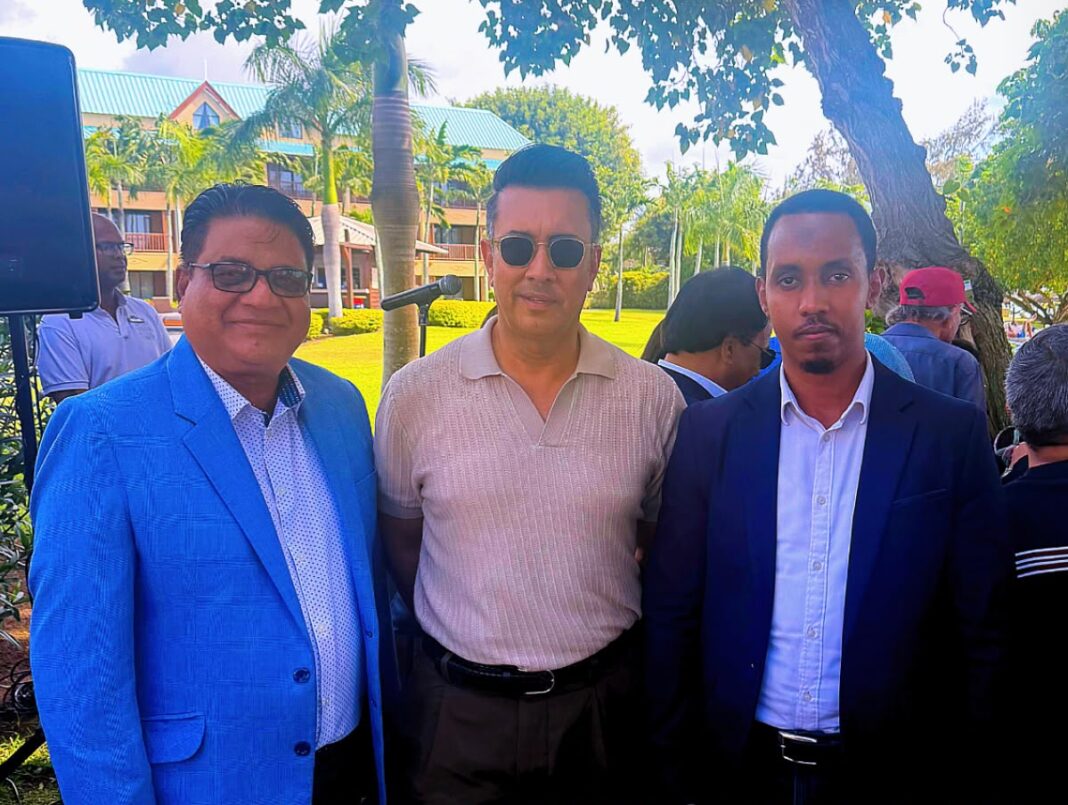
During our stay, we had the opportunity to meet religious leaders, Muslim professionals, institutional representatives and political leaders. Among the notable engagements was our meeting with the Honourable Shakeel Mohamed, GCSK, Minister of Housing and Lands of the Republic of Mauritius.
We also engaged with Hisham Rafik Rojoa, President of the Islamic Cultural Centre (ICC) Mauritius, Sheikh Bashir, representing Religions for Peace and the Interfaith Alliance, and members of the leadership of the Council of Religions.
These engagements were important because Dawah cannot operate in isolation from the broader realities of the communities it seeks to serve. Building relationships with religious institutions, civic leadership and other stakeholders creates opportunities for cooperation, mutual understanding and sustainable community development.
We also had the privilege of meeting local imams, delivering lectures at mosques and conducting Dawah training sessions at Quran House. These engagements allowed us to interact directly with people at the grassroots level, exchange experiences and discuss practical approaches to strengthening Islamic outreach.
Media engagements
An important component of our mission was engaging with the media and ensuring that the work being undertaken by the Muslim community received wider visibility.
Alhamdulillah, we were interviewed on Channel News Mauritius by journalist Tariq, where we had an opportunity to discuss our mission, the importance of Dawah and the prospects for greater cooperation between Islamic organisations.
Our mission in Mauritius was also featured prominently on the front page of The Star newspaper, bringing considerable visibility to our outreach and the work of ICRA.
We are grateful for these opportunities. Media engagement is an important instrument in communicating the message of Islam, highlighting constructive contributions by Muslim organisations and drawing attention to initiatives that deserve wider recognition.
Alhamdulillah, the reception was encouraging, and we were pleased to see the mission receive such attention.
The Blue Crescent Society: An institution with a vision
One of the most encouraging aspects of our visit was learning more about the work and achievements of The Blue Crescent Society.
Under the leadership of Sheikh Goolam Mohammud, the organisation has contributed to several important initiatives within the Mauritian Muslim community.
Among its notable achievements was hosting what is regarded as the country’s first Qur’an competition in November 1999, an initiative that helped promote Qur’anic learning and appreciation among the younger generation.
The organisation has also pursued institutional recognition for its humanitarian and community work, including an initiative seeking parliamentary recognition and a status comparable to that accorded to UNICEF. This reflects an ambition to establish stronger institutional foundations for humanitarian service.
Sheikh Goolam has also been instrumental in establishing the Muslim Chamber of Commerce, an initiative aimed at bringing Muslim entrepreneurs together, strengthening commercial relationships and encouraging cooperation within the business community.
This is an important concept. Muslim institutions must not only consider religious programming but also explore how their communities can become economically organised, socially influential and institutionally sustainable.
Despite the impressive number of mosques, Islamic institutions and community initiatives on the island, one concern became increasingly apparent during our engagements: the tendency of Islamic organisations to operate independently, often with limited coordination and collaboration.
This is not a challenge unique to Mauritius. It is one that we encounter in many parts of the Muslim world, particularly across Africa.
We have organisations with committed leadership, knowledgeable scholars, dedicated imams, financial
Abdulrahman Abdulghany is the founder of the Islam & Comparative Religion Academy (ICRA).


