
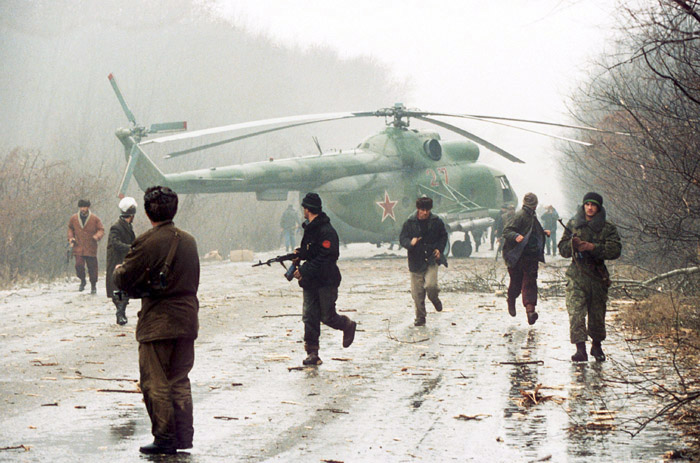

An armed resistance commander in Chechnya has vowed to continue the struggle against Russian occupation following the killing of Islamic preacher Turpal-Ali Mezhidov by security forces loyal to Moscow-backed leader Ramzan Kadyrov. Moulana Usamah Dockrat examines the resurgence of armed resistance, the Kadyrov family’s betrayal of Chechen independence and the enduring struggle to end Russian rule.
The statement, circulated online, comes amid renewed security operations across the republic and growing questions over whether an organised armed resistance is re-emerging after years of intense repression.
The commander, identified only as an Amir operating inside Chechnya, said that Mezhidov’s death had raised questions among Chechens about the future of the resistance, prompting him to address the population.
He expressed condolences to Mezhidov’s family, describing him as a martyr, and insisted that his death should not be interpreted as the end of the struggle.
The commander claimed that several dozen resistance members remained active across Chechnya, despite attempts by the authorities to identify and apprehend them.
He maintained that the resistance had established internal security arrangements designed to prevent the identification of one member from exposing others, allowing its members to remain undetected despite widespread searches.
According to the commander, the authorities had become increasingly concerned about the presence of resistance members, offering substantial financial rewards for information and promising amnesty to those willing to surrender.
He rejected these offers, declaring that the resistance had no intention of surrendering or abandoning its objective of ending the Russian occupation of Chechnya.
The killing of Turpal-Ali Mezhidov
On 19 October 2026, 36-year-old Turpal-Ali Mezhidov, an Islamic preacher from Gudermes, was killed following an armed confrontation with security forces.
Mezhidov was known locally for his Islamic studies, religious preaching and work accompanying Chechen pilgrims to Makkah and Madinah.
According to reports, security personnel had attempted to apprehend him earlier that day. When they failed to find him at home, they allegedly ordered him to report to the authorities and subsequently circulated a wanted notice.
Later that evening, Mezhidov encountered security forces at a checkpoint in the Chernorechye area on the outskirts of Grozny.
A shootout followed, during which several officers were reportedly wounded. Reports claimed that some security personnel had been killed, although this has not been independently confirmed.
Mezhidov escaped the initial confrontation but was subsequently pursued into the Kurchaloy district, where security forces surrounded and killed him.
Opposition sources alleged that Mezhidov had previously been subjected to abduction and torture by the authorities, portraying the confrontation as the culmination of longstanding persecution.
For three days, Chechen authorities provided little official information about the incident.
On 22 October, Ramzan Kadyrov acknowledged the operation, announcing that one suspected militant had been killed and another detained. His administration alleged that the suspects were connected to earlier sabotage activities and plans to attack security installations.
The incident marked the first armed confrontation officially acknowledged by the Chechen authorities since April 2025.
The subsequent security response included searches, heightened security deployments and threats against those accused of assisting the resistance.
Zamid Chalaev, commander of a Chechen special police regiment, offered a reward of $100,000 for information about wanted individuals.
Kadyrov also threatened collective responsibility for relatives of those involved in armed opposition, reflecting a longstanding practice of using pressure against families to suppress dissent.
Resistance commander outlines plans to continue the struggle
In his address, the Chechen commander maintained that Russia’s apparent control over the republic should not be mistaken for the disappearance of resistance.
He revealed that during the security mobilisation following Mezhidov’s confrontation, some resistance members had wanted to engage the forces deployed across Chechnya, but their commanders had refused permission.
He explained that the resistance’s current capabilities were insufficient for a direct military confrontation and that it had instead adopted a strategy centred on sabotage attacks.
While claiming that the resistance was making progress, he acknowledged that its forces were not yet strong enough to decisively challenge Russian control. Further organisation, preparation and training were necessary before it could expand its activities.
The commander also criticised the authorities for pressuring Chechens into military service and sending them to fight Russia’s war in Ukraine. He alleged that many of those deployed suffered heavy casualties.
He warned that continued submission to Moscow threatened not only Chechnya’s political independence but also its Islamic identity, religious practices and traditional way of life.
Calling on Chechens not to remain passive spectators, he argued that the population had a religious responsibility to support the struggle and not repeat what he described as past failures to assist resistance fighters.
Invoking Qur’an 4:75, which speaks of fighting in defence of oppressed men, women and children, he stated that resistance to Russian rule was a religious obligation tied to protecting the vulnerable.
The commander also cited a Prophetic narration warning against abandoning jihad and becoming preoccupied with worldly pursuits, arguing that the humiliation of the Chechen population would continue so long as Russian domination remained unchallenged.
Despite acknowledging the resistance’s limited present capabilities, he expressed confidence that victory would eventually be achieved, although he warned that the struggle would involve further casualties and setbacks.
He concluded by asserting that the delay in achieving independence was not primarily the result of Russian strength, but what he regarded as insufficient action on the part of the Chechen population.
The statement reflects the continued existence of a section of Chechen opposition that rejects Moscow’s authority altogether, rather than merely seeking reforms within the Russian political system.
Chechnya’s long struggle against Russian domination
Chechnya’s confrontation with Moscow stretches back centuries, with successive generations resisting Russian attempts to bring the predominantly Muslim North Caucasus under its control.
During the nineteenth century, Chechen fighters formed an important part of the resistance led by Imam Shamil, whose Islamic state in the Caucasus fought Russian imperial expansion for decades.
The struggle re-emerged following the collapse of the Soviet Union in 1991, when Chechnya declared independence under Dzhokhar Dudayev.
Russia refused to recognise its independence and launched a full-scale invasion in December 1994.
Despite Russia’s overwhelming military superiority and the devastating destruction of Grozny, Chechen resistance forces eventually compelled Moscow to withdraw in 1996.
The victory proved temporary.
In 1999, Russia launched a second war, bringing Chechnya back under Moscow’s authority through a campaign that devastated much of the republic and resulted in extensive civilian suffering.
Although large-scale fighting eventually subsided, armed resistance continued for years, with various Chechen groups maintaining their opposition to Russian rule.
The Kadyrov family’s betrayal of Chechen independence
Central to Russia’s consolidation of control was the defection of Akhmat Kadyrov, father of the republic’s current ruler.
Akhmat had served as Chechnya’s Mufti and supported the independence struggle during the First Chechen War. However, when Russia launched its second invasion in 1999, he abandoned the opposition and aligned himself with Moscow.
The Kremlin subsequently installed him as head of the Chechen administration, allowing Russia to rely increasingly on local Chechen forces to suppress the very independence movement he had previously supported.
Following Akhmat’s assassination in 2004, his son Ramzan inherited the family’s political and military influence, eventually becoming Chechnya’s leader in 2007.
Under Ramzan Kadyrov, Chechnya has remained firmly aligned with Moscow, while his security forces have been repeatedly implicated in torture, enforced disappearances, extrajudicial killings and collective punishment against opponents.
Human rights organisations have documented how the Kadyrov administration has systematically suppressed dissent, often targeting the relatives of suspected resistance members.
The Kadyrov family’s transformation from participants in the Chechen independence struggle to the principal enforcers of Russian authority is regarded by supporters of Chechen independence as one of the defining betrayals in the republic’s modern history.
It has allowed Moscow to maintain its control through a local ruling elite, while many of those who continue to demand independence face imprisonment, exile or death.
Renewed resistance raises questions about Russian control
The latest address from inside Chechnya challenges the image of a republic in which opposition to Russian rule has been completely extinguished.
While the extent of the alleged resistance network remains uncertain, the October confrontation and subsequent security response indicate that the authorities continue to regard armed opposition as a threat.
For the Chechen commander, the struggle is not simply about removing the Kadyrov administration, but about ending Russian domination and restoring Chechnya’s independence and Islamic identity.
More than three decades after Moscow launched its first post-Soviet invasion, Chechnya remains under Russian control, maintained in significant part through the Kadyrov family’s security apparatus.
The latest statement suggests that despite years of repression and the loss of many of its fighters, elements of the Chechen resistance are seeking to regroup and rebuild their capabilities. While their current strength remains uncertain, the commander’s remarks indicate an intention to reorganise and continue the struggle against Russian rule, with the eventual aim of ending Moscow’s control over Chechnya.