
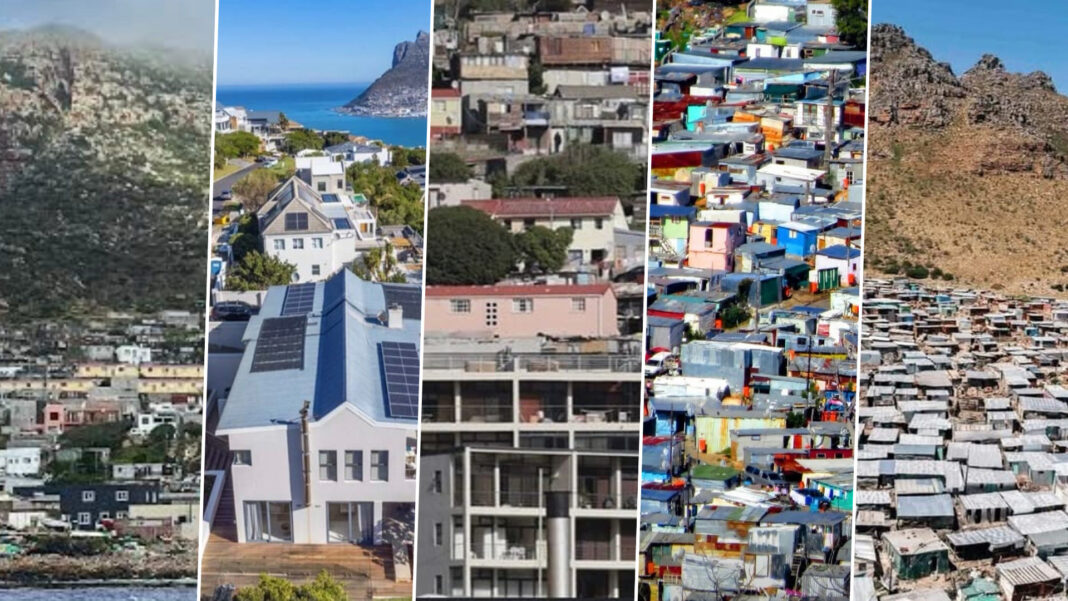

In picturesque Hout Bay, land acquired in 2018 to provide housing for approximately 1,400 poor families remains undeveloped, while working-class communities occupy less than 5% of the area, according to a local community leader.
Hout Bay is one of South Africa’s most picturesque coastal communities. A postcard scene of white yachts in a bustling harbour, fresh snoek on the braai, Chapman’s Peak Drive winding above the Atlantic, and tourists queuing for fish and chips against a spectacular mountain backdrop.
Yet it is also one of the country’s starkest examples of inequality — and, activists argue, evidence that the legacy of spatial apartheid remains deeply entrenched in DA-governed Cape Town.
On one side of the valley stand multimillion-rand homes, private security and wide streets in areas historically reserved for whites. On the other are Hangberg, home to coloured fishing families, and Imizamo Yethu, home to black African families — densely populated, overcrowded and fire-prone communities that occupy less than 5% of Hout Bay’s land, according to a local community leader.
Residents are still waiting for housing opportunities announced in 2021.
According to an August 2021 Western Cape government statement, land had been acquired to provide housing opportunities for approximately 1,400 families from Hangberg and Imizamo Yethu.
The land is situated in the affluent Valley area, historically reserved for whites, and the housing project was scheduled to begin in 2023. More than three years later, no housing has materialised on the acquired land.
Roscoe Jacobs, a former secretary of the Hout Bay Civic Association, former member of the South African Police Service (SAPS) Community Policing Forum and now an ANC ward councillor candidate in today’s municipal elections, believes the delay is political.
“The land acquired is in the Valley area, it is the first time that land in Hout Bay was made available for purchasing for the poor and working class people of Hangberg and Imizamo Yethu Township,” Jacobs said.
He explained that the land was purchased through an intergovernmental process involving all three spheres of government and the affected communities.
Four parcels of land, totalling almost eight hectares, were purchased in 2018 by the Housing Development Agency (HDA) — the national public entity responsible for identifying, acquiring and developing land for human settlements — and transferred to the Western Cape Department of Human Settlements.
The acquisition followed sustained community pressure. In 2018, after a devastating shack fire in the area, Jacobs embarked on a hunger strike and called on the President to intervene. He believes his protest helped secure the land purchase.
“In 2023, the housing project was supposed to kick, the Western Cape MEC for Human Settlement and the City’s Human Settlements Councillor made the announcement that the land was purchased for housing opportunities but to date that land has still not been utilised for the intended purpose of what it was purchased, there has not been any movement,” Jacobs said.
“We the poor and working class, the people of colour could not reside there on that land previously. The land was earmarked for housing opportunities but it seems like there is not any political will to address the apartheid spatial legacy that is very much visible and evident in Hout Bay.”
Jacobs accused the DA, which he says has governed the Hout Bay ward for 26 years, of failing to dismantle the area’s entrenched racial and spatial divisions.
“Hout Bay is very much a microcosm of the legacy of apartheid within South Africa in its current state,” he said.
“We have coloured people living in one corner of Hout Bay, we have the black African people in another corner and then we have the white people that are living on the majority of land in Hout Bay. Over the years, it might have changed a bit through the growth of opportunities that people might have seized, that might have changed a little bit but it has not really changed in terms of as racial demographics.”
According to Jacobs, the concentration of working-class communities on a fraction of Hout Bay’s land has contributed to overcrowding, crime, informal economic activity and recurring shack fires.
“So as the poor and working class communities, I am of the view that we live on less than five percent of the land in Hout Bay, these are in the majority African and coloured people and as a result of this, we have crime and the negative economy thriving within Hangberg and the township of Imizamo Yethu, as well as shack fires.”
He argued that the proposed housing development would not only ease overcrowding but also create jobs, develop skills and stimulate economic activity.
“It is my view that the new housing opportunities will ease the burden in the areas that are densely populated and it will create economic opportunities through the infrastructure and many would be able to be skilled on that project. To my knowledge since the DA has been governing Hout Bay they have only built or provided 72 housing opportunities in Hangberg.”
Jacobs also suggested that resistance to changing Hout Bay’s historical settlement patterns remains an obstacle to meaningful transformation.
“We still very much have people in Hout Bay Valley that still believe that the status quo must remain. We need to break down the spatial apartheid planning and its legacy in Hout Bay so that we can be an example, if we get this right, we can be the blue print to other areas in South Africa.”
City unsuitable ground conditions and revised housing plans
The City of Cape Town has defended the pace of its housing development programme, citing unsuitable ground conditions, revised construction plans and outstanding infrastructure approvals.
The City’s Mayoral Committee Member for Human Settlements, Councillor Carl Pophaim, said the Phase 3 housing project was no longer being pursued as a Community Residential Units (CRU) development after ground conditions were found to be unsuitable.
“This project has subsequently been handed over to Informal Settlements which is currently in the planning phase for a larger alternative building technology (ABT) project which will yield increased opportunities. This is in conjunction with an NGO which will be constructing these units,” he said.
“We are currently awaiting land use approval to upgrade the stormwater infrastructure to accommodate this development.”
Pophaim insisted that the City was committed to delivering housing as quickly as possible but maintained that the necessary planning and regulatory processes could not be bypassed.
“The City has experienced project teams who are committed and execute projects in the fastest time possible, meeting all requirements. We want to see our projects being successfully completed and our qualifying beneficiaries move into their new homes. Community cooperation and support is key to completing projects within the fastest practical time possible.”
For the families of Hangberg and Imizamo Yethu, however, the contrast remains stark.
Beyond their overcrowded neighbourhoods lie some of Cape Town’s most exclusive properties and valuable land. Yet eight years after land was acquired to help address their housing needs, the promise of homes — and a meaningful break from apartheid-era spatial divisions — remains unfulfilled.


