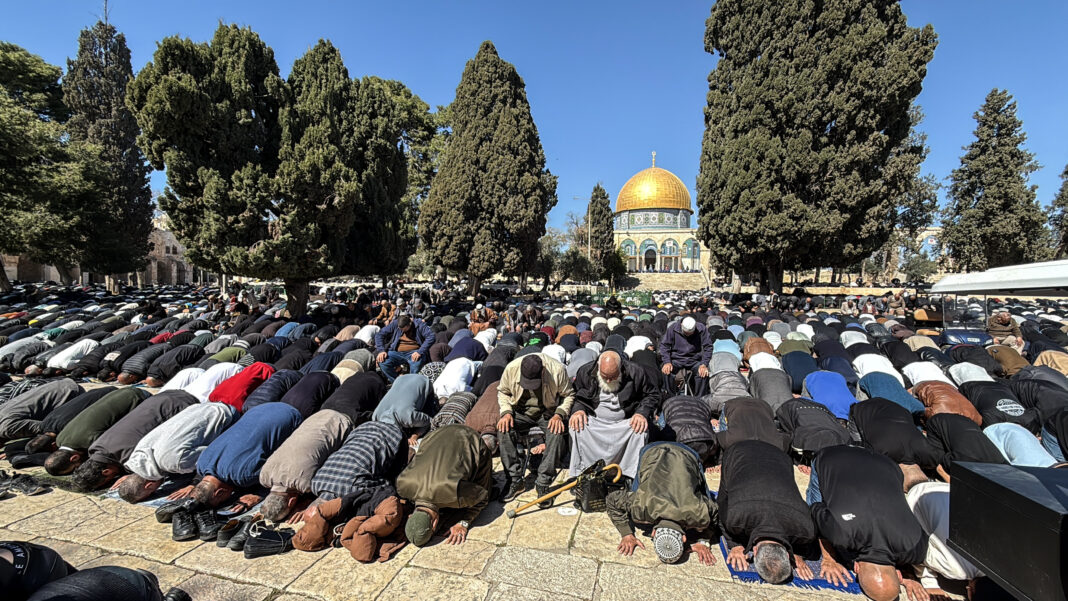

The struggle over Masjid Al-Aqsa is increasingly extending beyond the daily incursions by Israeli settlers, with growing concerns over the erosion of Muslim administrative authority, restrictions on the Islamic Waqf and physical changes taking place within and beneath the sacred sanctuary.
Speaking to One Nation Media (ONM), Dr Ismail Adam Patel, founder and chair of Friends of Al-Aqsa, warned that international media coverage often overlooks a more significant development: the gradual transfer of practical control over the sanctuary from the Islamic Waqf to Israeli authorities.
“The question is no longer only how many Israelis entered on a given day, but who practically is running al-Aqsa. Step by step, the answer is becoming the Israeli occupying forces,” he said.
Erosion of Muslim administrative authority
The Jordanian-backed Islamic Waqf, which administers the sanctuary, is facing mounting restrictions. Patel said Israeli authorities had cancelled the entry permits of around 30 long-serving Waqf employees, including the senior treasurer who co-signs its cheques. He said Israeli forces had also broken into and emptied four Waqf facilities within the compound, including the Dome of Imam al-Ghazali and Dar al-Hadith.
Restoration work at the Bab al-Rahma prayer hall has been blocked, while even basic maintenance, including pruning trees and clearing vegetation, is restricted. Waqf guards have reportedly been banned, assaulted and held in administrative detention. Al-Aqsa Imam Sheikh Ekrima Sabri and the Grand Mufti have also been barred from the sanctuary.
Patel further highlighted changes to prayer arrangements within the compound, warning that practices previously prohibited are increasingly being accommodated by Israeli authorities. Prayer sheets have reportedly been permitted since January 2026, followed by full prayer books in August. Collective prostrations, the Priestly Blessing and Israeli flags have also appeared in the eastern courtyards.
“These are not separate incidents. They follow the sequence that ended Muslim control of the Ibrahimi Masjid in Hebron: entry, then prayer, then time-sharing, then division, then the transfer of administrative authority,” Patel warned.
Restrictions above ground, excavations below
Access restrictions have also intensified. According to Patel, entry hours for Israelis now extend to six and a half hours daily, compared with approximately three hours in 2008. Palestinians, meanwhile, face the confiscation of identity documents, exclusion orders and restrictions on entering the sanctuary. Patel said more than 1,000 exclusion orders had been issued this year.
Beneath the compound, excavations and tunnels are another source of concern. Patel said at least 64 excavations and tunnels had been counted beneath and around the sanctuary, including a tunnel of approximately 550 metres running from al-Buraq Plaza towards Jaffa Gate. Palestinian officials have warned that structural damage and cracks resulting from excavations could threaten parts of Al-Aqsa.
With Hanukkah approaching, which runs from 4 to 12 December 2026, Patel identified several developments to watch, including the possible lighting of Hanukkah candles or a menorah inside the sanctuary, further restrictions on Waqf maintenance, extended entry hours and attempts to undermine Jordanian custodianship.
He cautioned against Israeli authorities intervening to carry out repairs while simultaneously preventing the Waqf from maintaining the sanctuary.
“Whoever repairs a building claims to own it,” he said, drawing parallels with developments at the Ibrahimi Masjid in Hebron.
Preserving Al-Aqsa’s Islamic identity and heritage
However, Patel believes the struggle over Al-Aqsa cannot be understood exclusively through political developments and security restrictions. The preservation of its Islamic history and heritage is equally important, particularly for younger generations.
He expressed concern that many young Muslims do not understand that Masjid Al-Aqsa refers to the entire 144-dunam sanctuary, rather than only the grey-domed Qibli prayer hall or the golden Dome of the Rock.
“In fact, it is the entire 144-dunam sanctuary: the courtyards, gates, domes, schools, wells and trees are all part of al-Aqsa masjid,” he explained.
This distinction is significant because, according to Patel, attempts to justify Jewish prayer within the compound rely on treating its courtyards as spaces outside the masjid. He also highlighted Al-Aqsa’s historical role as a centre of Islamic scholarship and learning, recalling the scholars who taught and wrote within its precincts for centuries. The Dome of Imam al-Ghazali, one of the facilities reportedly emptied by Israeli forces, represents part of this intellectual heritage.
Through his book, Masjid Al-Aqsa: Treasures of the Holy Sanctuary, and youth initiatives such as the Aqsa Explorer mission, Patel hopes to deepen understanding of the sanctuary through its history, architecture and Islamic significance.
The responsibility of the media
He believes local media organisations have an important responsibility, urging journalists to use accurate terminology, publish heritage features alongside breaking news, profile young people learning about Al-Aqsa and create opportunities for scholars and historians to educate audiences.
The challenge extends beyond historical education. Patel warned that repeated reporting of incursions and restrictions can eventually desensitise audiences, particularly when every development is presented as an isolated incident.
“Desensitisation happens when every story looks like the last one. ‘Settlers storm Al-Aqsa’ is accurate, but after the hundredth headline it reads like the weather,” he said.
Instead, he called for reporting that identifies patterns, documents changes and connects developments to the people affected. He also encouraged journalists to draw on credible Israeli sources and official statements where available, ensuring that reporting is properly documented.
Keeping Al-Aqsa alive in public consciousness
Initiatives such as Friends of Al-Aqsa’s Palestine Awareness Week, running from 23 to 29 November 2026, provide an opportunity to sustain public engagement. Patel also highlighted Global AqsaWeek and the #LoveAqsa campaign, which seek to reconnect communities with the sanctuary’s beauty, history and religious significance.
Ultimately, Patel believes keeping Al-Aqsa alive in public consciousness requires more than expressions of solidarity when another raid or restriction makes headlines. It demands consistent education, responsible journalism, historical awareness and sustained community engagement.
“A community that knows its heritage will defend it. Our task is to make sure the next generation knows what it is defending,” he said.