

By Mxolisi Ncube
Suspicions are mounting that political opportunists and organised groups are exploiting anti-migrant sentiment to destabilise South Africa ahead of the November 4 local government elections, following violent unrest in Soweto and Durban that left dozens injured or displaced and businesses destroyed.
The latest violence, which erupted on October 8, left at least 79 people displaced and 14 injured, according to the African Diaspora Forum (ADF), which represents migrant communities from more than 35 African and East Asian countries.
The unrest saw shops looted and set alight, vehicles torched and foreign nationals forced to flee their homes and businesses. Those affected reportedly include Zimbabweans, Malawians, Somalis, Ethiopians, Bangladeshis, Mozambicans and Basotho.
The violence has intensified concerns that xenophobic mobilisation is being fuelled not only by public anger over irregular migration, but also by misinformation, political opportunism and potentially organised criminal activity.
The ADF has warned that a possible “third hand” may be exploiting tensions for political gain as South Africa prepares to vote in less than a month.
ADF Secretary for Media and Publicity Bongani Mkwananzi condemned the attacks, warning of their devastating consequences for migrant families and communities.
“Behind every looted shop is a family whose livelihood may have been destroyed and behind every displaced person is a human being entitled to dignity and protection,” he said.
“No one should be attacked or deprived of their livelihood because of their nationality.”
Asylum ruling fuels misinformation
The latest violence follows controversy surrounding a Constitutional Court ruling and a subsequent Department of Home Affairs directive governing access to South Africa’s asylum system.
The directive, which was subsequently withdrawn, sought to implement a court ruling preventing authorities from refusing to consider asylum applications solely because applicants had entered the country unlawfully.
However, misleading claims circulating on social media and within communities suggested that the ruling automatically legalised undocumented migrants, granted them refugee status and entitled them to identity documents, social grants and government-built housing.
The government has rejected those interpretations, stressing that asylum applications remain subject to individual assessment and that applicants are not automatically granted legal status or residency.
Mkwananzi warned that deliberate misinformation was being weaponised to turn communities against foreign nationals, particularly by political formations campaigning on anti-migrant platforms.
“Government must not underestimate the consequences of poor public communication,” he said.
“Whenever a court ruling or administrative directive affects migration processes, the relevant departments must explain clearly what it means, what it does not mean and how it will be implemented.”
He warned that inadequate communication allowed misinformation to flourish, deepening resentment and exposing vulnerable communities to violence.
Political opportunism and organised criminality
Beyond the confusion surrounding asylum regulations, the ADF identified poverty, unemployment, inequality and poor service delivery as underlying sources of public frustration.
However, it warned that migrants were increasingly being scapegoated for broader economic and governance failures.
The timing of the violence, just weeks before the November 4 municipal elections, has raised suspicions that political actors may be exploiting anti-migrant sentiment to mobilise support and inflame tensions.
The ADF has also called for investigations into allegations that criminal groups are exploiting xenophobic mobilisation to loot businesses, intimidate traders and engage in extortion.
Mkwananzi criticised what he described as the contradiction of promoting African unity while encouraging hostility towards fellow Africans.
“Unemployment cannot justify xenophobia, poor service delivery cannot justify arson, and frustration with government cannot justify the destruction of another person’s livelihood,” he said.
He also questioned the police response, citing reports of delayed interventions and alleged failures to protect vulnerable communities.
“The ADF is concerned by reports of delayed responses and alleged failures to intervene. Such reports must be investigated transparently,” he said.
“Where threats and mobilisation are known in advance, law enforcement must use available intelligence to prevent attacks before lives and livelihoods are lost.”
The organisation stressed that the South African Police Service has a responsibility to protect everyone, regardless of nationality or immigration status.
It also warned that the withdrawal of the Home Affairs directive should not be interpreted as a victory for intimidation or mob pressure, insisting that disputes over court rulings and government policies must be resolved through lawful processes.
ActionSA accused of exploiting anti-migrant sentiment
The increasingly charged political climate has also drawn criticism from News24 Editor-in-Chief Adriaan Basson, who accused opposition party ActionSA of campaigning on what he described as “foreigner hate”.
In posts on X, Basson highlighted the party’s declining electoral support in Johannesburg, where it secured 16% of the vote in 2021 but was polling at just 7% ahead of the upcoming elections.
A polling graphic shared by Basson showed the Democratic Alliance (DA) leading projected turnout in Johannesburg with 29.2%, followed by the African National Congress (ANC) on 22.6%, MK Party on 12.3%, the Economic Freedom Fighters (EFF) on 11% and ActionSA on 7%.
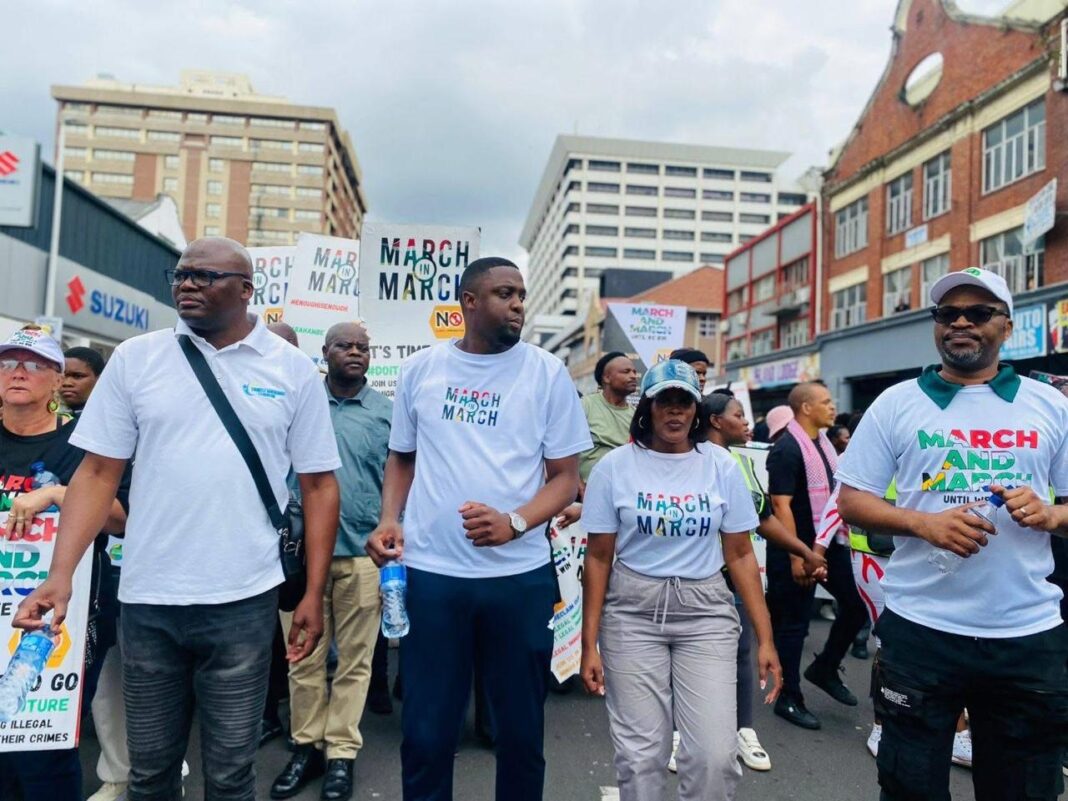
Basson also criticised ActionSA’s association with March and March leader Jacinta Ngobese-Zuma, accusing the party of courting the endorsement of a controversial anti-migrant activist.
He described Ngobese-Zuma as a “xenophobic, hateful, anti-democratic ringleader (and tenderpreneur)” and hinted at an impending News24 investigation into her financial backing.
“Tik-tok. Only a few hours to go before we tell you how Jacinta is funded,” he wrote.
His criticism followed reports that News24 journalist Khaya Sibulele Koko had received more than 100 hostile calls and death threats after Ngobese-Zuma allegedly published his telephone number on social media.
One threatening WhatsApp message reportedly read: “I’ll hunt you. And I will find you, I’ll make an example of you.”
News24 subsequently served Ngobese-Zuma with a letter of demand, while media freedom organisations condemned the alleged doxxing and intimidation.
Basson also challenged the portrayal of undocumented migrants as South Africa’s greatest problem.
“Don’t let anyone tell you illegal immigrants is the biggest issue in SA. It’s simply untrue,” he wrote.
Calls for urgent government intervention
Amid fears of further unrest, the ADF has called for coordinated government intervention to protect vulnerable communities and prevent another wave of xenophobic violence.
Its demands include stronger preventive policing, investigations into those responsible for organising and carrying out attacks, and humanitarian assistance for displaced people regardless of their nationality or immigration status.
The organisation also urged the Inter-Ministerial Committee on Migration to launch a sustained public information campaign addressing misconceptions about the Constitutional Court ruling and asylum procedures.
It called for greater involvement from diplomatic missions and meaningful dialogue between South African communities and migrant populations to address growing hostility.
“The Africa Diaspora Forum’s position is clear: migration must be managed through lawful processes, public policy must be communicated honestly, and the law must protect everyone equally,” Mkwananzi said.
With South Africa approaching a closely contested municipal election, the organisation warned that failure to confront misinformation, political opportunism and organised violence could deepen divisions and trigger further attacks.
“South Africa’s challenges are real, but xenophobia is not the solution,” Mkwananzi said.
“Without accountability, preventive action and accurate public communication, we risk repeating the same cycle of violence, displacement and destruction.”