
For South Africans, travelling to Saudi Arabia can be more than a journey between two countries. For Umrah and Hajj pilgrims, it is a journey towards some of Islam’s holiest sites, one that carries deep spiritual meaning, but can also involve significant financial and logistical challenges.
As religious travel and tourism between South Africa and Saudi Arabia continue to grow, the two countries are looking to strengthen their relationship through greater connectivity, tourism cooperation and improved services for travellers. However, a question has been raised about the inclusion and treatment of Muslims on the African continent by the Saudis.
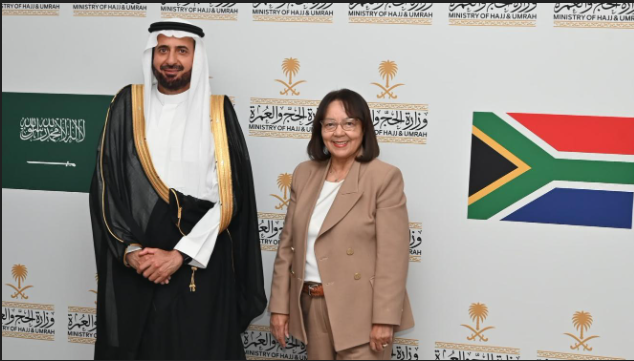
South African Minister of Tourism Patricia de Lille hosted Saudi Arabia’s Minister of Hajj and Umrah, H.E. Dr Tawfiq bin Fawzan Al-Rabiah, on 9 September 2026 during his official visit to South Africa.
According to the Department of Tourism, discussions focused on strengthening cooperation to better serve South African pilgrims and Umrah visitors, supporting the transition to digital services, improving coordination with tour operators and addressing practical challenges faced by travellers. The two sides also agreed to establish a joint working group and encouraged airlines in both countries to explore increasing flight frequencies.
The discussions come as the number of South Africans travelling to Saudi Arabia for Umrah continues to increase.
“Last year, around 56,000 South Africans travelled to the Kingdom for Umrah, an increase of approximately 10% compared to the previous year,” said Minister Al-Rabiah.
The figure points to the scale of religious travel between the two countries, while the latest discussions also place Umrah within a wider tourism relationship.
Minister de Lille said South African Tourism would develop seasonal packages to be marketed to Saudi travellers as part of efforts to strengthen connectivity and encourage greater two-way travel.
Tourism moving in both directions
The growth in travel is not limited to South Africans travelling to Saudi Arabia.
Saudi arrivals to South Africa increased from 5,461 in 2021 to 24,942 in 2025, according to the Department of Tourism. That represents an increase of approximately 350% over the period.
South African Tourism has also identified Islamic heritage and halal tourism as areas for closer cooperation between the two countries.
The relationship has a longer history.
South Africa and Saudi Arabia formally established diplomatic relations in 1994. Former President Nelson Mandela visited Saudi Arabia in November that year. South African government records also describe Saudi Arabia as having opposed apartheid and contributed to South Africa’s liberation struggle.
The countries’ tourism relationship was further affected by South Africa’s decision in 2019 to allow Saudi nationals to enter the country without visas for tourism, conferences and business visits. The arrangement was introduced by South Africa and was not, at that stage, a reciprocal visa-free agreement for South Africans travelling to Saudi Arabia.
The latest discussions therefore extend beyond religious travel, with both governments looking at tourism as another area through which bilateral ties can develop.
“South African Tourism will build seasonal packages that we can market to Saudi travellers as part of the approach to strengthen connectivity,” said Minister de Lille.
What does stronger connectivity mean for pilgrims?
For South African Muslims, increased air connectivity could make travelling to Saudi Arabia easier.
During the September meeting, the two countries agreed to encourage airlines to explore increasing flight frequencies, with the intention of facilitating movement for pilgrims, Umrah visitors and other travellers.
The meeting also gave South African pilgrims, Umrah visitors and tourism-sector representatives an opportunity to raise concerns directly with the Saudi delegation about their experiences and challenges.
However, greater connectivity does not necessarily resolve all of the difficulties surrounding pilgrimage.
Dr Jameel Asani from the Department of Religious Studies at the University of Johannesburg told One Nation Media [ONM] that “The government’s discussions should be viewed in the context of both religious travel and broader tourism.”
“The public text is about two-way tourism as much as about Hajj and Umrah. That is legitimate state business, but pilgrims should not be used as a marketing backdrop for Saudi arrivals to Cape Town and Johannesburg,” said Asani.
His comments come as South African pilgrims face changes to the way Hajj is facilitated.
A new Hajj system
Saudi Arabia introduced a new operational framework for South African Hajj pilgrims for the 2026 season. According to the Department of International Relations and Cooperation (DIRCO), the traditional use of licensed South African tour operators was discontinued, with service contracts instead being signed directly with Saudi service providers. Coordination is being managed through the Nusuk Masar electronic platform under the oversight of the Saudi Ministry of Hajj and Umrah.
“What was announced is useful in principle: a joint working group, more flights, digital coordination, and a stated willingness to listen to South African pilgrims and operators. More direct or frequent flights would reduce cost, transit risk, and exhaustion. A working group that actually includes pilgrims, operators, medical people, and DIRCO, not only tourism marketers, could fix real bottlenecks: visas, packages, complaints, and the quality of service inside the Kingdom,” said Asani”
“The public text is about two-way tourism as much as about Hajj and Umrah. That is legitimate state business, but pilgrims should not be used as a marketing backdrop for Saudi arrivals to Cape Town and Johannesburg,” added Asani.
The South African Hajj quota for the 1447 AH/2026 season was reduced from 2,500 to 1,140 pilgrims, while the previous SAHUC waiting list would no longer apply under the new system.
Asani said these changes could have significant consequences for South African pilgrims.
“The change that already affects Hajj 2026 is the move to Nusuk direct booking and a reported cut in South Africa’s Hajj quota from about 2,500 to 1,140,” he said.
“That is a sharper change than anything announced at the de Lille meeting. A smaller quota, no waiting list, first-come-first-served digital booking, and possible splitting of groups across Saudi providers can raise costs and reduce the community support South Africans used to travel with.”
Asani said there could also be potential benefits to the new system.
“Transparency and reduced middleman abuse are possible benefits. Loss of first time-pilgrim priority and local pastoral care are real risks,” he said.
The changes form part of wider moves towards digital management of Hajj services, including the use of Nusuk.
Does nationality affect the pilgrimage experience?
While the religious rites of Hajj remain the same for Muslims, Asani said the practical experience of pilgrimage can differ according to a range of factors.
“In fiqh and in official language, every Hajj is one Hajj. The rites are the same. The Haram is the same. Saudi authorities present pilgrims as ‘Guests of Allah’,” he said.
“In practice, pilgrims are not treated identically.”
Asani said differences can emerge from package prices, permits, nationality-related logistics, language and the bargaining power of the country sending pilgrims.
“Treatment tracks package price, official permit versus unofficial entry, nationality logistics, language, and bargaining power of the sending country, not only skin colour,” he said.
He said authorised pilgrims with valid Hajj permits generally have access to the official system, camps, transport arrangements, healthcare points and the Nusuk framework.
However, he also raised questions about equality in the allocation of Hajj quotas.
“Equality is not seen in quota politics. Places are allocated by country. A Muslim-minority country such as South Africa is squeezed,” said Asani.
He argued that countries with stronger Hajj institutions and greater negotiating capacity may have more influence when quotas and arrangements are discussed.
However, Abdulrahman Abdulghany, founder of the Islam & Comparative Religion Academy (ICRA), said concerns about the treatment of African and Black pilgrims should be distinguished from claims about official government policy.
“I think we need to be honest about this issue. There have been a significant number of complaints from African and Black pilgrims and visitors about how they have been treated in Saudi Arabia. I would not dismiss these experiences as isolated anecdotal incidents,” said Abdulghany.
“At the same time, I would distinguish between individual or societal racial discrimination, poor treatment by particular officials or service providers, and an official government policy of discriminating against African pilgrims.”
“I have not seen sufficient evidence to claim that the Saudi government has an official policy of treating African pilgrims differently because they are African. But that does not mean the complaints should be ignored,” he added.
His comments introduce an important distinction between reported individual experiences and evidence of an official state policy.
The African perspective
For Muslims in African countries, the experience can also be shaped by the size and resources of their national Muslim communities.
Mufti Mohamed Aslam, a mufti in Zimbabwe, told ONM that Zimbabwe’s relationship with the Saudi authorities involves direct engagement with the office responsible for Hajj affairs.
“In our own right we also engage with the office within the Ministry allocated to deal with us and we try to negotiate the best for our Hujjaaj in the circumstances we have,” he said.
“Note we are a very small number of Muslims compared to any of our neighbours.”
Zimbabwe’s Hajj quota, he said, is 150 pilgrims.
“So Alhamdulillah, our working relationship with the relevant office thus far is fairly good,” said Aslam.
His comments show that experiences among African Muslim communities are not uniform and can differ according to the size of the community, the country’s Hajj structures and its engagement with Saudi authorities.
Abdulghany also stressed the scale and diversity of Muslim communities across the African continent.
“One important point is that African Muslims are not a small or insignificant part of the global Muslim Ummah. Africa has hundreds of millions of Muslims, with a rich Islamic history stretching back to the earliest days of Islam,” he said.
“African pilgrims come with the same faith, the same devotion, and the same desire to fulfil this sacred journey as Muslims from every other part of the world.”
“The diversity of the Ummah should be recognised, and every pilgrim deserves dignity, respect, and excellent service,” he added.
Asani also pointed to economic inequality as another factor affecting the pilgrimage experience.
“Distance of the camp from the Haram, quality of tents, toilets, food, and transport is bought. Wealthy pilgrims from any continent buy proximity. Poorer pilgrims walk further,” he said.
He added that African contingents can include elderly, first-time and financially constrained pilgrims, which he argued can make differences in cost and service particularly significant.
A wider relationship
The growing movement of people between South Africa and Saudi Arabia demonstrates that the relationship between the two countries extends beyond diplomatic meetings.
For South African Muslims, Hajj and Umrah remain religious journeys first, while for both governments they are also connected to tourism, aviation, digital services and broader bilateral cooperation.
Abdulghany said stronger cooperation could also extend beyond South Africa.
“I believe that initiatives between Saudi Arabia and South Africa can serve as a model for broader cooperation with other African countries that have significant Muslim populations,” he said.
“Countries such as Kenya, Tanzania, Nigeria, Senegal, Ethiopia, Somalia, Mozambique, and others could also benefit from stronger engagement and coordination.”
The September meeting could therefore mark another step in a relationship that has developed across religious, diplomatic and economic spheres.
But as connectivity improves and tourism expands, the experience of the individual pilgrim remains an important part of the conversation.
Abdulghany said the focus should remain on the experience of pilgrims regardless of where they come from.
“The focus should always remain on serving the guests of Allah, regardless of nationality, race, or economic background. Improving the Hajj experience for African pilgrims ultimately strengthens the unity and brotherhood of the global Muslim community,” he said.
For many Muslims, Hajj and Umrah are once-in-a-lifetime acts of worship.
The relationship between South Africa and Saudi Arabia will therefore not only be reflected in the number of flights, tourists or pilgrims travelling between the two countries, but also in whether pilgrims can undertake the journey with dignity, transparency and meaningful access to the services they need.