
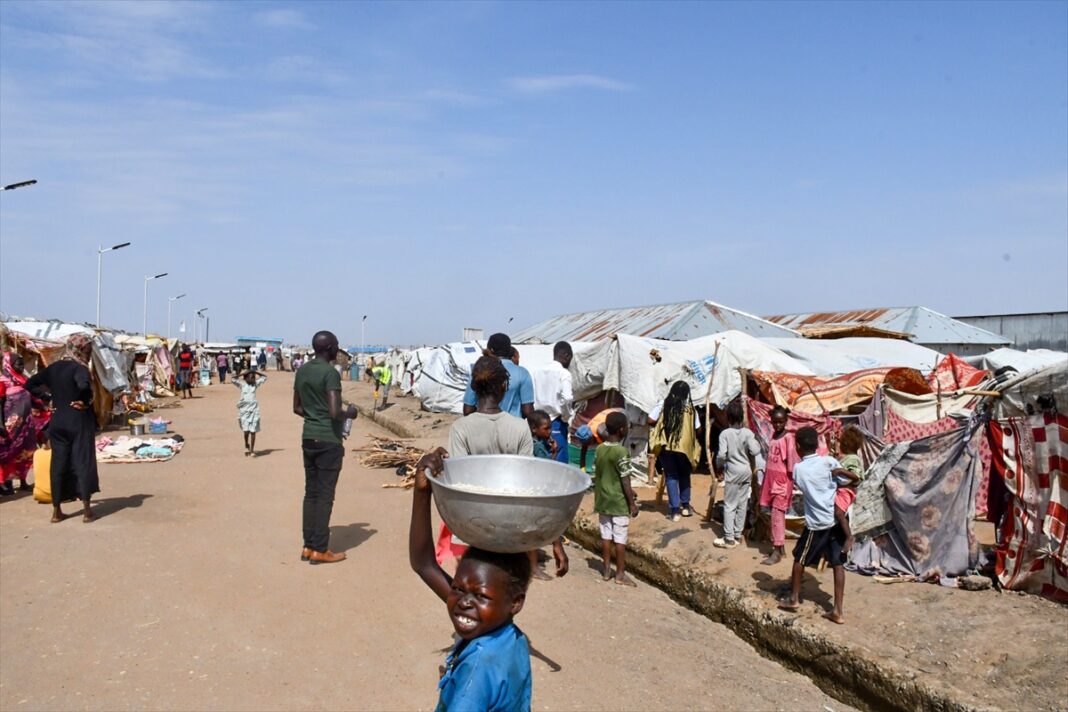

The Sudan war has been waged to a “deliberate stalemate” presenting the Sudanese people with a bleak future, says Dr Abdul Elgoni, an analyst who had previously been engaged in mediation between warring factions in Khartoum.
“Whoever saves one life, it is as if he has saved all of humanity.” [Quran 5:32]
As Sudan enters the fourth year of a devastating war, this Qur’anic principle carries particular urgency. Millions of civilians remain trapped between armed forces competing for territory and political control, while hospitals, schools, markets and humanitarian routes increasingly become part of the battlefield.
The war began on 15 April 2023 as a power struggle between the Sudanese Armed Forces (SAF), led by General Abdel Fattah al-Burhan, and the paramilitary Rapid Support Forces (RSF), commanded by Mohamed Hamdan Dagalo, commonly known as Hemedti. The two leaders had previously cooperated in the removal of former president Omar al-Bashir, but later clashed over control of the state and proposals to integrate the RSF into the regular army.
More than three years later, neither side has secured a decisive national victory. The fighting has instead produced a fragmented country, competing authorities and a humanitarian emergency that has displaced more than 14 million people.
Dr Abdul-Karim Elgoni is a Sudanese doctor and member of theAfrican Diaspora Forum (ADF) whose continuing contact with people inside Sudan gives him a personal connection to the conflict and its humanitarian consequences.
Elgoni describes the present situation as an “intentional stalemate”, arguing that the conflict has increasingly produced separate spheres of control rather than a unified national settlement.
“What I can see now is a stalemate,” he said. “For me, it is an intentional stalemate.”
He said that large parts of Darfur, South Kordofan and Blue Nile are controlled by forces aligned with the RSF and its political partners, while the SAF controls Khartoum, the Nile Valley and much of northern and eastern Sudan. In practical terms, he said, Sudan is increasingly functioning as though it has “two governments”, with North Kordofan remaining one of the most fiercely contested areas.
The fighting moves away from Khartoum
The balance of the war has changed considerably since 2024. The SAF recaptured Khartoum in 2025, allowing state institutions and some residents to return, although later drone strikes showed that the capital remains within reach of long-range attacks.
The most intense fighting has shifted towards Darfur, Kordofan and Blue Nile.
El Obeid, the capital of North Kordofan and home to roughly half a million people, has become a major flashpoint. The city lies between the RSF’s stronghold in Darfur and SAF-controlled areas further east. Repeated drone attacks have damaged electricity, fuel, water and health infrastructure, while international officials have warned that an RSF assault could expose civilians to another large-scale atrocity.
The warning that El Obeid could become “another El Fasher” refers to the RSF’s approximately 18-month siege of El Fasher, the capital of North Darfur. The blockade restricted food, water, medicine and humanitarian assistance, forcing some residents to survive on animal feed and hides before the city fell in October 2025.
Following the takeover, the United Nations documented mass killings, ethnically targeted executions, and attacks on civilians.Its fact-finding mission later said the violence bore the “hallmarks of genocide” against non-Arab communities.
The RSF has particularly been accused of targeting Fur, Masalit and Zaghawa–– non-Arab African communities in Darfur, as well as men and boys suspected of supporting the army. These attacks are rooted not only in the current competition for power, but also in the RSF’s origins in the Janjaweed militias, often described as the “devils on horseback” and the long history of ethnic violence, land seizure and forced displacement in Darfur.
In Blue Nile and parts of Kordofan, the RSF has also cooperated with the Sudan People’s Liberation Movement–North (SPLM-N), led by Abdelaziz al-Hilu and Malik Agar. This has allowed the RSF-aligned coalition to open additional fronts and place further pressure on SAF positions.
Foreign support transforms the battlefield
The most important development of 2026 has been the expansion of drone warfare.
Both sides now possess the ability to strike cities, markets, hospitals and infrastructure far beyond conventional front lines. The UN said drone attacks killed more than 1,000 civilians during the first five months of 2026, with evidence indicating that both the SAF and RSF conducted operations that may amount to war crimes.
A September report by the UN Independent International Fact-Finding Mission concluded that foreign weapons, military technology, personnel and logistical networks are sustaining the conflict.
Investigators found grounds to believe that networks operating through the United Arab Emirates, Chad, Libya and Somalia supplied the RSF with weapons, training, logistics and foreign personnel. The report also documented up to 2000 Colombian contractors operating advanced weapons alongside RSF forces. The countries accused of involvement have either denied the allegations or maintained that they are neutral.
The investigation into foreign support for the SAF was less advanced, but the mission found that foreign-supplied drones and loitering munitions had expanded the army’s long-range capabilities, including in operations that struck civilian locations.
Foreign intervention has therefore not produced a balance protecting civilians. Instead, it has enabled both forces to continue fighting despite enormous civillian losses.
The vulnerability within the SAF coalition
Even a military defeat of the RSF would not necessarily end Sudan’s instability.
The SAF relies partly on armed movements such as Gibril Ibrahim’s Justice and Equality Movement (JEM) and Minni Minnawi’s Sudan Liberation Movement, commonly abbreviated as SLM-MM. Although they fight alongside the army under the Joint Force banner, they remain separate armed organisationsrather than fully integrated units.
This exposes a central vulnerability: in order to defeat one parallel paramilitary force, the SAF has become dependent on other autonomous armed movements.
Their continued independence also weakens prospects for a single national command structure and postpones security arrangements required under the 2020 Juba Peace Agreement. Even after the RSF threat recedes, disputes over military integration, political influence and control of Darfur could remain.
What happens if the guns fall silent?
For Elgoni, an end to the fighting would first create an opportunity to save lives.
He said a ceasefire would allow aid to reach millions surviving on limited food, enable displaced farmers to return to their land and make it possible for schools, clinics and public offices to reopen.
Politically, he argued that Sudan would need an inclusive dialogue in which citizens can determine the country’s leadership without intimidation or armed coercion.
“People will start looking politically, how can we solve this problem?” he said. “It might take six months, a year, or two years, but during those times, people will be talking to each other through dialogue, not through bullets.”
He also called for South African humanitarian organisations to increase assistance and for the South African government to support efforts towards an initial termination of hostilities, and his third request was for South African teachers, academics and other professionals to help rebuild Sudan’s human capacity.
Sudan’s crisis is therefore larger than a battle between two generals. It is a struggle over whether the country will remain divided among armed centres of power or rebuild a unified state accountable to its people.
For Muslims observing the devastation, the Qur’anic command to preserve life gives the crisis an obligation beyond political analysis. Supporting those facing hunger, displacement and the destruction of their communities is part of preserving human dignity.
As Elgoni put it, even reaching a handful of people matters: “Even if we can reach ten people, it’s better than not reaching anyone.”
Until the external networks sustaining the fighting, the proliferation of armed groups and the political divisions underlying the war are addressed, Sudan risks remaining caught in a stalemate whose greatest cost continues to be carried by its civilians.