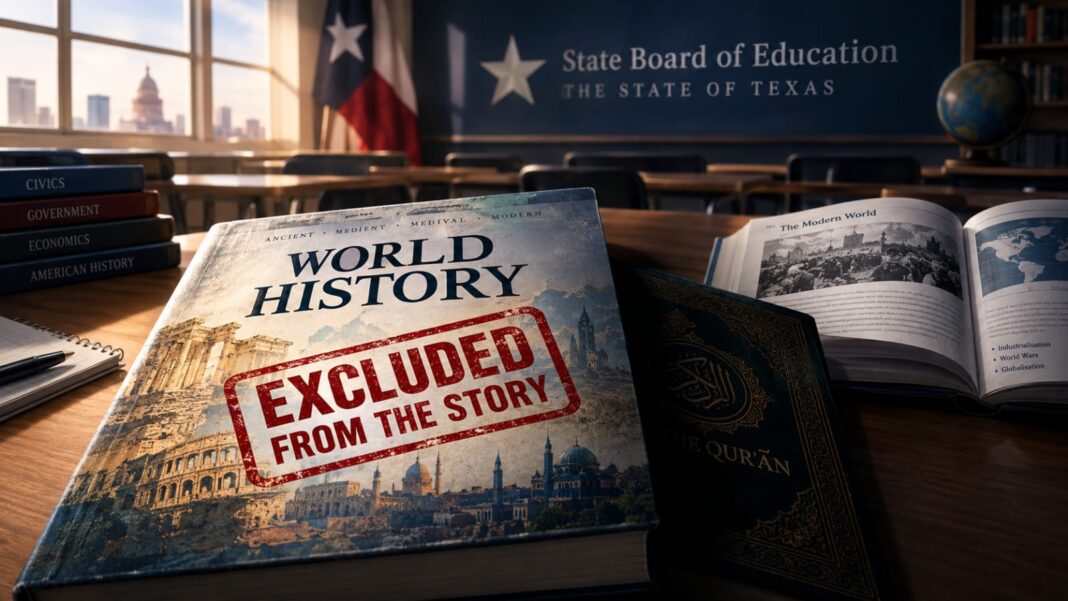

A classroom can be a political space without ever displaying a political slogan. Sometimes politics is found in the textbook, in what it teaches its children to remember. Texas has just provided a striking example.
This month (September 2026) the Texas State Board of Education completed its revision of the state’s K-12 social studies standards. The board said the revised curriculum placed a central emphasis on the foundations of Western civilisation and the values that shaped America and Texas.
Among the changes to world history are new requirements dealing with early Islam, jihad, Muslim military expansion, slavery and the Ottoman Empire. Modern lessons also make clear that Islam is not merely an event in somebody else’s history book. The debate has not remained inside schools.
At Dallas Fort Worth International Airport, a dispute emerged over plans to expand facilities where Muslims can perform wudu, the washing performed before prayer. The airport’s authorities ultimately cancelled plans for a new facility after determining that it would not provide the anticipated operational benefits.
But before that cancellation, Texas Governor Greg Abbott threatened to review state and federal grant funding connected to airports with Islamic washing facilities, arguing that such facilities amounted to religious favoritism.
Islam is a living faith followed by more than 2 billion people around the world and an estimated 2.5 million individuals in Texas. Who gets to tell their story?
Choosing what to remember
Moulama Uwais Dockrat, The head of Guardian Da’wah Institute and Secretary of the Association of Muslim Schools South Africa, said: “If you want to know what a civilisation really believes, do not only listen to its speeches. Look at what it teaches its children.
“Texas has just given us a remarkable example. In its newly adopted World History standards, students studying medieval Christianity are directed towards its “missionary activity, hospitals, and orphanages. A few lines later, early Islam is introduced partly through the Prophet Muhammad ﷺ and his ‘brutal military campaigns against Jewish and Christian tribes’. Students are then explicitly required to study the ‘teachings of jihad’.
“My purpose here is not to apologise for jihād, Muslim military history or Islamic political power. The point is far more important: Who chooses the story?”
From fourteen centuries of Islamic civilisation — revelation, law, theology, scholarship, governance, scientific development, institutions, spirituality, literature, conquest and virtue— somebody decided what would represent Islam to a child, Dockrat said.
“That is what curriculum does. It selects. It arranges. It emphasises. It frames.
“And Texas is refreshingly open about the fact that its curriculum has a civilisational orientation. The new World History standards explicitly describe the course as having a ‘special emphasis on the western and American tradition’.
“The Texas State Board of Education likewise describes its revised standards as placing a ‘central emphasis’ on the foundations of Western civilisation and the values that shaped America and Texas. They know from where they are educating. Do we?”
Dockrat said Muslims needed to wake up.
“We continue speaking about curriculum as though it were a neutral collection of subjects: mathematics, science, english, geography and history. We then place Islamic Studies alongside them and imagine that we have created an Islamic education.
“But every curriculum rests upon something deeper. At the most basic level, it assumes a worldview: an understanding of reality, knowledge, morality, purpose and society. It assumes a conception of the human being: what man is, what freedom means, what fulfils him and what his relationship is to authority, community and the world. And inevitably it assumes an ideal human being: the type of person the educational process ultimately hopes to produce,” Dockrat said.
“In much of modern education, I would argue, the background assumptions are broadly secular-liberal and humanist. Man is increasingly understood as an autonomous individual, and schooling is closely tied to forming citizens capable of functioning within the social, political and economic order.
“At its worst, this can reduce education to two outcomes: submission and utility to the nation-state — producing people who accept the dominant framework and who can function productively within it,” he said.
He said Texas itself described the purpose of its social-studies programme more positively: to form responsible, self-governing citizens who cherished its constitutional liberties and laws.
“But that actually strengthens the broader point. They know who they are trying to produce. What are we trying to produce?
“Is the successful product of Muslim education simply a doctor, lawyer, engineer or entrepreneur who also performs ṣalāh and attended Islamic Studies at school? Or are we trying to form an ʿabd of Allah — a human being whose knowledge, ambitions, character, morality, relationships and understanding of the world are all situated within Dīn?” Dockrat asked.
“If the latter is our objective, then Islamic education cannot simply mean taking somebody else’s curriculum and adding Qur’anic verses to it.
Yet this is too often what we do. We inherit the architecture. We inherit the categories. We inherit the philosophy of knowledge. We inherit the assumptions about success, progress, humanity and society.
“And then we ask how we can “Islamise” the finished product. Add an āyah here. A ḥadīth there. Create an Islamic-perspective sidebar. Increase the number of Islamic Studies periods. Then we wonder why the worldview of the graduate remains largely untouched.”
Dockrat said other societies were less embarrassed about education serving a civilisational purpose.
“Look again at Texas. Its standards include Muslim raiders and slave trading, the Ottoman capture of Constantinople and what the document calls the Islamic slave trade. In the modern section, pupils encounter terrorism, al-Qaeda, 9/11 and ISIS under a heading concerning radical Islam. They are making choices.
“They are constructing a historical narrative. They are deciding what knowledge their children require in order to become the people they want them to become. And we are still arguing about whether education has a worldview. Perhaps we should continue as we are. Conform harder. ‘Engage’ more. Try even harder to fit comfortably within intellectual structures built by others. Teach our children within somebody else’s categories and then expect them somehow to emerge instinctively viewing reality through Islam,” he said
Or perhaps we should learn the obvious lesson, he said.
“This does not mean intellectual isolation. Muslims should learn mathematics, science, technology, languages and everything beneficial humanity has discovered. Our civilisation historically learnt from others extensively. But learning from another civilisation is not the same as allowing another civilisation to define the framework through which you understand all knowledge.
“We need Muslim educators, scholars and institutions to move beyond asking only, ‘How do we add Islam to the curriculum?’ We need to ask a more fundamental question: What would education look like if we began from Islam? From our conception of knowledge. From our understanding of the human being. From our purpose in existence. From our intellectual tradition. From our vision of the person we hope to form,” he said.
Dockrat said it was not about establishing more Muslim schools.
“We need schools that know why they exist. We do not merely need Islamic Studies. We need an Islamic philosophy of education capable of shaping the curriculum as a whole. Other civilisations have understood that education is how a civilisation reproduces itself. It is time we understood that too,” he said.