
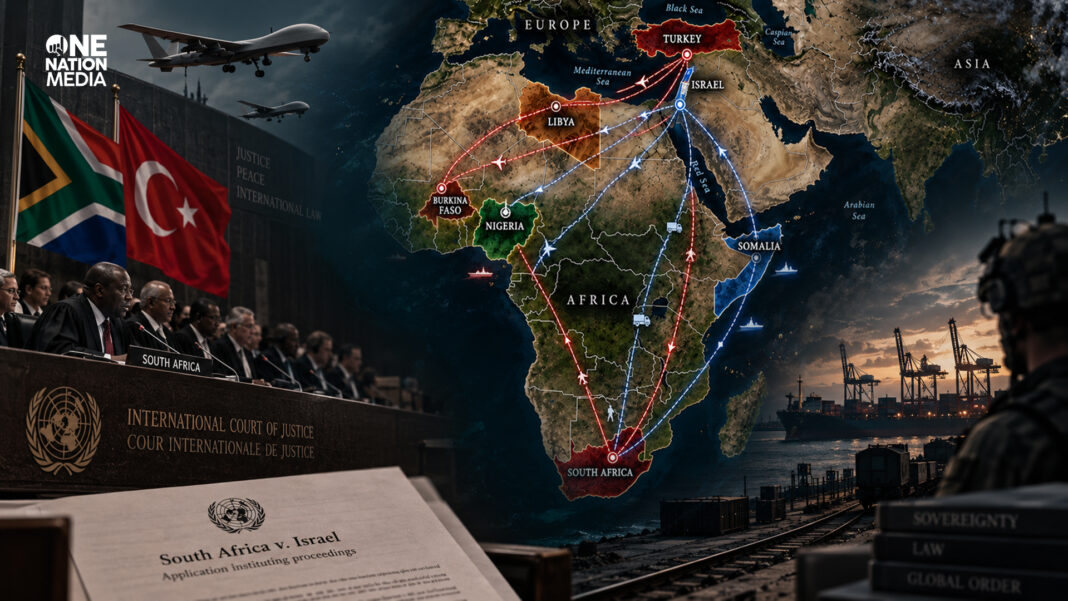

The recent geopolitical friction between Israel and Turkey has transformed a decades-long partnership into an intense, zero-sum regional rivalry, writes Najm Al-Din.
In March 1949, Turkey became the first Muslim-majority country to recognise Israel. For decades, the two states maintained close military, intelligence and economic ties. That relationship has now ruptured into an increasingly hostile diplomatic and strategic confrontation.
Palestine
Since the rise of Recep Tayyip Erdogan’s AKP, Turkish foreign policy has increasingly championed the Palestinian cause, combining Islamic solidarity with strategic realpolitik and domestic political mobilisation.
This has repeatedly strained relations with Israel, particularly as Erdogan rejected the designation of Hamas as a terrorist organisation, instead describing it as a “liberation movement” and hosting members of its leadership.
Ankara has also halted bilateral trade with Israel, conditioning its resumption on a permanent ceasefire in Gaza and the unhindered delivery of humanitarian aid.
While Erdogan’s fiery rhetoric serves a domestic political purpose and is frequently dismissed by critics as largely performative, Palestine remains a structural fault line preventing any meaningful geopolitical reconciliation between Turkey and Israel.
Syria
Another major source of tension is the clash between Turkish and Israeli security interests in Syria, where Ankara’s preference for a unified and centralised state conflicts with Israel’s desire for a fragmented and demilitarised security environment along its northern frontier.
Seeking to repatriate millions of Syrian refugees and neutralise Kurdish separatism, Ankara has supported the professionalisation of Syria’s new national army and the integration of former rebel factions under Turkish tutelage.
Israel, by contrast, views the emergence of a unified, Turkish-backed and heavily armed Syrian state as a potentially serious security threat.
As Ankara trains and supports Syrian forces in the north, Israel has cultivated ties with Druze forces in the south and supported greater autonomy for minority regions. Its support for Kurdish self-determination similarly serves to constrain the emergence of a powerful and potentially hostile central government.
Both countries are therefore deploying military, economic and diplomatic tools to limit one another’s influence in Syria, with their competition increasingly spilling into the wider Eastern Mediterranean.
Mediterranean
The discovery of Israel’s Leviathan and Tamar gas fields, alongside Cyprus’s Aphrodite field, transformed the Eastern Mediterranean into an increasingly important energy hub.
Israel, Cyprus and Greece subsequently deepened cooperation with regional partners through initiatives centred on energy exploration, infrastructure and export routes.
Turkey views these arrangements as part of an exclusionary regional architecture that challenges Ankara’s ambition to become Europe’s principal energy transit hub — a position that would significantly increase its leverage over the European Union.
Turkey’s “Blue Homeland” maritime doctrine also asserts expansive claims in waters contested by Greece and Cyprus, directly challenging competing energy and maritime projects. These tensions are further aggravated by Ankara’s non-recognition of the Republic of Cyprus and its support for Turkish Cypriot claims over offshore resources.
The confrontation in Syria therefore mirrors a broader contest for influence over Eastern Mediterranean energy corridors, where Turkey’s ambitions increasingly collide with Israeli-backed infrastructure and maritime strategies.
South Africa
Beyond the Mediterranean, Africa is emerging as another geopolitical arena in which Israeli and Turkish interests increasingly intersect.
Erdogan has strongly supported South Africa’s genocide case against Israel at the International Court of Justice, reflecting Ankara’s broader strategy of building partnerships with influential middle powers across the Global South.
Turkey and South Africa have also operationalised their Binational Commission, creating a permanent mechanism for state-level coordination on political, economic and defence matters.
Ankara has gone beyond rhetorical support for Pretoria’s legal campaign, submitting material relating to Israel’s conduct in Gaza and formally intervening in the ICJ proceedings under Article 63 of the court’s statute.
Turkey subsequently imposed sweeping trade restrictions on Israel as relations deteriorated further.
By deepening its political relationship with South Africa and aligning itself with Pretoria’s historical anti-apartheid identity and international legal activism, Ankara has helped elevate its confrontation with Israel beyond the Middle East and onto a global diplomatic and judicial platform.
As South Africa seeks to diversify its economic partnerships, Turkey has also emerged as an increasingly important market and strategic partner. Cooperation between Turkish aerospace and defence firms and South African industries could further deepen a military-industrial relationship less dependent on traditional Western suppliers.
Turkey’s alignment with South Africa should therefore not be viewed as an isolated legal or diplomatic manoeuvre. It is part of a much broader relationship through which Ankara seeks to expand its influence across Africa and strengthen its position within the Global South.
Libya
Turkey’s African footprint has meanwhile evolved from predominantly soft-power engagement into a far more substantial security architecture.
Ankara has positioned itself as an increasingly important power broker across North Africa, the Sahel and West Africa. This expanding presence has intensified its rivalry with Israel as both countries seek influence over strategic maritime corridors, airspace and regional governments.
In Libya, Turkey operates from Al-Watiya Airbase and maintains a military presence linked to the Misrata naval facilities, providing Ankara with important logistics and forward-deployment capabilities. The Turkish parliament has also repeatedly authorised the continued presence of Turkish forces in the country.
Through the Turkey-Libya Maritime Memorandum of Understanding, Ankara has sought to redraw Exclusive Economic Zone boundaries and strengthen its claims to energy exploration rights across the Eastern Mediterranean.
The arrangement directly challenges competing maritime and infrastructure projects supported by Israel, Greece and Cyprus, including routes designed to transport regional energy resources to European markets while bypassing Turkey.
Burkina Faso
Amid the withdrawal of French forces from the Sahel, Burkina Faso has also deepened its security relationship with Ankara.
The country has acquired Turkish Bayraktar TB2 and Akinci drones, alongside Turkish-made armoured tactical vehicles, as it seeks to confront escalating armed insurgencies.
Turkish companies have simultaneously expanded their economic footprint in the country, including within strategically important extractive industries.
This growing Turkish presence has fed wider Israeli concerns that Ankara is constructing an expanding network of political, military and commercial partnerships across Africa capable of reducing Israeli influence on the continent.
Nigeria
Nigeria has likewise deepened its defence relationship with Turkey. The two countries have expanded cooperation in areas including counter-insurgency, military training, defence technology and weapons procurement.
Turkish defence firms have become increasingly visible in Nigeria, while Nigerian personnel have undergone military training in Turkey as Abuja seeks new capabilities to confront insurgencies and other domestic security threats.
For Ankara, Nigeria represents far more than another defence customer.
As Africa’s most populous country and one of its largest economies, Nigeria offers Turkey a strategic foothold in West Africa and access to one of the continent’s most consequential political and security actors.
Somalia
Nowhere in Africa is Turkey’s strategic presence more deeply entrenched than Somalia.
Over the past decade, Ankara has built extensive influence through military training, humanitarian assistance, infrastructure investment and agreements covering maritime security and offshore energy exploration.
Turkey operates its largest overseas military training facility in Mogadishu and has played an increasingly prominent role in developing Somalia’s armed forces.
This growing presence places Ankara close to some of the world’s most important maritime routes, including the Gulf of Aden and Bab el-Mandeb Strait.
It also intersects directly with Israel’s strategic interest in the Red Sea and its growing engagement with Somaliland.
Reports that Israel could seek access to military or intelligence facilities around Somaliland’s port of Berbera have further intensified speculation that the Horn of Africa could become another theatre of Turkish-Israeli competition.
Berbera sits close to the Bab el-Mandeb, one of the world’s most important maritime chokepoints connecting the Red Sea with the Gulf of Aden.
Turkey’s backing of Somalia’s territorial integrity therefore places it in direct opposition to any external effort to legitimise Somaliland’s secession or transform the territory into a permanent strategic outpost.
At the same time, Israeli defence companies, including Elbit Systems, continue expanding their presence across Africa through the sale of military equipment, drones, cyber capabilities and surveillance technology to states including Morocco and Rwanda.
The competition is therefore not simply ideological.
Both countries are using military partnerships, defence exports, infrastructure investment, diplomatic alliances and access to strategic ports and maritime corridors to expand their respective spheres of influence.
Ultimately, the geopolitical rivalry between Turkey and Israel can no longer be understood solely through the lens of Palestine, Syria or the Eastern Mediterranean.
Africa is rapidly becoming one of its most consequential theatres.
From South Africa’s diplomatic offensive at the ICJ to Libya’s maritime corridors, the Sahel’s military realignment, Nigeria’s defence partnerships and Somalia’s strategic position overlooking the Red Sea, Ankara and Tel Aviv are increasingly competing for political influence, military access and economic leverage across the continent.
As Africa’s strategic importance grows within an increasingly multipolar international order, the Turkish-Israeli rivalry is likely to follow — transforming the continent into another major arena in their widening struggle for regional and global influence.


