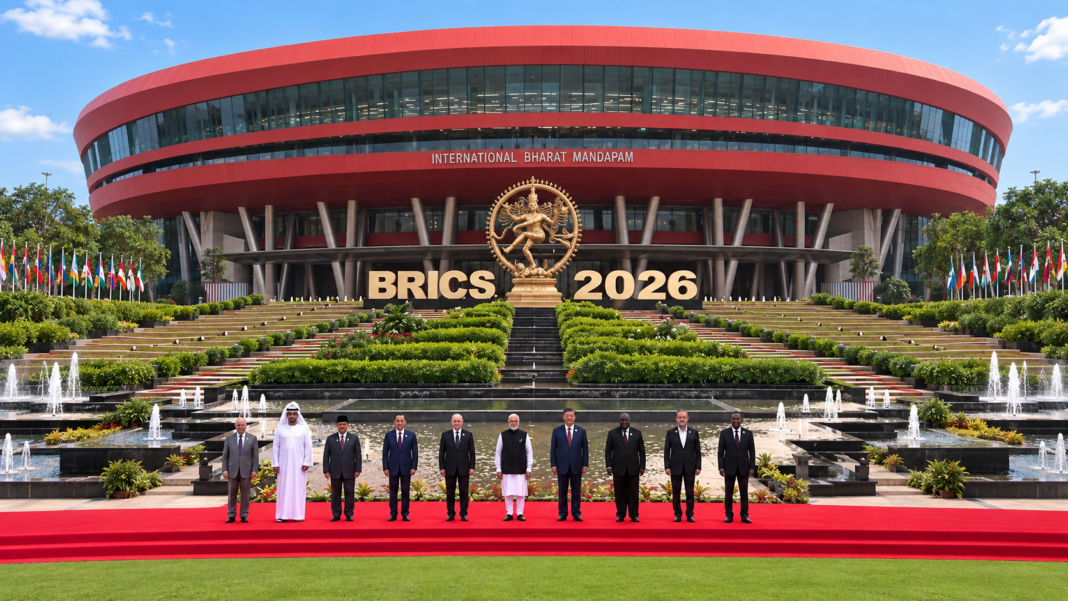

The expansion of BRICS has brought several Muslim-majority countries into one of the world’s most prominent groupings of emerging economies. But while their presence gives them a greater platform in a changing international order, a more difficult question remains: does it give Muslims a stronger voice in world affairs?
What began with Brazil, Russia, India and China expanded when South Africa formally joined in 2011. A major enlargement followed in 2024 with Egypt, Ethiopia, Iran, Saudi Arabia and the United Arab Emirates (UAE), while Indonesia became a full member in 2025.
BRICS now has 11 full members which, according to Indian government figures, collectively account for 49.5% of the world’s population, 40% of global GDP and 26% of global trade. Leaders gathered in New Delhi on September 12 and 13 for the 18th BRICS Summit under the theme, “Building for Resilience, Innovation, Cooperation and Sustainability”. This year also marks two decades since BRICS was established.
For its Muslim-majority members, the expansion means countries representing hundreds of millions of Muslims are now sitting inside a forum seeking to reshape global economic and political power. But representation by Muslim-majority states does not automatically amount to representation of Muslim interests.
In an interview with One Nation Media, Ziyad Motala, professor of law at Howard University in Washington, said the significance of BRICS for the Global South was that it provided an alternative centre of “political and economic gravity”.
“For decades, the major international institutions have reflected a world in which Western states exercised disproportionate influence. BRICS is one manifestation of a changing world in which countries in Asia, Africa and Latin America are saying that global governance should no longer be dictated principally from Washington, London, Paris and Brussels.
“That does not mean BRICS is a coherent ideological alliance. Far from it. Russia, China, Brazil and South Africa, in different ways, have pushed strongly for a less Western-dominated international order. India has a rather different agenda and wants good relations with the West as well.”
Motala said Saudi Arabia and the UAE had their own strategic calculations and were “still very much in the Western camp”.
“I will go so far as to say they are principally concerned with their own survival and wealth accumulation and care little or nothing about Muslims. So BRICS is an unwieldy coalition, but perhaps that is also the point. The Global South itself is not monolithic.
“I would be careful about speaking of BRICS as providing a voice for the Muslim world. I am not sure there is such a thing as a single Muslim political voice. Iran, Saudi Arabia, the UAE, Indonesia and Egypt are all Muslim-majority countries, but their foreign policies, interests and political outlooks are radically different,” Motala said.
Those divisions are central to understanding what BRICS can — and cannot — become.
“Indeed, even within the Middle East, Iran and the UAE presently have sharply conflicting interests. Saudi Arabia has another set of priorities. Indonesia approaches international affairs from a very different historical and geographical perspective. And India, although home to one of the world’s largest Muslim populations, under its present political dispensation has generated very serious concerns about its treatment of Muslims.
“So, I would say BRICS gives several important Muslim-majority countries a larger platform, but that is quite different from saying that BRICS speaks for Muslims.”
Can BRICS change the balance of power?
For Muslim societies, the importance of BRICS may therefore lie less in religious solidarity and more in its ability to challenge structures of international power that have shaped everything from trade and debt to sanctions, development finance and diplomacy.
Asked whether BRICS could effectively address problems affecting Muslim societies, Motala said:
“Potentially, yes, but not because it is a Muslim organisation or because of concerns about Muslims. It can do so because many of those problems are connected to larger questions of global power: Palestine, economic dependency, sanctions, development, debt, control of international financial institutions, the structure of the UN Security Council and the unequal application of international law.
“BRICS can strengthen the bargaining power of countries that have historically had relatively little influence over those structures. Institutions such as the New Development Bank, greater South-South trade, alternative payment arrangements and pressure for reform of the UN and international financial institutions can have real significance,” he said.
For decades, many of the institutions governing international finance, development and political decision-making have been dominated by Western powers. BRICS has emerged partly from demands by emerging economies for greater representation within those institutions and greater room to determine their own economic priorities.
The inclusion of Egypt, Iran, Saudi Arabia, the UAE and Indonesia therefore matters far beyond their Muslim-majority populations. Together, they bring major energy reserves, strategic waterways, financial centres, large consumer markets and significant geopolitical influence into the grouping.
Saudi Arabia is one of the world’s most important energy producers, while the UAE is a major global logistics and financial hub. Egypt controls the Suez Canal, one of the world’s most important maritime trade routes. Iran possesses significant energy resources and occupies a strategic position linking the Middle East, Central Asia and South Asia.
Indonesia adds another dimension. As the world’s fourth-most populous country and the largest Muslim-majority country by population, its participation brings a major Southeast Asian economy into BRICS and ensures that the grouping’s Muslim-majority representation is not concentrated solely in the Middle East.
Economic independence
One of the most closely watched aspects of BRICS has been its attempt to increase the use of national currencies in trade and financial settlements.
The discussion is frequently described as “de-dollarisation”, although BRICS documents have generally focused more cautiously on expanding local-currency transactions, developing cross-border payment systems and reducing unnecessary dependence on existing financial channels rather than immediately replacing the dollar with a single BRICS currency.
BRICS has formally encouraged the increased use of local currencies between member countries and their trading partners, while discussions have continued around new payment instruments and platforms. The New Development Bank has also expanded local-currency financing as part of its development mandate.
For countries such as Iran, which has faced extensive Western sanctions and restrictions on access to parts of the international financial system, alternative trade and payment mechanisms can have obvious strategic significance.
Saudi Arabia, the UAE, Egypt and Indonesia have very different relationships with Western financial institutions, but greater South-South trade and more diversified financial mechanisms could still give them greater economic room to manoeuvre.
That does not mean BRICS members share a common vision.
Motala warned against “romanticising” the grouping.
“Some have very close relations with Israel, some strongly support Palestine. Some are antagonistic towards Iran, others are close to it. China, India and Russia each have their own major-power interests. BRICS will therefore be much better at challenging Western monopoly over global decision-making than at articulating some unified position on behalf of Muslims.
“Worse, the UAE is most antagonistic to Muslims. There have been revelations of them supporting attacks on Muslim institutions in Europe under the pretext of going after the Muslim Brotherhood. For me, that is probably the most important way of understanding BRICS. Its significance lies less in a shared ideology or a shared set of values than in the fact that it pluralises global power.
“Modi’s India, Iran, the UAE, Brazil, China and South Africa plainly do not share a single worldview or moral agenda. What some of them do share, to varying degrees, is an interest in a world in which the West no longer has an effective monopoly over the rules, institutions and language of international affairs,” Motala said.
This may ultimately be the most important distinction.
The rise of BRICS does not necessarily replace one global power centre with another, nor does its expansion create a unified Global South. Rather, it creates more centres from which countries can bargain, trade, finance development and exercise political influence.
“So I would not describe BRICS as a Muslim bloc, and I would be cautious even about describing it simply as an anti-Western bloc. It is better understood as part of the movement towards a more multipolar world. For the Global South, including Muslim-majority societies, that opening could be important, but the jury is still out on how that will play out,” Motala said.
For Muslim-majority countries, that opening creates both opportunity and responsibility. Greater economic independence and political leverage do not automatically translate into greater solidarity with Palestine, protection of Muslim communities or a collective response to crises affecting the Ummah.
Iran, Saudi Arabia, the UAE, Egypt and Indonesia enter BRICS with different interests. China, Russia, India, Brazil and South Africa bring their own ambitions. The grouping survives not because its members agree on everything, but because they see value in cooperating where their interests converge.
The deeper question, then, is not simply whether more Muslim-majority countries have seats at the BRICS table. It is what they choose to do with those seats.
BRICS cannot speak for the Muslim world. But it may give parts of the Muslim world a stronger voice in shaping the world that comes next.