

What looks like a bargain may carry a far heavier cost — for the economy, for consumer safety and for trust, writes Shonie Lesoga.
A designer handbag for a third of the price. Branded sneakers that look almost genuine. An electronic device packaged like the original — but isn’t.
Across social media pages, informal markets and online marketplaces, the offers are everywhere.
They may look like bargains. Behind them, however, can lie illegal supply chains involving counterfeit manufacturing, tax evasion, consumer deception and potentially unsafe products.
For Muslims, the question is not only legal. It is also ethical.
“O you who have believed, do not consume one another’s wealth unjustly but only [in lawful] business by mutual consent.” — [Quran 4:29]
The verse establishes a principle that extends beyond personal conduct: commerce should be based on lawful exchange, mutual consent and honesty. Counterfeit trade challenges each of these principles when consumers are deliberately misled about a product’s origin, quality or authenticity.
A growing illicit market
Over the past few years, South Africa has seen a rise in illicit trade, particularly involving well-known international brands.
South African authorities have repeatedly intercepted counterfeit goods linked to international supply chains, with China frequently identified among the countries of origin.
The goods enter through ports, airports and other points of entry before moving through networks of importers, wholesalers and retailers.
Johannesburg has emerged as a major market for counterfeit and illicit goods, while Durban’s seaport makes KwaZulu-Natal a key entry point.
Demand also continues to fuel the trade. Counterfeit products are sold through informal markets, independent shops, social-media sellers and online marketplaces where third-party vendors operate.
While lower prices may appeal to consumers, knowingly manufacturing, selling or misrepresenting counterfeit goods contradicts the Islamic values of honesty and justice. In Islam, trade conducted with integrity can be an act of worship, and every transaction carries a moral responsibility.
The manufacture, importation and sale of counterfeit goods can violate South Africa’s Counterfeit Goods Act, Trade Marks Act and Merchandise Marks Act. Beyond breaking the law, such practices undermine trust between buyer and seller and weaken the ethical foundations on which commerce depends.
Why do traders sell fakes?
Many stores identified as selling counterfeit goods are foreign-owned, but the reasons traders enter the market are not always straightforward.
For some, affordability and consumer demand form part of the equation. For others, profit is the primary motivation.
One Muslim shop owner told ONM:
“What compels some traders to sell counterfeit goods is because some may see it as an affordable way to sell what is popular; others are greedy. We cannot know for sure what their intentions are. Maybe they really cannot afford to sell the original products, and it’s the only way they can make a little bit of money.”
This does not mean every inexpensive product is unethical. Islam does not require consumers to buy expensive goods, nor does it prohibit traders from selling affordable alternatives.
The issue is deception — when a product is presented as something it is not.
Business, in the Islamic tradition, is not simply a means of making money. It is an amanah — a trust. A transaction in which one party deliberately deceives another undermines the genuine mutual consent that should exist between buyer and seller.
The R300-billion cost
The economic consequences are substantial.
South Africa’s illicit and counterfeit goods market is estimated to cost the economy between R200 billion and R300 billion annually in lost revenue through unpaid Value-Added Tax (VAT), customs duties and corporate taxes, former SARS Commissioner Edward Kieswetter told Parliament earlier this year.
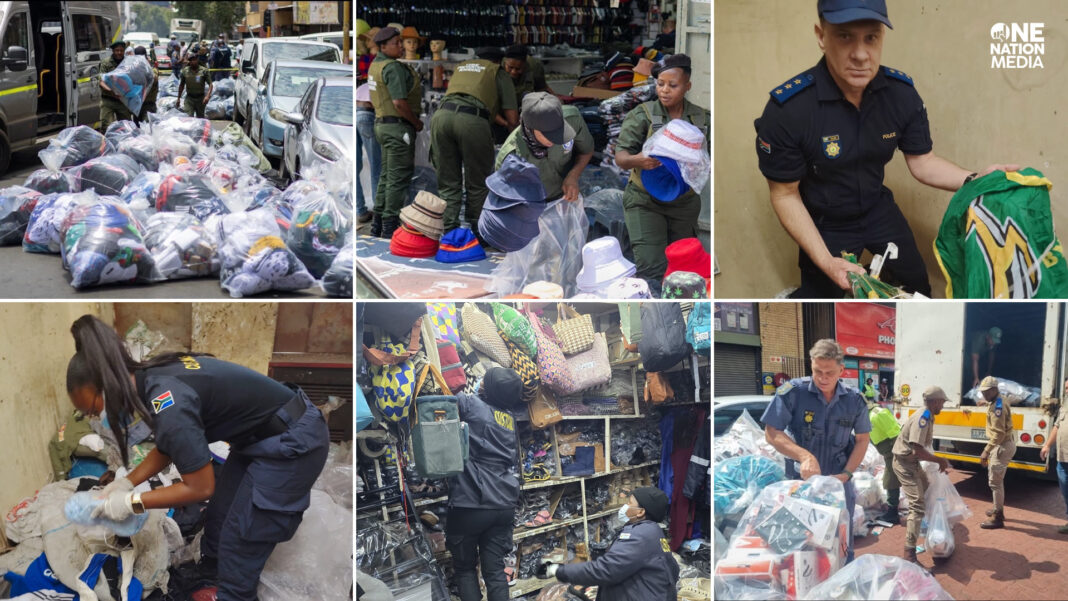
Between January and August this year, authorities seized counterfeit and illicit goods worth more than R260 million across the Western Cape, Gauteng, Limpopo and KwaZulu-Natal — provinces where several major operations have taken place.
Recent raids have involved multiple government agencies.
During an operation in Johannesburg’s central business district, SAPS national spokesperson Amanda Van Wyk said the operation involved SAPS units, the Department of Home Affairs, the South African Revenue Service Customs Division and the National Regulator for Compulsory Specifications.
“This is still an active operation, which is led by several role players, both internal and external,” Van Wyk said.
Legitimate businesses also suffer significant losses. Official producers are estimated to lose as much as R187 billion in production capacity annually to the illicit market.
Beyond the financial impact, authentic brands can suffer reputational damage when consumers associate poor-quality counterfeit products with genuine goods. The widespread availability of fakes can also undermine investor confidence and create greater uncertainty within South Africa’s commercial environment.
More than trademarks
Counterfeit goods can also pose health and safety risks.
They may not be subject to the same regulatory standards as legitimate products, may fail to comply with required safety regulations and, in some cases, may not have been approved for consumer use by the relevant authorities.
For Muslims, that adds another dimension.
The question is not only whether a product carries a legitimate trademark, but whether the earnings generated through its sale are lawful and whether the transaction honours the trust between buyer and seller.
Honest business dealings strengthen communities, promote justice and build trust within the marketplace.
The rise of counterfeit goods is therefore a reminder that commercial success should not come at the expense of integrity.
As the Qur’anic principle makes clear, lasting prosperity is not measured by profit alone, but also by lawful earnings and ethical conduct.


