
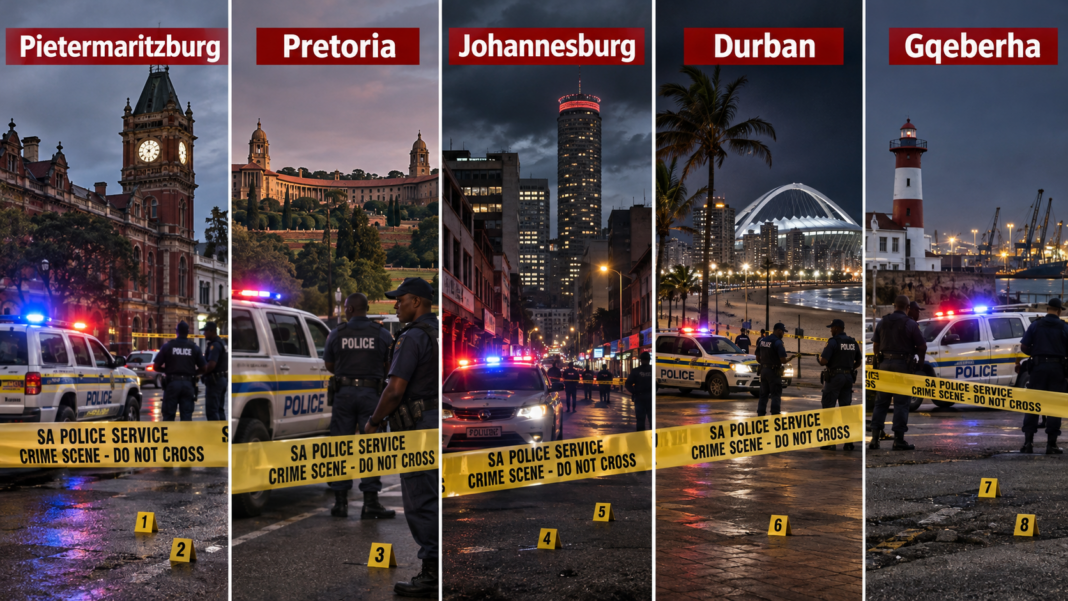

Five South African cities rank among the world’s ten most crime-ridden cities, according to Numbeo’s 2026 Crime Index. With violent crime continuing to plague the country, Moulana Uwais Dockrat questions whether South Africa’s justice system has become too lenient and argues that it is time to reconsider harsher punishments, including those prescribed under Islamic law.
The index is based on public perceptions rather than official crime statistics, but the picture it paints is disturbing nonetheless. South Africans increasingly live with the fear of becoming victims of crime.
We have almost normalised living behind electric fences, burglar bars, security gates and armed response systems. Our homes resemble prisons, while criminals appear increasingly fearless.
And yet, we continue discussing crime as though another awareness campaign, another police operation or another government promise will somehow solve the problem.
Perhaps it is time to ask a more uncomfortable question: Have we become too reluctant to seriously punish criminals?
South Africa abolished capital punishment in 1995. The Constitutional Court ruled that the death penalty was incompatible with constitutional protections of life, dignity and freedom from cruel punishment.
But should the debate end there?
When an innocent person is brutally murdered, when a family is destroyed by violent crime or when armed criminals terrorise entire communities, surely society must also consider the rights of victims and the responsibility of the state to protect innocent life.
There is a difference between cruelty and justice, between arbitrary violence and punishment imposed through a legitimate judicial process.
Perhaps the time has come to reopen the discussion on capital punishment for the most serious crimes.
And why stop at capital punishment?
Islamic criminal law offers a fundamentally different understanding of crime, justice and deterrence.
Consider the prescribed punishment of amputation for certain forms of theft. To the modern secular mind, cutting off the hand of a thief may immediately appear barbaric.
But is our present situation necessarily more humane?
What about the elderly woman assaulted during a robbery? The family whose breadwinner is murdered for a cellphone? The child who grows up in a community controlled by violent criminals?
Does a society become more compassionate simply because its punishments appear less severe?
Of course, Islamic law does not prescribe amputation for every theft. Strict evidentiary requirements, qualifying conditions and legal safeguards apply. Punishment cannot be separated from a broader system of justice, social responsibility and protection against wrongful conviction.
It must also be understood that these punishments cannot be separated from the broader conditions of society. Where poverty, hunger and economic desperation contribute to crime, these circumstances must first be addressed. Islamic law recognises such considerations, and prescribed punishments are not applied indiscriminately without regard to people’s circumstances.
Therefore, implementing these laws must form part of a much broader societal transformation that addresses poverty, ensures justice and establishes the conditions in which people can live with dignity.
The principle, however, deserves serious consideration: the consequences of crime should be sufficiently serious to protect society and discourage criminal behaviour.
We must also recognise that punishment is not simply about dealing with a criminal after a crime has been committed. It is about establishing a society in which the sanctity of life, property and personal security is taken seriously. A justice system must send an unmistakable message that violating these rights carries serious consequences.
This requires more than legislation on paper. It requires a functioning justice system in which criminals are apprehended, cases are properly prosecuted and punishments are consistently enforced. Without this, even the strongest laws become meaningless.
But the larger question remains.
Why must our discussion of justice be confined to the assumptions of one particular constitutional and philosophical tradition?
Why are alternatives dismissed before their underlying principles are even examined?
A society facing extraordinary levels of crime should be willing to question its assumptions about punishment, deterrence, victims’ rights and public safety.
This is not a call for mob justice, arbitrary punishment or abandoning due process. Quite the opposite. The more serious the punishment, the greater the responsibility to ensure fairness, certainty and protection against injustice.
We have spent decades debating the rights of criminals. Perhaps it is time to give equal seriousness to the rights of those who live in fear of them.
The question is not merely whether our punishments are humane.
It is whether our entire system of justice is adequately protecting human life.
And judging by the fear in our streets, that question is becoming increasingly difficult to ignore.


