
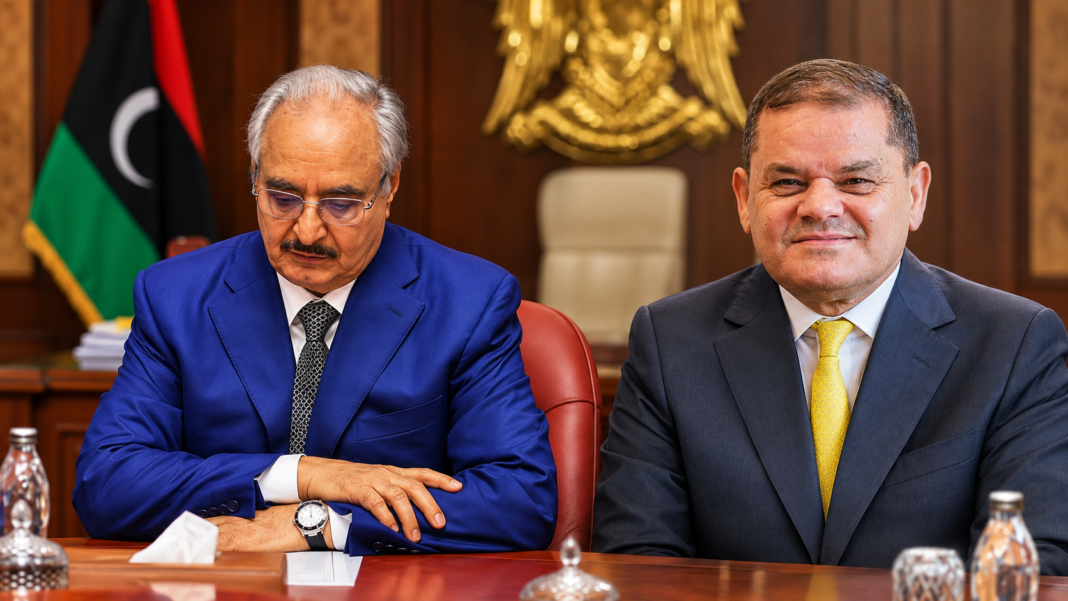

A sweeping diplomatic offensive led by Paris and Washington, against a backdrop of geopolitical rivalries, is intensifying efforts to bring Libya’s rival military camps closer together. The objective is to break the deadlock that has paralysed negotiations over the country’s reunification for years. But behind this rapprochement between the opposing military establishments in eastern and western Libya lie competing strategic interests involving Moscow and Ankara as well.
For more than a decade, Libya has remained deeply divided politically, institutionally and militarily. However, a new diplomatic drive appears to be gathering momentum, with the aim of accelerating rapprochement between the country’s two main centres of power. In early November 2026, the chiefs of staff representing the rival camps, Salah al-Namroush, from the western-based Tripoli camp, and Khaled Haftar, representing the eastern forces, were received in Paris for talks on unifying the military establishment and coordinating border control.
Yet behind this diplomatic push lies a fundamental question: is the real objective to rebuild a unified Libyan state, or to negotiate a new balance of power between local elites controlling the country’s oil wealth and foreign powers seeking to secure its strategic position in the Mediterranean?
For the United States, stabilising Libya represents a political, economic and security priority. The country possesses substantial oil reserves and occupies a strategic position in the Mediterranean, on the doorstep of the Sahel and along several major migration and trade routes. Washington therefore appears to favour a pragmatic compromise between the main power centres, one that could secure economic infrastructure and restore institutional coordination. Massad Boulos, an adviser to US President Donald Trump, has been associated with efforts to bring together the leading political families in eastern and western Libya.
France, meanwhile, is seeking to regain influence in a diplomatic process in which the United States appears to have taken the lead. According to French journalist Houda Ibrahim, Paris had reportedly been sidelined in some of the American initiatives pursued in recent months. Its renewed involvement in the negotiations may therefore reflect a desire to reassert its diplomatic standing, as well as concerns over Mediterranean security and shifting regional power dynamics in Africa.
The most controversial aspect of this mediation concerns a proposed power-sharing arrangement between the two main families dominating Libya’s centres of decision-making: the Haftars in the east and the Dbeibahs in the west.
According to reports, discussions driven by US envoy Massad Boulos have brought to the fore a possible power-sharing scenario between the Haftar and Dbeibah families. Under this arrangement, Saddam Haftar, son of military commander Khalifa Haftar, would reportedly be appointed president of a future executive authority, while Abdel Hamid Dbeibah would remain head of government. This is not, however, an officially confirmed US position, but rather a potential compromise reportedly being discussed in Libyan political and diplomatic circles.
Such an arrangement has already generated opposition within the Tripoli camp. Diplomatic pressure has also included repeated warnings of severe financial and legal sanctions against Libyan actors obstructing the ongoing negotiations. A peace imposed under such circumstances would remain structurally fragile. Washington, meanwhile, appears to be seeking to turn reunification into a source of economic and strategic leverage.
Tarek Megerisi, an associate fellow at the European Council on Foreign Relations (ECFR), has also argued that the United States is seeking to promote an arrangement between the two de facto ruling families in the country. He warns that such a compromise could entrench a new authoritarian system.
For France, the challenge is to prevent the United States from becoming the sole power broker in Libya. Paris is seeking to preserve its role in the country’s military restructuring, contain Russian influence in the Mediterranean and the Sahel, and protect its energy and security interests. Behind the stated objective of reunification, pursued without any genuine consultation with the Libyan population, both powers are seeking to influence the architecture of Libya’s future political order and shape the country’s strategic alliances.
Russia and Turkiye
The international dimension makes the process even more complex. Libya’s divisions are not solely the product of internal rivalries; the country is also constrained by foreign powers that have turned it into a strategic geopolitical foothold. In the east, Russia maintains military ties with Khalifa Haftar’s camp, notably through Russian military structures and the presence of the Africa Corps. This foothold provides Moscow with significant strategic leverage in the Mediterranean and across Africa. A reunification process backed by Washington could therefore become a source of concern for Moscow if it threatened to undermine its military positions.
In the west, Turkiye also has substantial military, economic and maritime interests. Its support for the Tripoli authorities has enabled Ankara to consolidate its influence, particularly through military cooperation agreements and maritime arrangements concluded with the Libyan authorities. Turkey may therefore approach any new security architecture with caution, especially if it risks undermining the guarantees it has secured through its involvement in Libya.
Nevertheless, Moscow and Ankara are not necessarily opposed to reunification as such. Their positions will largely depend on their ability to safeguard their respective interests within any emerging political and military order.
For all four foreign powers, the guiding consideration is their own strategic interests, rather than the liberation sought by the Libyan people.
The ongoing manoeuvres also raise questions about the role of the United Nations in Libya. For several years, the United Nations Support Mission in Libya (UNSMIL) has sought to facilitate inter-Libyan dialogue, but with little success.
The Franco-American initiatives could help bring about security rapprochement and short-term stabilisation. However, unifying institutions does not necessarily mean reconciling a nation. As long as political rivalries and foreign interests remain unresolved, Libya risks moving from institutional fragmentation to a new power-sharing arrangement among entrenched elites, leaving a revolution against dictatorship to culminate in another dictator’s rule, compounded by foreign domination.
For the Libyan people who revolted against dictatorship, what would such a settlement achieve? Replacing one dictator with another, while securing the interests of foreign powers, would leave them without the liberation they sought.