
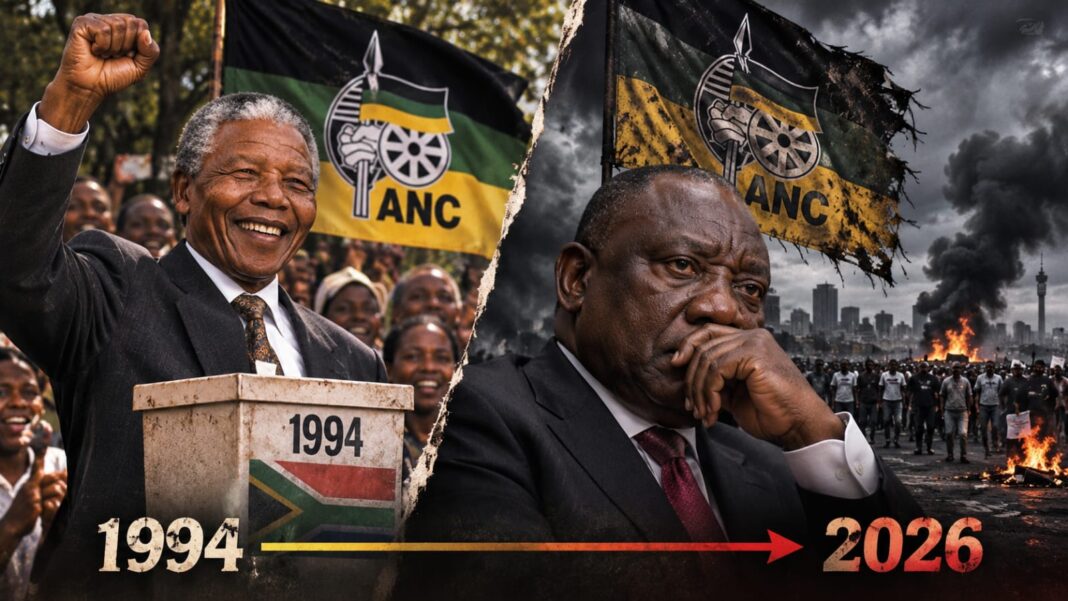

The African National Congress (ANC), once the unrivalled political force that carried Nelson Mandela to power and led South Africa out of apartheid, has suffered a historic electoral defeat. More than three decades after its landmark 1994 victory, the former liberation movement has seen its support collapse to just 30.76% in the 4 November local government elections, raising profound questions about its political future.
The final results, declared by the Electoral Commission of South Africa (IEC) on Sunday, 8 November, confirm the ANC’s worst municipal election performance to date, down from 45.6% in 2021. Although it remains the country’s largest political party nationally, its once-commanding grip on the electorate has weakened dramatically as opposition parties gain ground and coalition politics reshape the country’s political landscape.
The outcome extends a period of declining electoral support for the former liberation movement, which lost its parliamentary majority in the 2024 national and provincial elections, leading to the formation of the Government of National Unity (GNU).
The Democratic Alliance (DA) retained second place nationally, increasing its share from 21.7% in 2021 to 24.60%. The uMkhonto weSizwe (MK) Party, contesting local government elections for the first time, secured 9.61%, followed by the Economic Freedom Fighters (EFF) with 6.25% and ActionSA with 5.68%.
Other political parties and independent candidates collectively accounted for 22.97% of the national vote, reflecting the increasingly fragmented nature of South Africa’s political landscape.
Opposition parties gain ground in major cities
The shift in electoral support was particularly evident across the country’s eight metropolitan municipalities, where the ANC failed to emerge as the leading party in most major urban centres.
The DA secured the highest share of the vote in five metros: Johannesburg, Cape Town, Tshwane, Ekurhuleni and Nelson Mandela Bay. Its strongest result came in Cape Town, where it received 56.42%, securing an outright majority in the municipal council.
In Johannesburg, the country’s economic hub, the DA emerged as the leading party with 34.79%, followed by the ANC at 20.25% and ActionSA at 16.27%. In Tshwane, the DA secured 34.37%, with ActionSA receiving 22.07% and the ANC 20.22%.
The DA also led in Ekurhuleni with 30.68% and Nelson Mandela Bay with 44.17%.
In KwaZulu-Natal, the MK Party emerged as the leading party in eThekwini, securing 38.29% of the vote. The DA followed with 25.45%, while the ANC received 16.43%.
Meanwhile, the ANC retained its lead in Buffalo City, with 41.93%, and Mangaung, where it received 33.91%.
The results illustrate how political support varies across municipalities, with no single party commanding the same level of support nationally and across the country’s major urban centres.
Coalition negotiations take centre stage
With no single party securing an outright majority in 127 of the country’s 213 municipal councils, coalition negotiations are expected to play a central role in determining who governs in numerous municipalities.
The IEC confirmed that 72 councils had a party with an outright majority of seats. In the remaining 127 councils, no party secured more than half of the seats, making them hung councils.
Johannesburg, Tshwane, Ekurhuleni and eThekwini are among the metropolitan municipalities where coalition arrangements will be particularly significant.
South Africa’s municipal system does not provide for the direct election of mayors by residents. Instead, councillors elect mayors once municipal councils have been constituted. This means that the party receiving the highest share of votes does not automatically secure the mayoral position.
The negotiations will therefore determine which parties can reach agreements, secure sufficient council support and establish functioning municipal administrations.
Beyond the ballot box
The IEC recorded national voter turnout of 52%, an increase from the 45.9% recorded in the 2021 local government elections. Approximately 14.9 million people voted out of a registered electorate of 29.2 million.
A total of 521 political parties and 636 independent candidates contested the elections, collectively fielding approximately 137,000 candidates.
While the results reveal a redistribution of political support, the responsibility of governing remains the central challenge facing elected representatives.
Municipalities are responsible for essential services, including water and sanitation, refuse removal, municipal roads and local infrastructure. These are the areas in which residents directly experience the consequences of municipal governance.
For communities dealing with unreliable services, infrastructure failures and deteriorating public amenities, the formation of a new administration is only the beginning. The incoming councils will be expected to demonstrate that their political agreements can translate into functioning administrations capable of addressing these challenges.
With the results declared, the focus now shifts from electoral campaigns to coalition negotiations, the formation of councils and the delivery of municipal services.
The election has determined who will occupy the council chambers. Whether those elected can restore public confidence and improve conditions in the communities they represent will be measured long after the ballot boxes have been packed away.


