
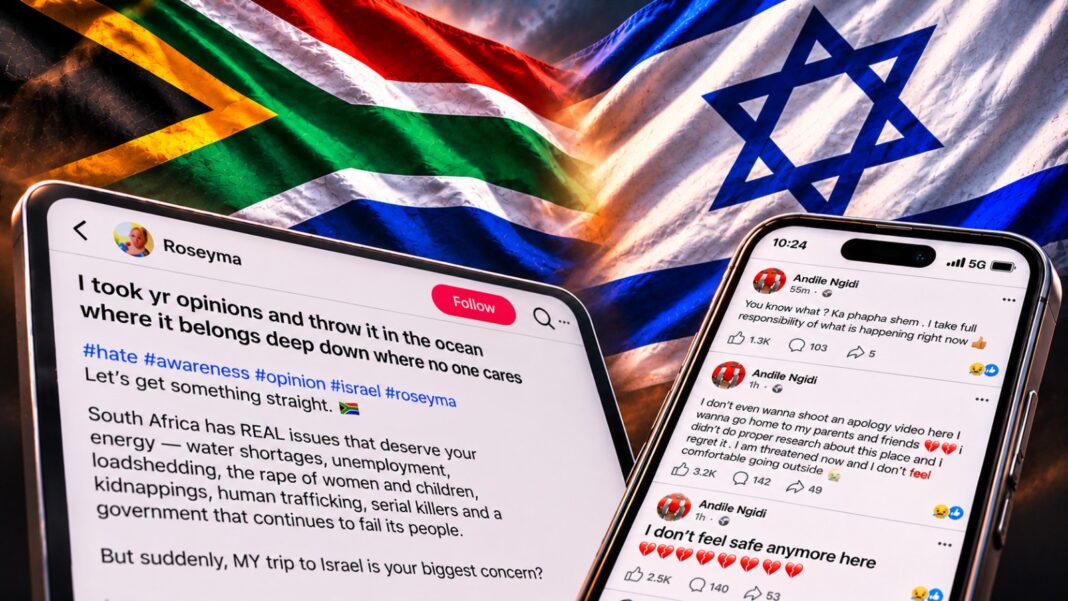

As sponsored trips to Israel spark outrage, South African influencers who rejected invitations have revealed financial offers and pressure to visit the country, raising questions about efforts to reshape Israel’s image amid the suffering of Palestinians in Gaza and the West Bank. They say the offers were about image, not tourism.
But not every South African influencer is willing to put a price on their influence. As sponsored trips to Israel spark public outrage, several creators have revealed how they rejected invitations to promote the country, questioning the motives behind offers of money, travel and carefully curated experiences.
Their refusals have added a different dimension to the controversy, shifting attention from those who accepted the trips to the organisations approaching South African personalities and the possible objectives behind what critics see as an attempt to rehabilitate Israel’s international image.
The revelations raise a pressing question: is Israel seeking genuine cultural engagement, or are South African influencers being recruited to present a favourable image of a country facing growing international scrutiny and isolation over its treatment of Palestinians?
‘They think I am dumb’
Comedian and podcaster Zille Wizzy revealed that he was offered an invitation to Israel. “I saw the message and said lol, these people are crazy, they think I am dumb,” he said.
Durban-based content creator Entertainmentsquare2 Backup also disclosed that she had been approached but declined after questioning the destination and the risks of travelling to a region experiencing conflict.
“I was one of the people that got called to go on the pre-trip to Israel; this is my backup account, drop a follow. Anyway, when I heard Israel, I said, huh, who, where, how? Isn’t there a war that’s happening in Israel? You want me over there to go float in the Dead Sea, and you want a missile to launch itself as I’m floating in the Dead Sea?” she said.
According to the influencer, an agency continued trying to persuade her, suggesting she would never receive another opportunity like it.
Podcaster Charlene Mpete similarly revealed that financial incentives were presented when she was approached to participate. “When the booking came, it said Tel Aviv, Middle East… They showed me the money via video call; luckily there is some spirit that said no,” she said.
Their accounts raise questions about who is financing the invitations, what participants are expected to promote and whether audiences are informed about the commercial arrangements behind the content they consume.
An employee at Beds2go also posted a video on TikTok, saying: “Someone called me saying he’ll pay for my ticket and my accommodation, as long as I advertise for Israel.”
The employee questioned the awareness of influencers who accepted the offer: “What kind of influencers are you that you don’t know what’s happening in the world, or you’re sleeping under a rock?”
When influence becomes a marketing tool
While several influencers rejected the invitations, others accepted. Content creator Roseyma, known as Miss Independent, dismissed the backlash, arguing that South Africans should focus on domestic challenges rather than her travels.
“I am a content creator, not a politician. I am not here to debate politics, defend governments or carry the burden of your political opinions,” she said.
Another participant, Mellow, reportedly removed videos of her travels following criticism. Andile Ngidi, known as Space Andza, expressed regret over his participation, acknowledging that he had failed to properly research the offer. He subsequently apologised and announced his intention to return home.
Mufti Usamah Dockrat of the Guardian Institute’s research unit believes the controversy exposes how financial incentives and sponsored travel can shape the decisions of individuals regarded as independent voices.
“I think the first mistake we make is calling these people influencers, as though they are independent thinkers shaping public opinion,” he said.
“Many so-called influencers are actually more influenced than they are influencing. They are influenced by algorithms, trends, popularity, sponsorships, money and the expectations of their audiences. Their livelihoods often depend on remaining relevant and keeping certain people happy.
“So we must ask: Who is really influencing whom?” Mufti Dockrat said.
He warned that promotional campaigns need not involve explicit political messaging to influence public perceptions.
“You do not necessarily need to convince someone to defend Israel’s actions. Sometimes you simply need them to post beautiful pictures, enjoy themselves and present an attractive image of the country. The political message is communicated without ever being explicitly stated.”
His observations highlight concerns that sponsored lifestyle content could help normalise Israel’s image while diverting attention from Palestinian suffering, even when participants do not openly discuss politics.
The controversy comes against the backdrop of South Africa’s genocide case against Israel at the International Court of Justice (ICJ). Pretoria accuses Israel of violating the Genocide Convention through its military conduct in Gaza, allegations Israel denies. Although the Court has issued provisional measures, it has not delivered a final judgment on the genocide allegations.
Who benefits from Israel’s image makeover?
For South Africans, whose history is deeply connected to the struggle against apartheid, the controversy extends beyond the right of individuals to travel. It raises questions about whether sponsorships and social media popularity can be used to influence public attitudes towards Israel while the plight of Palestinians remains unresolved.
The identities of those ultimately financing and directing the latest influencer trips have not been independently established. However, the accounts of influencers who were approached or accepted the offers warrant closer scrutiny of the arrangements, particularly any payments, promotional obligations and requirements to disclose sponsorships.
If the purpose is simply tourism, why are financial incentives being offered, and what exactly are these influencers expected to deliver?
For those who rejected the invitations, the controversy has demonstrated that not every opportunity is worth accepting. Their decisions have also challenged the assumption that popularity and financial reward must take precedence over principle.
As Israel’s promotional efforts face scrutiny, the bigger question is no longer simply what influencers are showing their audiences, but who is paying for that exposure and what those behind it hope to achieve.
Sometimes the most powerful message an influencer can send is not a sponsored post, but the decision to say no.


