
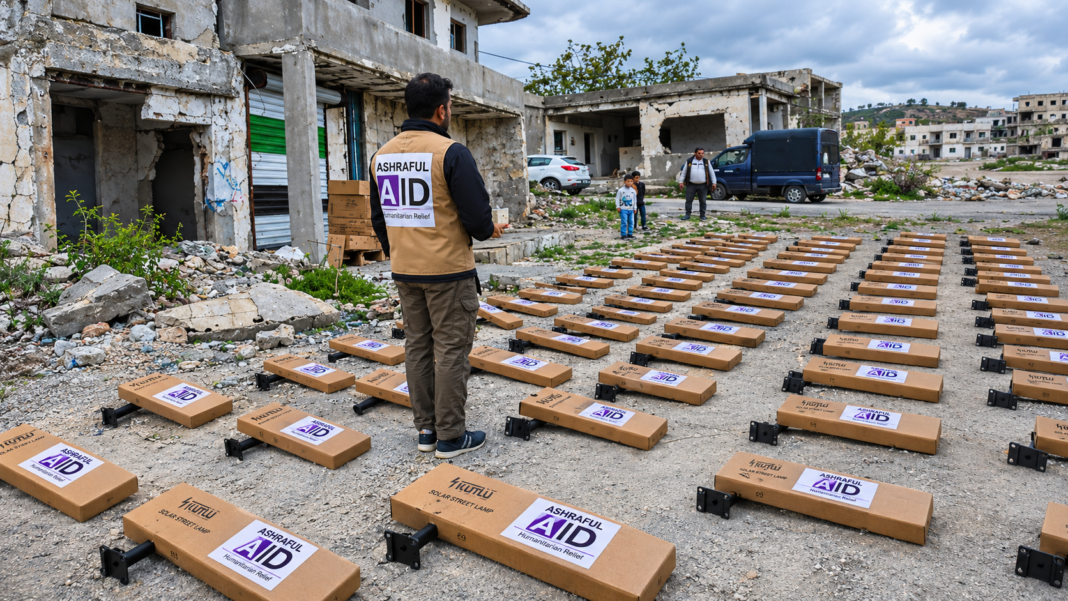

After years of devastating war, displaced Syrian families are struggling to rebuild their lives, with access to bread, essential medication, electricity and secure housing remaining daily challenges. Humanitarian organisation Ashraful Aid is working to restore these basic necessities while helping vulnerable communities move beyond survival towards stability and self-sufficiency.
Rebuilding a country after years of war is not only about restoring damaged buildings and infrastructure. It is also about helping families put food on the table, access medication, find shelter and regain the stability they once had. For many Syrians, the effects of years of conflict continue to shape everyday life, with families still struggling to access necessities and rebuild what they have lost.
Ashraful Aid has been working with affected communities in villages across Syria, providing humanitarian assistance while supporting projects aimed at helping families move beyond immediate relief. Through its bakery project, humanitarian pharmacy, food distributions and solar energy initiatives, the organisation is working to address some of the daily challenges facing vulnerable families.
More than temporary assistance
Speaking to One Nation Media (ONM), Zaeem Kara, Marketing Coordinator and representative of Ashraful Aid, explained that the work goes beyond temporary assistance.
“Ashraful Aid’s work goes beyond providing temporary assistance, with a focus on restoring dignity, stability and a sense of normality to communities affected by the conflict,” he said.
“For many of them, things we take for granted, like having bread on the table, access to medication or reliable electricity, are still daily challenges,” Kara said.
Its bakery project provides bread to displaced families while creating employment opportunities for local communities. The humanitarian pharmacy helps make essential medication more accessible, while food distributions provide assistance to households struggling to meet their basic needs. The organisation has also introduced solar energy projects in local villages, recognising that access to electricity plays an important role in rebuilding everyday life.
“Reliable electricity allows children to study in the evenings, helps families carry out household activities and provides communities with a more dependable source of energy,” Kara said.
Getting aid to those who need it
However, getting humanitarian assistance to those who need it most remains a challenge. According to Kara, the scale of need following years of conflict, alongside damaged infrastructure and difficulties accessing remote communities, makes delivery particularly challenging.
Some families have lost their homes and livelihoods, leaving them unable to provide for themselves. Their needs also continue to change, with households requiring food assistance at one point and medication or shelter at another. With rising inflation around the world, things are not easy.
“We work closely with our partners on the ground to identify communities with the greatest needs, paying particular attention to children, women, elderly people and displaced families,” Kara said.
“Ultimately, our challenge is not only getting aid into Syria, but ensuring that it reaches the right people, at the right time, in a way that preserves their dignity,” he added.
From relief to self-sufficiency
While emergency assistance remains necessary, Ashraful Aid says long-term recovery requires more than providing families with their immediate needs. The organisation has supported housing initiatives that have allowed displaced families to move out of temporary shelters and into proper homes, giving them a safer environment from which to rebuild their lives.
It has also supported vocational training opportunities for Syrian refugees, helping individuals develop practical skills that could eventually allow them to earn an income and support their households. Education is another important part of its approach. The organisation believes that giving children access to learning and adults opportunities to work can contribute to a more sustainable future.
Its bakery project is one example of how humanitarian assistance can also create opportunities for self-sufficiency, providing food to families while generating employment for members of the community. Kara emphasised that Ashraful Aid’s long-term vision is to help families move away from relying entirely on humanitarian assistance and towards having the skills, opportunities and resources to support themselves.
Trust and accountability
Because humanitarian organisations rely on public contributions to continue their work, questions about the use of donations and accountability remain important.
“Transparency and accountability are extremely important to us because every donation represents somebody placing their trust in Ashraful Aid,” Kara said.
“When someone contributes towards our Syria projects, they are trusting us to use those funds responsibly and to make a meaningful difference.”
“We recognise that responsibility, which is why proper financial records, project oversight and communication with our implementation partners are essential to our work.”
“Our approach is to ensure that project funding is allocated towards its intended purpose, that distributions and activities can be documented, and that we receive feedback from those implementing the projects on the ground,” Kara said.
He added that donors are kept informed through project updates, reports and visual documentation where possible.
“Accountability isn’t only about showing how much money has been spent. It’s about demonstrating what that contribution has achieved and how it has improved people’s lives.”
“For us, the trust of our donors is what allows us to continue serving vulnerable communities, and maintaining that trust is something we take very seriously,” Kara said.
As Syria continues to face the consequences of years of conflict, the need for humanitarian assistance remains significant. For organisations such as Ashraful Aid, the challenge is not only responding to immediate suffering but also supporting communities as they work towards rebuilding their lives.
Ultimately, rebuilding begins at the household level, where access to food, healthcare, electricity, education and employment can make the difference between surviving another day and having the opportunity to build a better future.


