
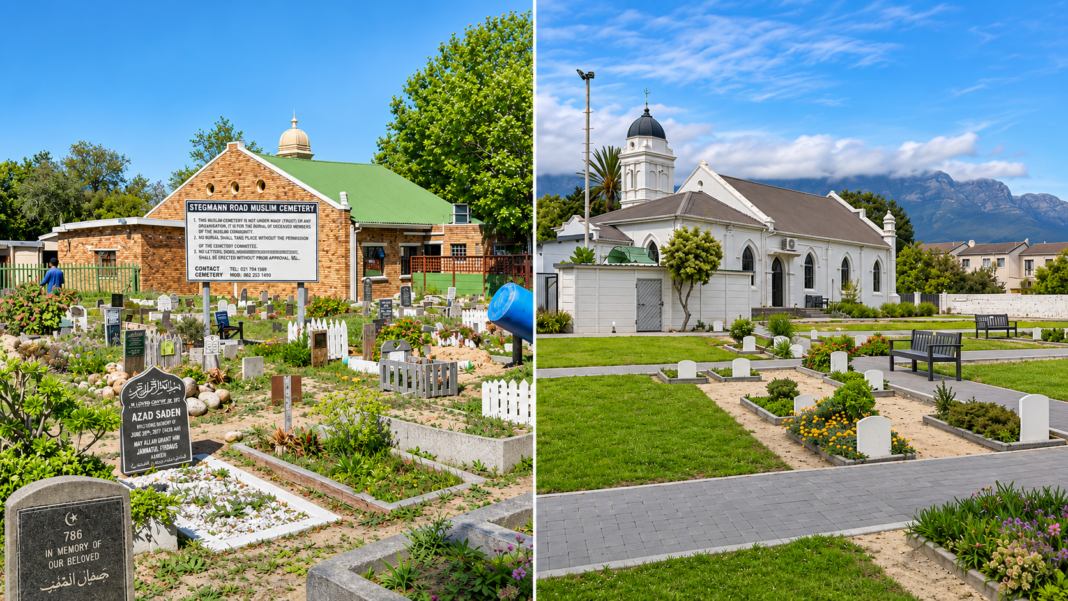

With Cape Town running out of Muslim burial space, communities are turning to an old practice to buy time: reopening graves.
For more than a century, the Stegmann Road Maqbara in Claremont lay silent. Its last burial took place in 1911. The land, earmarked for Muslim burials, sat unused while the community around it was forcibly removed under the Group Areas Act.
When it reopened, it was not just a reclaiming of space. It was an act of historical justice and a warning of what is coming.
Cape Town will run out of Muslim burial space within a year.
That was the warning issued a few months ago by Muslim Judicial Council (MJC) president Shaykh Riad Fataar. The shortage, he said, extends across both private Muslim cemeteries and Muslim sections in municipal cemeteries.
Fataar, who chaired the MJC’s Burial Administration from 2007, says the crisis was anticipated more than two decades ago. A Metropolitan Cemetery Study undertaken by the City of Cape Town in 2003 had already identified mounting pressure on burial space across the metro.
In the years that followed, the City made space available at Klip Road and within several municipal cemeteries, including Delft, Welmoed, Maitland, Modderdam Road and Khayelitsha. Klip Road North was developed with space for approximately 3,600 Muslim graves.
“Those allocations delayed the crisis, they did not resolve it,” Fataar said.
In 2021, the City stated that its cemeteries were accommodating approximately 150 Muslim burials a month. COVID-19 increased demand, and the Muslim allotment at Klip Road was exhausted. The City created a Muslim burial block at Maitland with capacity for a further 837 graves.
By August 2025, the Muslim allotments at Delft and Muizenberg had also reached capacity, while Constantia closed for new burials.
Families could apply to reopen existing graves at Klip Road, Delft and Muizenberg, and the City was considering the same option at Constantia. Space for new graves remained available at several other municipal cemeteries, including Maitland, Welmoed, Rusthof, Modderdam and Ocean View.
The 15-year rule
The solution now being adopted across the city is grave recycling.
Fataar explained: “The MJC fatwa allows an existing grave to be reopened after 15 years, subject to strict conditions.”
“The remains of the person already buried there must be protected and the required separation maintained.”
“The family must agree to the reopening, while the City must confirm that the grave can accommodate another burial.”
“Reopening older graves has extended the life of existing cemeteries. It has, however, not replaced the need for new land, and not all families want to reopen a grave,” he added.
The MJC has also explored land offered by the private sector but found some sites unsuitable because of a high water table, while others could not proceed without costly environmental studies that community organisations could not afford.
Fataar said the City had not indicated how much of the proposed new capacity would be set aside for Muslim burials or when it would become available.
“Further municipal sections might provide short-term relief, but would not settle the larger question. What we are looking for is something permanent.”
“The City’s earlier interventions bought the community time,” he concluded. “That time is now running out.”
Learning from the world
At Stegmann Road, the leadership is looking abroad for models that could create more space.
Nazeem Jamie, Managing Trustee of the Moslem Community Claremont Trust and Executive Chairperson of the Al-Jaamia/Stegmann Road Mosque, said they are observing how highly urbanised Muslim populations are coping.
“This is absolutely a global crisis, and we are paying close attention to how highly urbanised Muslim populations across the globe are coping,” he said.
“For instance, in parts of Europe, the UK and Malaysia, the double interment or ‘double-depth’ burial method has become a structured standard.”
“Islamic councils there have issued formal fatwas allowing family members to be stacked vertically in a single plot over time,” he said.
“They achieve this by initially digging deeper down to seven feet, burying using the traditional shiq method, replacing the soil, and later digging only five feet down to bury a second relative. A strict barrier of earth and wooden planks separates them, ensuring the lower remains are never disturbed.”
Jamie said prominent bodies, such as Egypt’s burial authorities, have ruled that multi-level graves or brick-vaulted levels are permissible.
“While we must stay strictly aligned with local MJC rulings, knowing that these models exist legally within Shari’ah internationally gives us some confidence moving forward,” he said.
The Stegmann Road Maqbara consists of two distinct sections. The first is land directly owned by the Moslem Community Claremont Trust, while the second is a portion allocated by the City of Cape Town for Muslim burials.
Currently, the entire site can accommodate approximately 1,300 graves, Jamie said. “However, we are starting to fill up spaces at a steady pace.”
“Because of this, we have to think long-term and carefully consider eligibility. We have a growing community, existing pre-reserved graves for our elders, and our immediate feeder areas to look after, which include Newlands, Claremont, Harfield Village and Rondebosch.”
There is also a powerful element of historical justice tied to the project.
“This is incredibly close to our hearts. The Muslim community of Claremont were among the very first victims to be forcibly removed under the Group Areas Act,” Jamie said.
“When we reopened the maqbara, we wanted to right a historical wrong by affording a once-off opportunity to elders who were forcibly displaced from this area, and we allowed them to secure a grave by pre-reservation.”
“We applied a strict set of criteria to a dedicated pool of 300 graves to ensure that those who lost their homes here could at least secure their final resting place in the soil they were torn away from.”
The leadership is also trying to secure a large piece of land adjacent to the mosque that belongs to the City. The land was earmarked for social housing, but due to the growing crisis, they believe it could be reallocated for additional burial plots.
“We need to sit down with the decision-makers, present our case, and negotiate the future utilisation of that land to safeguard our community’s future,” Jamie added.
Constantia: digging deeper, sooner
At Constantia Maqbara, owned by several families who purchased the land years ago, the same pressure is forcing innovation.
Natheem Hendricks, Chairperson of the Mosque and Cemetery Committee for Masjid Monier, said part of the burial site is close to 200 years old. The second portion celebrated its centenary a few years ago.
“There is limited space for burials. If we should continue burying regularly, then we should have space about 2–4 years,” he said.
“What we started a few years back was the reburial. After 15 years of a family member being deceased, we encourage the family to be buried in the same site. Because of that, we’ve started a process of multi-level burials.”
“We go slightly deeper, which would allow the second burial to happen two to three years later instead of the 12–15 years. That will be family burial sites.”
“If we can manage this process adequately, we may have sufficient space for another 10 years. On a rotational basis, this can happen to increase burial space,” Hendricks added.
Constantia is also considering a previously used burial site.
“We have had interaction with the City for additional space because we are considering another property,” he said. “There is an older burial site where Muslims previously buried, which is the Prestwich Road site.”
“We contacted the City for consultations, but that has not taken place. They haven’t responded to us as yet,” he concluded.
What the City says
It has been reported that the City has only made burial space available through Muslim sections in general municipal cemeteries. It last provided land for a dedicated Muslim cemetery about a century ago.
According to the Constitution, responsibility for cemeteries rests with local government. The Municipal Systems Act requires municipal services to be accessible, sustainable and regularly reviewed for expansion or improvement.
Cape Town’s Cemeteries, Crematoria and Funeral Undertakers By-law allows the City to reserve sections for specific faith communities and requires religious burial practices to be considered. It does not, however, require the City to provide a stand-alone Muslim cemetery.
The City’s 2026/27 budget allocates R73.1 million to cemetery upgrades across Cape Town. It is also seeking approval for new or expanded cemeteries in Strand, Kuils River, Mitchells Plain and parts of the southern suburbs.
The Recreation and Parks Department this week confirmed that many of its older cemeteries have reached capacity and are currently only able to accommodate second burials in existing family graves or the interment of ashes.
In a statement, the department said: “Historically, the Muslim community has been allocated burial land through Crown Grant arrangements. However, these burial grounds have also reached capacity.”
“In response, permission was granted for two cemeteries, namely Brodie Road Cemetery in Wynberg and Stegman Road Cemetery in Claremont, to be reopened for new Muslim burials after having remained dormant for several decades.”
“In addition, the Welmoed Cemetery has been extended to accommodate 1,099 additional Muslim burial spaces.”
“Furthermore, the City of Cape Town is planning to incorporate dedicated Muslim burial sections into 8 future cemetery extensions and new developments. These include the Kuils River and Rusthof cemetery extensions, as well as the new Tafelsig and Vaalfontein cemeteries.”
The cost of distance
The crisis falls hardest on poorer families, who have to travel long distances to bury their loved ones in affordable graves further away from home because space closer to their communities is gone.
Currently, the Mowbray Maqbara still offers space and is the cheapest option. Muizenberg, Klip Road, Johnson Road and several others are among those filled to capacity.
Nageeb Nordien, author of the Janazah Handbook, explained that the cost of burying a loved one has increased drastically because of distance, capacity issues and regulations undertakers must follow.
“For Janaazahs, undertakers come out and do the necessary at a cost. Ten to 15 years ago, the cost was way less than today, but due to capacity issues and regulations,” he said.
“We are living in a time of rising costs, constantly increasing, and different burial services charge differently.”
“Formerly, people would wash the body and transport that body of a family member to the maqbara in their private vehicles, maybe a van. Nowadays, it’s not allowed according to the rules and regulations, and it’s that, along with other things, that creates the increased costs of Janazahs.”
“R7,500–R8,000 is the going rate depending on where you’re going and who you use. If you’re going to the private maqbaras like Stegmann Road, it will cost much more,” Nordien added.
For now, the answer for Cape Town’s Muslims is not new land. It is the careful, dignified reuse of the land they already have: one grave, two burials, and a community determined not to run out of a final resting place.


