
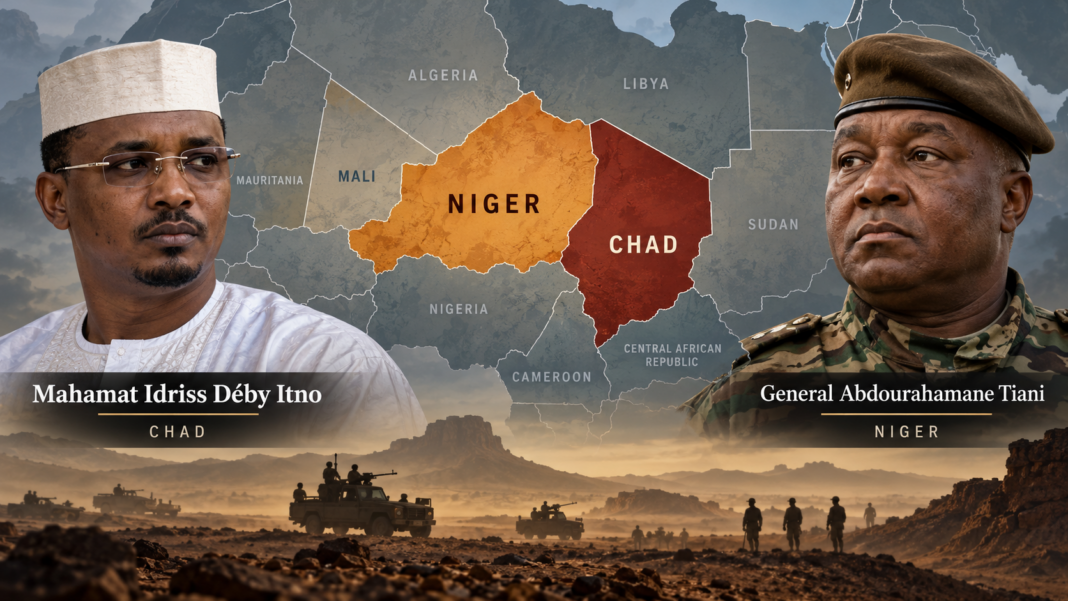

Niger has accused Chad of carrying out an airstrike, allegedly with French support, that killed two civilians. Chad denies involvement and accuses Niamey of harbouring armed opposition groups.
Niamey has threatened retaliation. N’Djamena has warned of legal action. And the Sahel faces another potential flashpoint.
In the immediate aftermath of the reported strike, Niger summoned the Chadian ambassador to lodge what it described as a “solemn protest”. The government also announced plans to refer the matter to the UN Security Council and the African Union.
Local reports suggest Niger has placed its air force on high alert and increased patrols along the border where the incident reportedly occurred.
However, the circumstances surrounding the alleged strike and reports of increased military activity have not been independently verified. What is clear is how rapidly diplomatic tensions have escalated.
A Region already realigned
The incident comes at a particularly sensitive moment for the Sahel.
Less than a month ago, Chadian President Mahamat Idriss Déby visited the Élysée Palace, where Chad and France agreed to revive military cooperation following years of strained relations.
In Niamey, where anti-French sentiment has shaped political developments since the 2023 military coup, the rapprochement has raised concerns.
Niger now suspects Paris of involvement in the reported airstrike, although France has not publicly responded to the allegation.
Meanwhile, Algeria has approved the deployment of troops to Nigerien territory to protect shared energy and economic interests, another indication of shifting regional security arrangements following the Alliance of Sahel States’ (AES) break with the Economic Community of West African States (ECOWAS).
On the ground, Chad says it has been conducting air operations in Tibesti against the Miski Self-Defence Committee, an armed opposition group operating near the Nigerien border.
N’Djamena alleges that Chadian rebels may be using Nigerien territory to undermine its government and security institutions.
Niamey, however, rejects the accusations and has repeatedly accused Chad of pursuing a “hostile course of action”, including allegedly providing “strategic depth to mercenaries attacking our populations, as well as our strategic and energy infrastructure”.
In September, Niger also accused Chad of involvement in an alleged attempt to stage a military mutiny in Niamey.
Both governments increasingly view their shared border, stretching more than 1,000 kilometres across the desert, as a potential battleground for indirect confrontation involving armed groups, smuggling networks and competing regional interests.
The risk of a proxy conflict
The increasingly confrontational rhetoric from both governments has raised concerns that diplomatic tensions could escalate into military hostilities.
Niamey insists it reserves the right to retaliate against what it considers an act of aggression.
N’Djamena, meanwhile, says it will pursue its rights and available remedies under international law if Niger fails to end what Chad describes as hostile activities.
Should tensions deteriorate further, two potential scenarios could emerge:
- Direct or indirect military clashes along the border involving state forces or allied armed groups.
- Internal instability in Chad, where external pressure could deepen divisions within the military or embolden opposition groups challenging Déby’s government.
Neither scenario has materialised, but developments elsewhere in the region highlight the dangers of escalating accusations and competing foreign interests.
Relations between Benin and Niger have deteriorated significantly since Niamey repeatedly accused French mercenaries of operating from Beninese territory to destabilise Niger.
Although no direct connection has been established between those allegations and the attempted coup against Beninese President Patrice Talon in December 2025, Nigeria provided military support and France supplied intelligence assistance to Cotonou to help defeat the attempted overthrow.
The episode demonstrated how allegations of foreign military interference can intensify existing regional tensions and complicate an already fragile security environment.
What this means for the AES
The developing crisis also presents a significant test of regional solidarity and military cooperation.
Niger belongs to the Alliance of Sahel States alongside Mali and Burkina Faso, a bloc formed around collective security, sovereignty and resistance to foreign interference, particularly from France.
A prolonged confrontation with Chad, a major regional military power outside both the AES and ECOWAS, could further fragment security coordination across a region already struggling with overlapping armed insurgencies.
Chad’s strategic location, bordering Libya, Sudan, Niger, Nigeria, Cameroon and the Central African Republic, also makes any escalation particularly consequential.
For the AES, the central question is whether to treat the dispute as an isolated bilateral confrontation or as part of a broader pattern of pressure involving governments maintaining close military relations with Paris.
The latter interpretation risks transforming a border dispute into a wider geopolitical confrontation, potentially drawing in other regional powers.
What to watch next
Beyond the competing accusations, three developments could determine whether the crisis remains a diplomatic dispute or escalates into a military confrontation.
- Establishing the facts: Can the circumstances of the reported airstrike, including its location, timing, weapons used and responsibility, be independently established?
- Diplomatic intervention: Will Algeria, the African Union or other regional mediators establish direct communication between N’Djamena and Niamey before tensions escalate further?
- France’s involvement: Will Paris publicly address Niger’s allegations, or could continued silence deepen suspicions surrounding renewed Franco-Chadian military cooperation?
With the Sahel already confronting multiple security crises, a military confrontation between Niger and Chad risks opening another front in an increasingly fragmented region.
For both governments, the immediate challenge is to prevent unverified allegations, deepening mistrust and competing foreign interests from escalating into another devastating regional conflict.


