
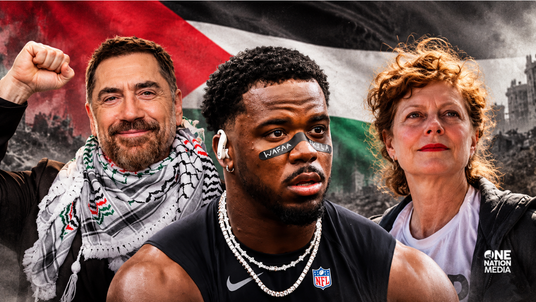

For decades, criticism of Israel carried professional and reputational risks across parts of Western politics, media and entertainment. Silence was often the safer option. That calculation appears to be changing.
From the NFL to Hollywood, athletes and actors are increasingly willing to speak publicly about Palestinians, even when doing so carries financial or professional consequences. Their interventions also coincide with a measurable shift in American public opinion, particularly among younger people.
Fined $11,941 for Hind Rajab
Houston Texans linebacker Azeez Al-Shaair, a Muslim American, was fined $11,941 by the NFL after writing “Hind Rajab” on his eye black during a game against the Buffalo Bills. The NFL prohibits players from displaying unauthorised personal messages on their uniforms and equipment.
Hind Rajab was a Palestinian child killed in Gaza in January 2024 after becoming trapped in a car with members of her family while waiting for rescuers.
A Forensic Architecture investigation examined the circumstances of her killing using satellite imagery, audio analysis and other evidence. Investigators documented 335 bullet holes in the vehicle and identified Israeli Merkava tanks in the vicinity of the car.
Her name has since become one of the most recognisable symbols of Palestinian children killed during Israel’s war in Gaza.
For Al-Shaair, the purpose of displaying it was simple: make people ask who she was.
“What’s a life worth? Is a life worth $11,000? No, I think it’s priceless,” he told reporters after the fine.
It was not his first punishment. Earlier this year, he was fined $11,593 for displaying “Stop the Genocide” on his eye black.
But the response escalated when Al-Shaair later wore the name of eight-year-old Wafaa Akila, who was killed alongside her father in an Israeli attack in Gaza. According to reports, an NFL official told him to remove the message or face being taken out of the game. He complied.
The episode sharpened the debate. The question was no longer simply how much a player might be fined for displaying such a message, but whether he would be allowed to remain on the field while wearing it.
Hollywood’s uncomfortable voices
The willingness to absorb consequences extends beyond sport.
Academy Award winner Susan Sarandon says her support for Palestinians has damaged her career. She was dropped by United Talent Agency following remarks at a pro-Palestinian rally in 2023, and said in September that she was still losing film roles because of her public stance.
She has not stopped speaking out.
On September 24, Sarandon was among at least 30 people arrested outside the United Nations in New York during a protest against Israeli Prime Minister Benjamin Netanyahu.
Around 200 demonstrators gathered wearing matching white T-shirts carrying messages including “Fund people not bombs”, “No war” and “Free Palestine”.
Spanish actor Javier Bardem has also become one of Hollywood’s most vocal critics of Israel’s war in Gaza.
The Oscar winner has acknowledged that fears of professional consequences exist, while saying his own stance has not reduced his opportunities.
“The fear does exist, granted, but one has to do things even if you feel a bit scared or afraid,” he said at the Cannes Film Festival in May.
Bardem also credited younger generations with helping drive a shift in attitudes, arguing that more people were beginning to reject what they were seeing in Gaza.
Hollywood and professional sport are industries built heavily around image, sponsorship and commercial relationships. That is what makes these interventions significant.
Al-Shaair, Sarandon and Bardem face very different pressures, but each has continued speaking publicly about Palestinians despite the prospect, or reality, of professional consequences.
What the polls show
Their visibility coincides with a significant shift in US public opinion.
A Pew Research Center survey conducted from May 4 to 17 found that American views of both the Israeli people and the Israeli government have become considerably more negative in recent years, while views of Palestinians have remained broadly stable.
In 2022, 67% of Americans viewed Israeli people favourably. By 2026, that figure had fallen to 52%.
Favourable views of the Israeli government dropped from 47% to 32% over the same period, while 62% now hold an unfavourable view.
By contrast, favourable views of Palestinian people stood at 53% in 2022 and 50% in 2026.
The shift, therefore, is not primarily a dramatic surge in favourable views of Palestinians. It is a substantial decline in the much stronger favourable views Israel previously enjoyed.
The generational divide is particularly stark.
Among Americans aged 18 to 29, 58% viewed Palestinian people favourably, compared with 32% who viewed Israeli people favourably. Just 18% had a favourable view of the Israeli government.
And sympathy for Palestinian civilians should not be confused with support for Hamas.
Pew found that 84% of Americans held an unfavourable view of Hamas. That distinction matters in a debate where concern for Palestinian lives is sometimes conflated with support for an armed group, just as criticism of the Israeli government should not automatically be treated as hostility towards Israeli people.
A principle beyond politics
For Muslims, the issue is not only political. It is also theological.
“Whoever takes a life — unless as a punishment for murder or mischief in the land — it will be as if they killed all of humanity; and whoever saves a life, it will be as if they saved all of humanity.” [Quran 5:32]
The verse underscores the sanctity of innocent life beyond national, racial and political divisions.
The change in public discourse does not mean there is consensus, nor that support for Israel has disappeared. But criticism of the Israeli government and concern for Palestinian civilians are increasingly visible in institutions where speaking out could once carry significant professional consequences.
That does not mean those consequences have vanished. Sarandon says she is still losing work. Al-Shaair has been fined and threatened with removal from a game. Bardem acknowledges the fear of repercussions.
What appears to be changing is the willingness to accept those consequences.
Al-Shaair put the principle in the simplest terms. Asked to weigh the cost of a fine against the value of a human life, there was no comparison.
A life is priceless.