
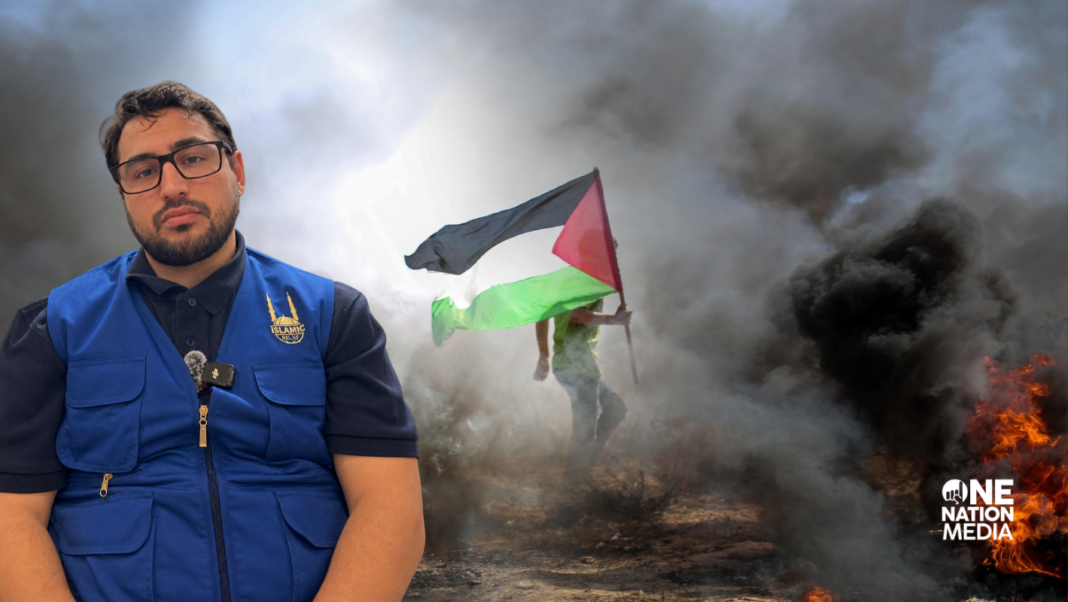

Islamic Relief Director Salaheddin Aboulgasem has described the devastating humanitarian crisis in Gaza following his recent visit to the occupied Palestinian territory, warning that Palestinians continue to endure relentless violence, hunger and displacement despite reports of a ceasefire.
Imagine waking up not to an alarm clock, but to the sound of drones.
Not knowing whether you will have enough food to feed your children. Whether the shelter you slept in will survive the rain. Whether the people you love will still be alive tomorrow.
Imagine living like that not for a day, a week or a month — but for years. That is Gaza today.
Having recently returned from Gaza, Salaheddin (Salah) Aboulgasem, Director of Global Family Development at Islamic Relief, sat down with One Nation Media (ONM) to share what life is really like beyond the photographs, videos and headlines that reach our screens.
“I think no words exist to be able to describe the realities of life on the ground in Gaza,” he said.
When bombs become ordinary
Aboulgasem recalled how sudden noises in Gaza initially startled him. What struck him most was how accustomed Palestinians had become to the sounds of war.
The constant presence of drones. The sound of bombs. The absence of safety. None of it was unusual anymore.
“That normality is not peace, normality is war. Normality is not food, it’s hunger. Normality is not shelter, it’s having no shelter.”
Perhaps the most painful reality he described was the normality of performing multiple janazah prayers — funeral prayers — in a single day.
Palestinians are not afforded the opportunity to grieve one loved one before being confronted with another tragedy. Their grief is overshadowed by the need to survive.
And despite reports of a ceasefire, Aboulgasem was blunt: “People talk about a ceasefire. There is no ceasefire. There has never been a ceasefire.”
People are still being killed. People are still living without the most basic humanitarian necessities: safety and food.
Surviving another winter
For many of us, rainfall means retreating into the warmth of our homes, climbing beneath our blankets and waiting for the weather to pass.
For Palestinians living in makeshift tents, there is nowhere else to go.
More than 95% of Gaza’s population has been displaced — not once, but multiple times, Aboulgasem said.
Recent severe rainfall and flooding destroyed more than 80,000 tents, leaving thousands of already displaced families without shelter once again.
Imagine having to abandon your home, leave behind your belongings and rebuild what little you have elsewhere, only to lose everything again.
For many Palestinian families, this has become a recurring experience.
With limited access to healthcare, food and adequate shelter, innocent children have already lost their lives in the cold, he said.
The very things many of us take for granted — a dry bed, a warm meal, clean drinking water, a roof over our heads — have become daily struggles for Palestinians.
The young girl he will never forget
During one of his visits to Gaza, Aboulgasem met a young girl whose story continues to inspire him.
Her name is Marwa. She was just nine years old.
Her home had been bombed, and her family had sought safety inside an already partially destroyed building. According to Aboulgasem, soldiers entered the building and killed both her parents in front of her.
At just nine years old, Marwa held her dying mother in her arms, unable to save her.
Yet when Aboulgasem met Marwa, rather than speaking of despair, she spoke about her future.
“When I get older, I want to be a doctor,” he recalled her telling him. “I want to have the skills and the capability to be able to save them, because I felt helpless as my mum was in my arms… dying. And I want to get an education to be able to help.”
While other children dream of becoming doctors because they find medicine exciting or inspiring, Marwa’s dream was born from the helplessness of watching her mother die.
Despite everything that had been taken from her, she wanted to dedicate her future to saving the lives of others.
“That’s the spirit of the people of Gaza. There is resilience. There is consistency. There is a feeling that, subhanAllah, they will never give up, and they will always want to support one another,” Aboulgasem said.
Despite enduring unimaginable suffering themselves, Palestinians have not lost their willingness to support one another.
Their resilience, however, should not be mistaken for an ability to endure without assistance.
When the world stops watching
For those outside Palestine, Gaza can be as close as the mobile phones in our hands — and as distant as the moment we put them down.
Aboulgasem expressed concern that people had become increasingly desensitised to Palestinian suffering. He explained that one of the reasons for his visit to South Africa was to bring attention back to Gaza.
As media coverage, protests and donations have declined, the humanitarian needs of Palestinians have not disappeared.
“People are still dying. People are still being bombed. People are still hungry,” he said.
Islamic Relief has experienced a decline in donations for Gaza, with Aboulgasem attributing this partly to the perception that a ceasefire had brought an end to the suffering.
He also acknowledged concerns among donors about whether their humanitarian aid was reaching Palestinians.
Although restrictions continue to limit the delivery of aid, Islamic Relief staff remain on the ground, risking their lives to distribute aid funded through zakaah and sadaqah.
More children have been orphaned. Children still need psychological support. Palestinians continue to suffer from hunger and thirst.
Gaza and the test of our generation
When asked how his experiences in Gaza had affected his perspective on Islam and faith, Aboulgasem turned the question towards the Ummah.
While Allah is testing Palestinians through immense hardship, those witnessing their suffering are also confronted with a test of their own.
“Our future generations will ask us as a generation: ‘You saw in 4K, on your social media, on your news, on every possible channel and avenue that never existed before, you witnessed a genocide taking place in front of you. How did you react and how did you respond?'”
For Marwa, life must continue without her parents. For countless Palestinian families, tomorrow will bring another struggle for food, water, warmth and survival.
For the rest of us, tomorrow may simply be another ordinary day.
But what will we tell future generations when they ask us what we did while the people of Gaza suffered before our very eyes?


