
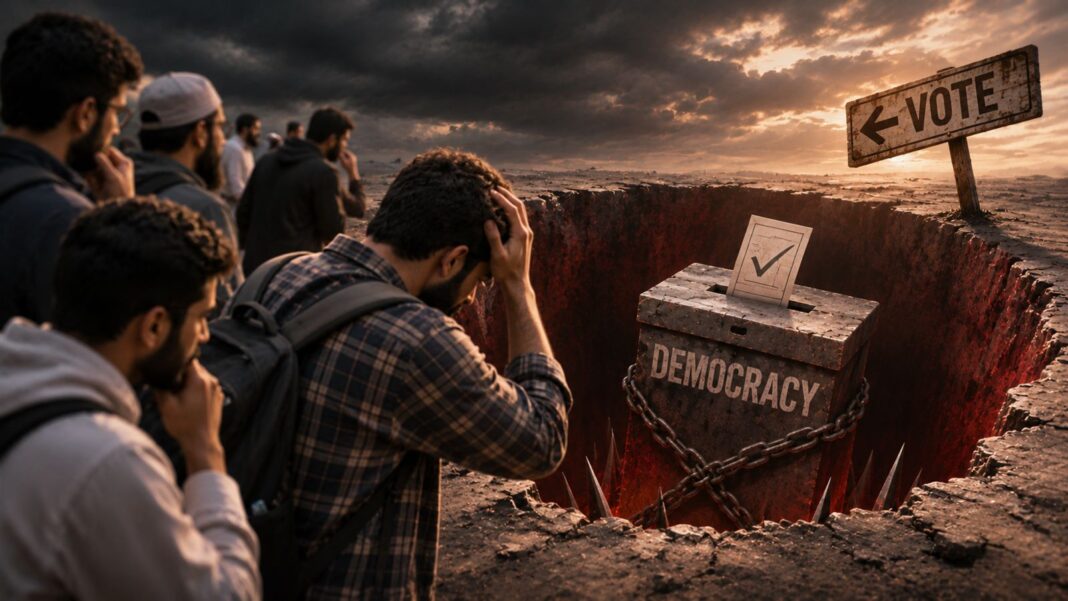

“Democracy is the worst form of government except all those other forms that have been tried from time to time,” Winston Churchill told the UK Parliament in 1947.
It is an extraordinary advertisement. Imagine a restaurant displaying a sign that reads: “Terrible food. Apparently everywhere else is worse.” The customers might accept the comparison. They would still be entitled to ask whether anyone intends to repair the oven.
Churchill’s remark has become a remarkably convenient answer to complaints about democracy. Mention corruption, broken promises or collapsing services, and someone produces it as though a quotation can repair a sewage pump. Meanwhile, the practical question remains: why can a system supposedly designed to make government serve the public create so many incentives to do something else?
The popularity contest: When winning matters more than governing
Begin with the recruitment process. The vacancy is for someone who can run a country. The interview can look suspiciously like an audition for someone who can fill a stadium.
One candidate understands public finances, admits that resources are limited and explains why repairing the water network will take eight years. Another promises immediate jobs, cheaper electricity, lower taxes and prosperity for everybody. The first has made the elementary campaign error of bringing arithmetic to a popularity contest.
Being able to move a crowd is useful. So is being able to move sewage through a pipe. These are separate qualifications.
Nor does a majority magically settle whether a policy makes sense. A million people can support an unaffordable promise without making it affordable. The national budget remains stubbornly unimpressed by applause.
Voters, meanwhile, are expected to perform an astonishing assignment. Between earning a living, raising children and finding out why the electricity has disappeared, they must assess economic programmes, investigate candidates, distinguish genuine reporting from propaganda and determine which smiling person is least likely to misplace the treasury.
A slogan can travel around the country while its correction is still putting on its shoes. Where manipulating opinion delivers votes more cheaply than solving problems, manipulation becomes a competitive advantage.
Even a well-informed voter faces another difficulty: the choices may all be poor. Selecting the least alarming candidate is hardly a ringing endorsement of the winner. Yet the victory speech will announce that the nation has spoken with overwhelming confidence.
The ballot also operates as a compulsory package deal. You wanted the education policy. Unfortunately, it arrived attached to the party leadership, an economic programme you dislike and several candidates you would hesitate to appoint to a school tuck shop. There is no box marked: “Yes to the classrooms; please remove the gentleman explaining the missing money.”
Money, political influence and the illusion of choice
Before blaming citizens for their choices, however, examine who gets to become a choice.
Campaigns cost money. A capable outsider without wealthy supporters or party machinery may never reach the serious contest. Party officials can decide the shortlist long before voters encounter it. A representative whose career depends on remaining on that list quickly learns which opinions are safe to hold.
Expensive campaigns also create dependencies. Where donations purchase influence, the financier receives a meeting while the voter receives a message beginning, “Dear valued citizen.” International IDEA identifies unchecked political financing as a route to corruption and disproportionate influence over government.
Organised interests enjoy another advantage. A company seeking a favour worth millions has every reason to employ lobbyists and maintain relationships. Each citizen paying a small share of the cost has considerably less incentive to spend Tuesday afternoon investigating it. Concentrated benefits arrive with a legal team; scattered losses arrive quietly on everybody’s bill.
Then the results appear, complete with a solemn declaration of “the people’s will”.
Depending on the electoral system, the winner may have received fewer than half the votes. A modest advantage in votes can also become a substantial advantage in seats. The mandate sometimes grows noticeably between the counting centre and the victory podium.
For a community that repeatedly finds itself on the losing side, the problem is more serious. Without enforceable protections, the same majority can keep governing while the same minority keeps being told to participate enthusiastically next time.
Coalitions introduce further surprises. People vote for one programme and receive a negotiated arrangement assembled after the election. A small party holding the deciding seats can suddenly discuss ministries in the possessive.
When those arrangements collapse repeatedly, budgets and appointments can stall while services deteriorate. South Africa’s local-government association has documented precisely these consequences of unstable municipal coalitions. The public wanted someone to collect the rubbish. The parties are still negotiating who gets the chairperson’s office.
Short-term promises, long-term failures
Once installed, the successful candidate encounters the electoral calendar.
A reform requiring fifteen years has a serious disadvantage when the next election is five years away. Necessary changes can impose immediate costs, with benefits arriving after the politician has left office. Postponing the repair may therefore be the safer career decision. Governments’ difficulty in planning beyond electoral cycles is a recognised problem.
Maintenance suffers especially badly. A new bridge has a ribbon to cut. A properly maintained bridge has inconsiderately failed to provide a ceremony.
Borrowing offers a convenient escape. Deliver benefits now, claim the applause and leave the repayments to a future government. Children are particularly useful contributors to this arrangement: they can inherit the debt without inconveniencing the campaign by voting against it.
When a new administration arrives, continuity may become another casualty. Useful projects can be cancelled, redesigned or renamed because they carry the previous government’s fingerprints. The country pays again for the privilege of starting over.
Opposition parties face their own uncomfortable incentive. Government failure can improve their electoral prospects. Supporting a useful measure may help the public while helping a rival claim success. Cooperation then acquires a political price.
Responsibility, meanwhile, becomes wonderfully mobile. The minister blames the municipality, the municipality blames the province, and the province blames the previous administration. Everybody has explained the problem. Nobody has restored the water.
Africa’s democratic dilemma: Poverty, patronage and accountability
These pressures can operate anywhere. Across African countries, their consequences become especially severe where poverty, weak institutions and concentrated power make political access central to everyday survival.
A family struggling to buy food cannot eat a manifesto. An immediate benefit may seem more credible than another promise of prosperity next decade. Research using African survey data finds that poorer voters are more likely to be targeted for vote buying. Their vulnerability becomes somebody else’s campaign strategy. People trying to survive until Friday are advised to think about the long term by politicians whose next meal is already on an expense account.
Where public jobs, contracts and assistance flow through political connections, elections become struggles over access to livelihoods. If the presidency controls too many appointments, resources and institutions, losing an election can mean losing far more than an argument.
Under those conditions, voting for “our person” can become a form of insurance. A community may fear that another group’s victory will bring exclusion. Its candidate’s disappointing relationship with competence becomes secondary to the hope of protection.
The incentive to distribute rewards also damages administration. Loyal supporters receive positions requiring skills they may not possess. Enthusiasm for the party becomes a qualification for managing a department. Unfortunately, drainage systems show very little respect for political loyalty.
An honest successor cannot instantly repair this. Governments need trained officials, reliable records, functioning procurement and the ability to enforce decisions. Changing the minister’s photograph does not create an engineer.
Accountability should restrain these failures. But elections are intermittent, while the opportunities for abuse are daily. Weak courts, auditors, investigators and legislatures leave long periods in which damage can accumulate.
Party representatives may also hesitate to expose their colleagues because the scandal could cost votes. Public oversight becomes awkward when the investigator’s career depends on the political health of the people being investigated.
The incumbent can then acquire advantages unavailable to challengers. Public resources and official publicity can be used to support the governing party, a problem documented by International IDEA in African political financing. The public is effectively asked to help finance the campaign to keep the existing leadership in office.
Where intimidation or violence enters the contest, even the freedom to choose becomes compromised. Citizens must calculate the possible consequences of supporting the wrong side. An election conducted under fear has a substantial problem that cannot be cured by producing a neatly printed ballot.
Resource wealth adds another complication. A government receiving substantial income from oil or minerals may depend less on ordinary taxpayers. The concern is that controlling that income becomes more attractive than building a productive economy responsive to citizens. IMF research finds an association between higher resource revenues and lower collection of other taxes; the wider accountability concern follows from that reduced dependence.
Even a newly elected government with decent intentions can discover that its room to act is much smaller than its manifesto suggested. It inherits debt repayments, existing commitments and expensive imports. The treasury has an irritating attachment to numbers. Voters can change the name on the office door. They cannot vote the interest bill into retirement.
Once the celebrations end, citizens may also discover that access to their representatives has become surprisingly difficult. Across 38 countries surveyed by Afrobarometer in 2024–2025, an average of only 17% said their MPs often or always tried to listen to ordinary people. The electorate’s microphone appears capable of developing faults shortly after polling day.
African countries differ enormously, and these problems vary with their institutions and political histories. Their existence does not establish that every alternative performs better. It does, however, expose the weakness of treating the act of voting as a sufficient answer to questions of competence, power and accountability.
The incentives deserve scrutiny. When expensive campaigning gives financiers influence, immediate promises outperform patient work, party loyalty protects misconduct and control of the state determines access to livelihoods, poor outcomes should provoke more than surprise at the character of the latest politician.
A system should be judged by its ability to select capable leaders, restrain abuse, correct failure and deliver the ordinary conditions of a decent life. The successful counting of votes is one part of that assessment.
Churchill’s restaurant still needs a functioning kitchen. Until then, the citizen can enjoy the familiar announcement:
“Your voice is very important to us. Please remain on hold until the next election.”


