
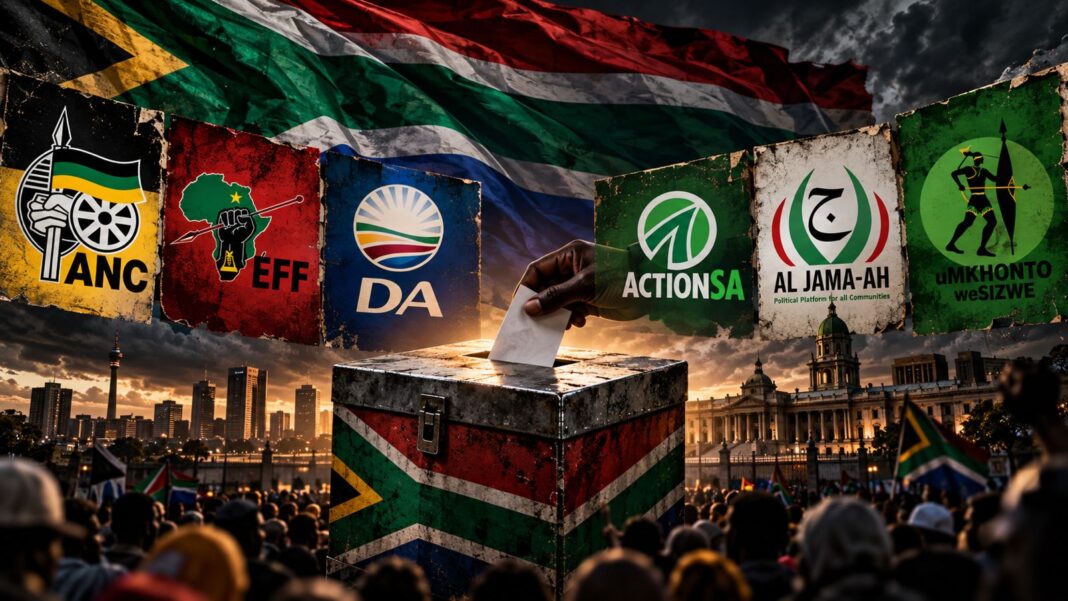

Every election season, South Africans hear about their “sacred democratic duty.” We queue, we vote, we debate coalitions and then return home to check whether there is water in the taps. The votes are counted with extraordinary precision. The potholes, meanwhile, appear to enjoy constitutional protection, writes Moulana Uwais Dockrat.
On 4 November, South Africans went to the polls for the municipal elections. The posters will come down, the speeches will fade and politicians will become harder to find. But their smiling faces and promises will surely return ahead of the 2029 national and provincial elections. Perhaps by then, the potholes will have acquired voting rights.
Yet recent surveys suggest something deeper than ordinary political frustration. South Africans are increasingly questioning not merely their politicians but the political arrangement itself.
The 2025/26 HSRC–IEC Voter Participation Survey found that only 36% preferred democracy over other forms of government. Another 34% said the form of government did not matter to them, while 26% were open to non-democratic alternatives.
Afrobarometer’s findings tell a similar story: 70% were dissatisfied with how democracy was functioning, and 49% approved of military rule. In 2022, 72% said they would consider foregoing regular elections if an unelected government could deliver jobs, housing and law and order.
None of this proves that South Africans want dictatorship. Indeed, another Afrobarometer question found that 61% favoured elections as the best way of choosing leaders. But these findings challenge the idea that electoral democracy enjoys unquestioning public confidence.
Perhaps people are tiring of being told that their greatest political achievement is the opportunity to select who will disappoint them next.
The familiar prescription: better voters, politicians, coalitions and campaigns. Apparently, the answer to decades of disappointment is another campaign poster promising to fix everything after the next election.
But what if the problem runs deeper?
What if we have spent so much time debating who should govern that we have neglected a more fundamental question: by what principles should society be governed?
Secular democracy is routinely presented as the neutral destination of political progress. Yet secularism is not an absence of worldview. It carries assumptions about religion, morality, law, freedom and the ordering of society. It decides which convictions may shape public institutions and which are to remain private.
Elections can change the occupants of government offices without changing those underlying assumptions. It is rather like changing the driver every few years while forbidding passengers to question the destination.
And majority support is not a substitute for moral truth. An injustice does not become just because 51% approve it. Nor does a vulnerable minority become less deserving of protection because it loses a vote. Checks and restraints on those in authority matter, but they do not resolve the deeper question of where moral authority comes from.
Nor does questioning electoral democracy mean welcoming military rule or handing unchecked power to a strongman. Replacing a disappointing parliament with an unaccountable ruler would merely exchange one problem for another.
There are other possibilities worth discussing.
What would government look like if authority were treated as a sacred trust rather than a political prize? If rulers understood themselves as accountable not only to those they govern but ultimately to their Creator?
If consultation, justice, public welfare, protection of the vulnerable and moral responsibility stood at the centre of political life?
If laws were rooted in enduring moral principles rather than simply in whichever coalition assembles enough votes?
South Africans want safety, dignity, livelihoods and justice. Those seeking to defend the present system can make their case. But those questioning its underlying premises deserve to be heard too.
Perhaps the real irony is this: in a system built around the will of the people, questioning the system itself is so often treated as beyond discussion.
If we are constantly told that the people are sovereign, surely they should at least be allowed to question the very system that claims to represent their will.
After another election, perhaps the next serious question is not which party should govern, but whether our political imagination extends beyond the choices printed on a ballot paper.


