
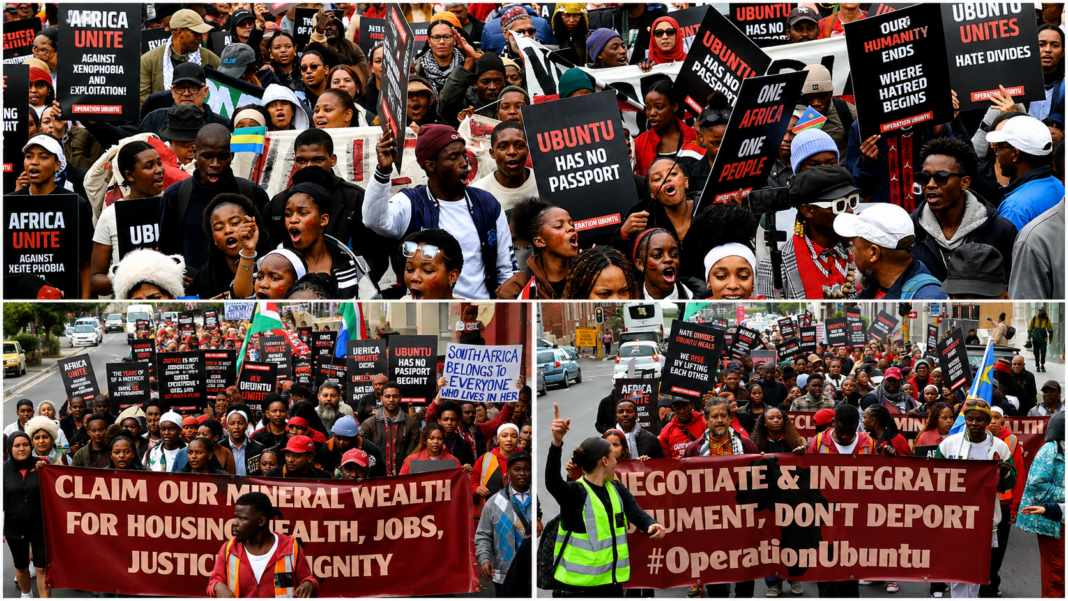

Civil society groups have called on the South African Police Service (SAPS) to protect migrant and refugee communities and act against alleged vigilante violence following nationwide #OperationUbuntu marches on 8 August.
Demonstrators took to the streets in Johannesburg, Pretoria, Cape Town and Durban as part of a coordinated mobilisation demanding an end to xenophobic and vigilante violence.
The marches culminated in a memorandum to SAPS, endorsed by 80 organisations and members of the public, which described ending such violence as a “non-negotiable” demand.
The memorandum calls for the arrest and prosecution of March and March leaders Jacinta Ngubese Zuma and Nkosikhona Ndabandaba, known as “Phakelumthakathi”, as well as Ngizwe Mchunu, over allegations of hate speech and incitement to violence.
It also calls for action against individuals accused of threatening migrant communities online.
The allegations against those named are contained in the Operation Ubuntu memorandum and have not been independently established.
The ‘Musina Moment’
Organisers say the mobilisation was prompted by events surrounding 30 June, which they refer to as the “Musina Moment”.
Nasiha Soomar, a candidate attorney and member of the Operation Ubuntu organising team, told One Nation Media (ONM) the date marked a turning point in the treatment of migrant communities.
“The immediate trigger was what we call the Musina Moment, 30 June 2026, when the state allowed vigilante groups to roam the streets and intimidate our fellow African sisters and brothers and their children,” she said.
The memorandum claims more than 160,000 people were forced to leave South Africa through what organisers describe as a “so-called voluntary repatriation programme”.
Soomar rejected the characterisation of the departures as voluntary.
“That is not voluntary, that is forced removal,” she said.
However, the figure differs significantly from the approximately 53,000 people Justice Minister Mmamoloko Kubayi has cited as having returned through voluntary repatriation and deportation processes.
Durban refugees at centre of concerns
The situation involving migrants and refugees at the Home Affairs Refugee Reception Centre on Che Guevara Road in Durban also features prominently in the memorandum.
Soomar said 457 people were processed by authorities following a period of displacement, with only two found to be undocumented.
She said many nevertheless remained without adequate accommodation and were sleeping on the pavement outside the centre.
“The state itself confirmed these were overwhelmingly legal, documented refugees,” Soomar told ONM.
The memorandum also refers to alleged threats against the community, including social media posts in eThekwini containing references to “petrol and burners”.
It further alleges that Ndabandaba assaulted a refugee at Che Guevara Road. The allegation forms part of the organisers’ call for his arrest and prosecution.
Concerns over vigilante policing
Another concern raised by organisers is the alleged intimidation and harassment of migrants by informal or vigilante groups.
Soomar stressed that the term “amapanyaza”, used in some Gauteng submissions, should not be confused with the province’s official Crime Prevention Wardens.
She said organisers were referring to informal groups allegedly checking documents, forcing migrant-owned businesses to close and obstructing access to public services.
The memorandum calls on SAPS to investigate such activity and take “direct, sustained action” against vigilante groups.
It also demands greater community safety and action against gender-based violence, drug-related violence and mass shootings.
Migrants ‘cannot be blamed’ for SA’s crises
Operation Ubuntu argues that South Africa’s unemployment, housing and public-service crises should not be blamed on migrants and refugees.
Soomar said migrants account for around 5.1% of the population, while South Africa’s unemployment rate stands at about 32%.
“There is no version of the maths where 5% of the population is responsible for an unemployment crisis of that scale,” she told ONM.
She instead attributed the country’s problems to corruption, poor governance and economic inequality, calling for greater accountability from government and businesses.
Organisers also want the government to reconsider its approach to migration policy, arguing that integration and negotiation should be prioritised over expulsion.
The memorandum calls on SAPS to investigate reports of violence, intimidation and threats against migrants and refugees, prosecute those responsible and provide protection at known flashpoints.
For Soomar, protecting refugees is a legal obligation rather than a discretionary act.
“Refugees are protected under South African law. That is not a favour we are asking for, it is the law,” she said.
Organisers say the mobilisation forms part of a broader effort to build solidarity across African communities while challenging the scapegoating of migrants for South Africa’s social and economic problems.
“Ubuntu is not suspended, and it never will be,” Soomar said.