
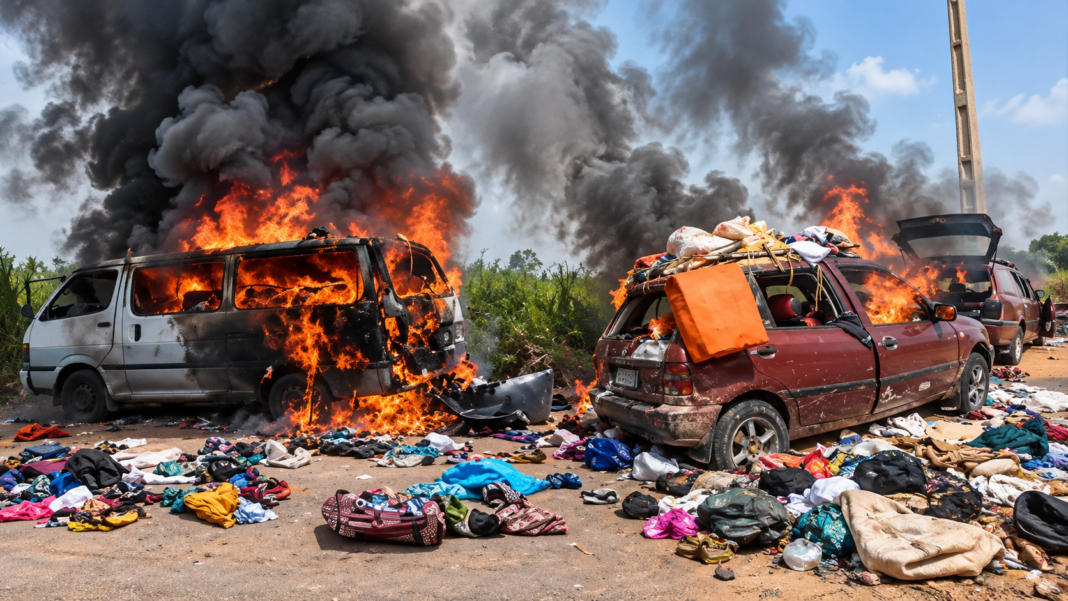

At least 22 people were reportedly killed while travelling to a weekly market under security escort in Nigeria’s Zamfara State, raising fresh questions about the protection of rural communities.
For millions of people across rural northern Nigeria, weekly markets are a lifeline, providing farmers with an opportunity to sell their produce, traders with a source of income and families with access to essential food and supplies. In parts of Zamfara State, however, even reaching the market has become a potentially deadly journey.
That danger was laid bare on Sunday, 11 October, when suspected armed bandits ambushed traders travelling under security escort along a route in Bukkuyum Local Government Area.
At least 22 people were reportedly killed in the attack, including security personnel, although some accounts have placed the death toll even higher. Several others were injured.
Initial reports indicated that the traders were travelling between Gurusu and Gwashi to attend a weekly market when their convoy came under attack.
The precise death toll remains unclear. Reports citing security researcher Malik Samuel put the figure at 27, comprising 19 civilians and eight security personnel. Subsequent reports cited Zamfara State lawmaker Hamisu Faru as saying at least 22 people, including four soldiers, had been killed.
Local resident Malam Aminu Gwashi also confirmed that civilians and security personnel were among those killed.
A lifeline under threat
Across northern Nigeria, weekly markets are far more than centres of commerce. They connect farmers, livestock owners, traders and families across communities where livelihoods depend heavily on the movement of people and goods.
When the roads leading to these markets become unsafe, the consequences extend far beyond those directly affected by attacks.
Trade slows, transport costs rise, food supplies are disrupted and farmers risk losing income as buyers and sellers become increasingly reluctant to travel.
The wider Bukkuyum area has repeatedly experienced attacks by armed groups, severely disrupting commercial activity and everyday movement.
The latest ambush is particularly concerning because the victims were reportedly travelling under security protection.
If civilians require armed escorts merely to reach a weekly market, and those escorts themselves can be overwhelmed, fundamental questions arise about the state’s ability to protect rural communities and secure the roads connecting them.
Questions over protection
Zamfara has endured years of armed banditry, kidnappings and killings that have displaced communities, disrupted farming and forced some markets and transport routes to close periodically.
The deaths of security personnel in the latest attack further underscore the dangers faced by those deployed to protect civilians.
However, sustainable protection cannot depend on armed escorts alone. It requires reliable intelligence, surveillance of vulnerable routes, stronger coordination between security agencies and trusted mechanisms through which residents can report emerging threats before attacks occur.
Several questions remain unanswered: How many people were killed? How were the attackers able to ambush a protected convoy? Were any warnings received beforehand? And which armed group was responsible?
Early reports indicated that attempts to obtain comment from Operation Fansan Yamma and the Nigerian Army’s 8 Division had been unsuccessful.
For the affected families, establishing the full circumstances of the attack is not merely a question of casualty figures. It is also a matter of accountability.
Beyond condemnation
The immediate priorities are to establish the verified death toll, provide medical care for the wounded, support the families of those killed and identify those responsible for the attack.
The longer-term challenge is far greater: restoring sufficient security so that an ordinary journey to a weekly market no longer requires military protection or carries the risk of never returning home.
For rural communities already enduring years of insecurity, the ability to farm, trade, travel and provide for their families is inseparable from the question of safety.
Until protection becomes sustained rather than reactive, ordinary acts of survival will continue to carry extraordinary risks.