
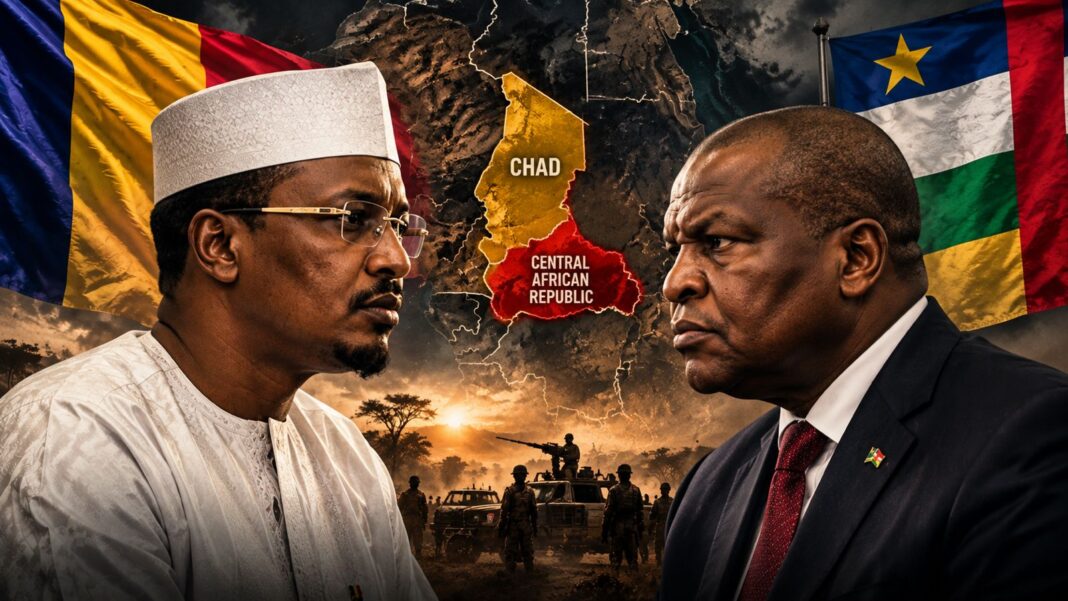

Operation in Vakaga deepens tensions as Bangui and N’Djamena give conflicting accounts of what happened along their volatile frontier.
An air and ground operation on 10 October in the Central African Republic’s Vakaga prefecture, near the tri-border area with Chad and Sudan, has triggered some of the sharpest tensions in years between Bangui and N’Djamena.
Bangui says it acted pre-emptively against rebels preparing an offensive, with support from Russian security personnel. Chad says Central African forces crossed into its territory and wounded civilians and soldiers.
What happened on the ground, including precisely where the strikes landed, has not been independently established. However, the confrontation is unfolding in a region where local conflicts are increasingly intertwined with a wider contest for influence.
What happened
According to Central African authorities, intelligence indicated that a coalition of armed groups was preparing an offensive against government positions in the second half of October. The groups reportedly included elements of the Popular Front for the Rebirth of the Central African Republic (FPRC), led by Noureddine Adam.
Bangui presented the 10 October operation as a pre-emptive strike intended to neutralise that threat.
Chad’s account is starkly different. N’Djamena says Central African forces entered the locality of Abnabak, in the Tissi area of Chadian territory, leaving several civilians and military personnel seriously injured.
The Community of Officers for International Security (COSI), a communications platform linked to Russian personnel operating in CAR, described the operation as having thwarted a “full-scale invasion” and claimed the rebels had “Western backing”.
It reported that more than 60 fighters were killed or wounded. Other reports have also suggested fatalities among combatants and Russian personnel.
None of these casualty figures has been independently verified.
A pattern, not an isolated incident
For Chad, the 10 October confrontation is not being treated as an isolated incident.
Chadian Foreign Minister Ahmed Kogri summoned the CAR ambassador to lodge a formal protest and deliver a warning, reaffirming Chad’s determination to defend its territorial integrity and protect its citizens.
N’Djamena said several border incidents had been recorded since 2021 and warned that repeated violations would not go unanswered.
Vakaga lies at one of Central Africa’s most volatile crossroads. Armed-group movements, cross-border retreats, persistent rebellion inside CAR and the ongoing war in neighbouring Sudan have made the frontier difficult to police and increasingly vulnerable to spillover.
The danger is that what begins as a counter-insurgency operation on one side of a poorly defined and porous border can quickly be interpreted as an act of aggression on the other.
The Russia factor
Russia has become one of CAR’s most important security partners since 2018, providing training, military assistance and operational support to government forces.
Moscow’s security architecture in Africa, initially associated with the Wagner Group, has increasingly been reorganised under structures more directly linked to the Russian state, including Africa Corps.
That partnership has given Bangui greater military reach against armed groups, but it has also altered the balance of power in a region where France was once the dominant external security actor.
Chad’s position is more complex. N’Djamena ended its defence cooperation agreement with France in late 2024, but relations have since begun to recover.
President Mahamat Idriss Déby met French President Emmanuel Macron in Paris on 13 October, just days after the border incident, as the two countries moved towards renewed defence and security cooperation.
The timing adds another dimension to the Vakaga confrontation. Chad is seeking to protect its regional security interests while balancing relations with traditional Western partners and newer powers competing for influence across the Sahel and Central Africa.
Allegations that external actors are supporting CAR rebel groups operating along the border have also surfaced. No independently verified evidence establishing such backing has been made public, but the accusations are fuelling perceptions that the conflict is becoming part of a wider proxy struggle.
Bangui is now firmly embedded in Moscow’s security orbit, while Chad has pursued a more flexible strategy, maintaining relations with multiple competing powers.
Against this backdrop, even a localised border confrontation risks being interpreted through the lens of the wider contest for influence in the region.
Three possible paths
Diplomatic de-escalation: Bangui provides clarification, both governments strengthen communication between their border forces, and the confrontation is contained through diplomatic channels.
Prolonged crisis: Mistrust deepens, military forces reinforce positions along the frontier, and both sides exchange accusations without moving into direct confrontation.
Escalation: Further incursions, strikes or a Chadian military response transform a disputed border operation into a direct confrontation between the two states.
For both governments, the immediate challenge is preventing operations against armed groups from escalating into a conflict between neighbouring states.
However, the stakes now extend beyond Bangui and N’Djamena.
With Sudan at war, Russia entrenched in CAR and France rebuilding its security relationship with Chad, the frontier has become part of a much larger struggle over who shapes Central Africa’s security order.